

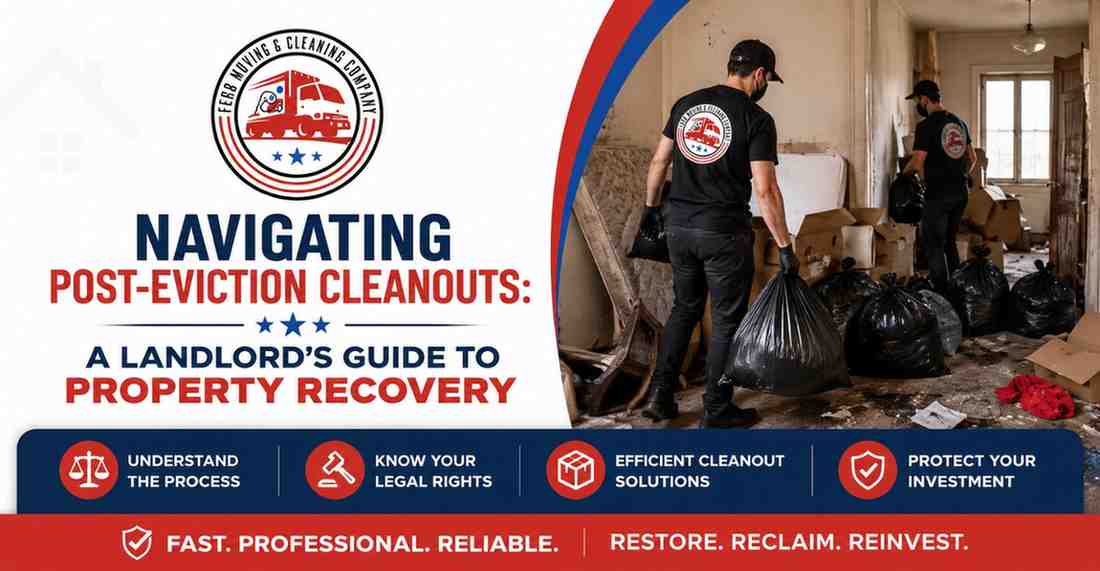
The legal battle is finally over. After months of missed rent, endless paperwork, housing court appearances, and waiting for a city marshal to execute the warrant, you finally have legal possession of your property again. But as you turn the key and push the door open, a new nightmare begins.
For property managers and landlords, regaining possession of an apartment is rarely the end of the story. More often than not, evicted tenants leave behind a staggering amount of debris, abandoned furniture, and, in severe cases, severe property damage and biological hazards.
The transition from a chaotic, abandoned unit to a pristine, market-ready apartment requires a strategic approach. It involves a mix of legal compliance, heavy lifting, junk removal, and intense sanitation. Here is a comprehensive guide to handling post-eviction logistics, minimizing your vacancy period, and getting your investment back on track.
Standard tenant turnovers are relatively predictable. A tenant packs their belongings, hires a moving truck, sweeps the floors, and hands over the keys. Evictions are the exact opposite. Because the move-out is forced, the environment left behind is often chaotic and disorganized.
Before you throw a single item into a garbage bag, it is critical to understand the legal framework surrounding abandoned property. In New York, landlords cannot simply toss a former tenant’s belongings onto the curb immediately after an eviction. While the city marshal returns possession of the real estate to you under the New York State Unified Court System guidelines, the personal property inside often still legally belongs to the evicted tenant.
You are generally required to store these items safely for a reasonable period (often up to 30 days, though local statutes should always be confirmed with your real estate attorney) to give the former tenant a chance to reclaim them. This means you need a system for sorting what is clearly garbage (rotting food, broken glass, soiled items) from what is legally considered personal property (electronics, furniture, clothing, documents).
Post-eviction units are frequently unsafe. Without regular maintenance or care, these apartments can become breeding grounds for pests. It is not uncommon to find:
Biohazards: Spoiled food in unplugged refrigerators, pet waste, or worse.
Pest Infestations: Cockroaches, bedbugs, and rodents thrive in cluttered, neglected spaces.
Structural Damage: Hidden behind piles of debris, you may find water damage, punched walls, or torn flooring.
Handling these hazards without proper personal protective equipment (PPE) and OSHA-compliant training is a massive liability. Asking your standard building maintenance crew to handle a severe hoarding or eviction cleanout can lead to workplace injuries and workers’ compensation claims.
To minimize the time your unit sits vacant, you need a systematic approach to clearing out the apartment.
The absolute first step, ideally happening the moment the marshal hands you possession, is changing the locks. Never assume the previous tenant won’t try to return.
Once secured, before moving a single item, document the entire property. Take high-resolution photos and videos of every room, inside every closet, and inside the appliances. This documentation serves two purposes:
Liability Protection: It proves the exact state of the belongings left behind, protecting you against false claims that valuable items were stolen or damaged by your team.
Damage Assessment: It provides evidence of damages beyond normal wear and tear, which you will need if you intend to pursue the former tenant for repair costs in civil court.
Once documentation is complete, the sorting process begins. This is highly labor-intensive.
You must separate obvious refuse from items of value. Garbage, broken items, and perishable food can be bagged and prepped for disposal. Items of value must be carefully boxed, inventoried, and moved to a secure storage location—either a designated storage unit in your building or an off-site facility.
Standard residential moving companies are usually ill-equipped to handle the grim realities of a forced move-out. They expect items to be neatly packed in uniform boxes, not strewn across a floor covered in grime.
This is where specialized logistics teams become invaluable. When dealing with properties in the borough, partnering with experienced eviction movers Bronx ensures that the removal process aligns with both local regulations and the physical demands of a distressed property. These specialized teams understand how to differentiate between junk hauling and careful property storage. They arrive with the heavy-duty bags, protective gear, and industrial bins required to clear a space rapidly and safely.
Once the physical items—both the stored property and the garbage—are removed, the true condition of the apartment is revealed. An eviction cleanout is not just a standard “broom sweep.” It requires a restorative deep clean.
Months of neglect can leave layers of grime on walls, baseboards, and windows. Kitchens and bathrooms are typically the worst offenders.
Kitchens: Appliances may need to be pulled out to clean the accumulated grease and pest droppings behind them. Refrigerators left with rotting food may need specialized chemical treatments to remove embedded odors, or they may need to be scrapped entirely.
Bathrooms: Hard water stains, mold, and mildew often require industrial-grade descalers and biocides to make the space sanitary again.
One of the most stubborn remnants of a bad tenancy is odor. Smoke, pet urine, and decaying organic matter can permeate drywall, carpets, and hardwood floors. Simply painting over the walls will not solve the issue; the odors will eventually seep through.
Professional cleaning services often use ozone generators or thermal fogging to neutralize odors at a molecular level. Furthermore, the HVAC system or window AC units must be thoroughly cleaned. Filters must be replaced, and vents must be sanitized to prevent blowing dust and old odors back into a freshly cleaned room.
In a densely populated area like New York City, you cannot simply drag an entire apartment’s worth of broken furniture and garbage to the curb. The Department of Sanitation (DSNY) has strict rules regarding bulk pickup and commercial waste disposal.
Dumping large quantities of junk on the sidewalk without a scheduled bulk pickup appointment will result in heavy fines for the property owner. Furthermore, certain items like mattresses must be sealed in specialized plastic bags before they can be placed outside, per DSNY bedbug prevention rules.
Electronics (e-waste), paint, and certain chemicals cannot be disposed of in standard trash at all. A professional junk removal service will separate recyclables, e-waste, and standard refuse, hauling it directly to the appropriate transfer stations and saving landlords from steep municipal fines and angry neighbors.
The traditional route of recovering an apartment involves acting as a general contractor:
Hiring a moving crew to box and store abandoned property.
Hiring a junk removal service to haul away the garbage.
Hiring a specialized cleaning crew to sanitize the unit.
Bringing in a contractor to handle repairs and painting.
Managing four different schedules creates massive delays. If the junk removal team is a day late, the cleaners can’t start. Every day the apartment sits empty is a day of lost rental income, adding to the financial deficit already caused by the non-paying tenant.
The most efficient way to handle a unit turnover is to hire a single company capable of executing the moving, the junk hauling, and the deep cleaning simultaneously. A cohesive team can sort, pack, haul, and scrub in a fraction of the time it takes to coordinate separate vendors.
These comprehensive teams treat the recovery as a single, fluid project. While one half of the crew is carrying out heavy furniture and bagging debris, the other half is already beginning the deep sanitation of the cleared rooms.
Evictions are an unfortunate reality of the property management business. They are emotionally draining, legally complex, and financially taxing. When you finally win your property back, the last thing you need is to spend weeks managing the physical cleanout.
By understanding the legal requirements of abandoned property, recognizing the health hazards involved, and utilizing specialized professionals, you can dramatically compress the timeline between an eviction and a new, paying lease. Your goal is to erase all traces of the previous tenancy and present a spotless, welcoming home to the next renter.
FECH Moving & Cleaning Company FECH Moving & Cleaning Company is a fully licensed and insured logistics and restoration team serving the NYC metropolitan area. With years of hands-on experience in distressed property recovery, our crews are expertly trained to handle the unique challenges of forced move-outs, hoarding situations, and severe property neglect. We bridge the gap between heavy-duty hauling and meticulous sanitation, ensuring property managers can turn over their units quickly and safely. Learn more about our comprehensive services as reliable eviction movers Bronx, and let us help you get your investment back on the market.

© 2025 Crivva - Hosted by Airy Hosting Managed Website Hosting.