

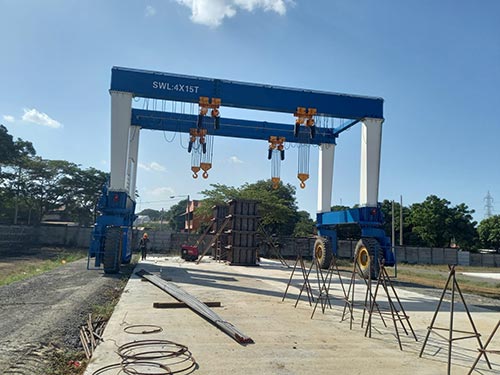
Double girder gantry cranes are critical equipment in industries that handle heavy and oversized loads, such as steel plants, shipyards, precast concrete factories, and power plants. For particularly heavy or long loads, a single hoist often cannot safely lift the load alone. Multi-hoist synchronized control technology solves this problem by allowing multiple hoists on the same crane to lift a single load in perfect coordination.
A multi-hoist system involves installing two or more hoists on a single crane bridge to lift a single load. This setup provides several key advantages:
Increasing lifting capacity: By distributing the weight across multiple hoists, the double girder gantry crane for sale can lift heavier loads than a single hoist could handle.
Improving load stability: Multiple hoists reduce sway and rotation, especially for long or uneven loads.
Flexible load handling: Operators can adjust hoist spacing according to the load’s size and shape, achieving precise positioning.
However, multiple hoists must operate in perfect synchronization. Without proper coordination, one hoist may move faster than another, causing load tilting, uneven stress on the crane structure, and potential mechanical failure. This makes synchronized control technology essential for safe and efficient operation.
Synchronized control ensures that all hoists lift or lower a load at the same speed, maintaining balance and safety. If synchronization is not implemented, several issues may occur:
Load tilting or rotation: Uneven lifting can twist or rotate long or asymmetrical loads.
Uneven structural stress: One hoist carrying more weight than others increases the risk of structural fatigue or failure.
Reduced operational safety: Uncoordinated hoists can cause load sway, accidents, or dropped loads.
By maintaining precise coordination between multiple hoists, synchronized control technology prevents these hazards and ensures reliable performance, even under heavy or complex lifting conditions.
Multi-hoist synchronized control relies on a combination of sensors, controllers, and feedback mechanisms to coordinate hoist motion. The core principles include:
The control system continuously monitors the load on each hoist to ensure even weight distribution. Proper load sharing protects the crane structure from excessive stress and enhances operational safety.
Motors driving each hoist are controlled to operate at the same lifting and lowering speed. Modern systems use variable frequency drives (VFDs) and servo motors with closed-loop feedback to maintain precise synchronization.
Encoders, laser sensors, or other position feedback devices track the exact vertical position of each hoist. If one hoist begins to lag or move ahead, the control system automatically adjusts its speed, ensuring perfectly synchronized motion.
Advanced controllers detect and correct deviations in hoist motion in real-time. This automatic correction maintains smooth and safe lifting, even for extremely heavy or long loads.
There are two main approaches to multi-hoist synchronization:
Mechanical synchronization: Older systems used connecting shafts or gears to coordinate hoist movement. While reliable, this method is inflexible, difficult to maintain, and unsuitable for very heavy loads or long spans.
Electronic synchronization: Modern cranes use sensors and centralized controllers to coordinate multiple hoists. Benefits include:
Adjustable hoist spacing
Variable lifting speeds
Real-time load monitoring
Integration with other automation systems
Electronic synchronization has become the industry standard, providing superior precision, safety, and operational flexibility.
Multi-hoist synchronized control provides significant safety advantages:
Reduced load sway: Coordinated lifting keeps loads stable, minimizing swing that could endanger personnel or equipment.
Avoiding structural overload: Even weight distribution prevents excessive stress on the crane’s bridge, girders, and rails.
Preventing load rotation: Crucial for long, asymmetrical, or flexible loads to avoid twisting.
Emergency stopping: Advanced systems allow operators to halt all hoists simultaneously, preventing uncontrolled drops or accidents.
Modern multi-hoist systems often integrate with broader automation technologies to further improve performance and safety:
Anti-sway systems: Reduce swinging during acceleration or deceleration.
Load moment monitoring: Ensures the crane is not overloaded at any point during operation.
Remote operation and real-time monitoring: Operators can safely control the crane from a distance using wireless controls or automated systems.
Data logging and predictive maintenance: Tracks hoist performance, synchronization quality, and load cycles for maintenance and safety audits.
By combining multi-hoist synchronization with automation, operators achieve precise, efficient, and safe load handling, even in complex industrial environments.
Multi-hoist synchronized double girder cranes are essential in industries where large, heavy, or irregular loads are common:
Steel industry: Handling long steel billets, coils, or heavy machinery components across factory floors or storage yards.
Shipbuilding: Lifting large ship sections, engines, or propellers with precise positioning for assembly.
Precast concrete plants: Transporting long beams, slabs, and modular components exceeding single-hoist capacity.
Power plants: Installing turbines, transformers, and other oversized equipment where balanced lifting is critical.
In each of these applications, synchronized multi-hoist operation ensures maximum safety, efficiency, and precision.
Despite its advantages, multi-hoist synchronized systems present some challenges:
Complex control systems: Installation, programming, and maintenance require skilled engineers.
Higher initial cost: Electronic synchronized systems are more expensive than single hoist gantry cranes.
Calibration and maintenance: Sensors, drives, and controllers must be regularly calibrated to maintain precise synchronization.
Operator training: Personnel must understand multi-hoist coordination and safety protocols for safe operation.
Emerging technologies are shaping the future of multi-hoist synchronized control:
AI-assisted load management: Machine learning algorithms optimize weight distribution and hoist performance in real time.
IoT-based predictive maintenance: Sensors monitor motor performance and synchronization quality to predict failures before they occur.
Fully automated cranes: Autonomous lifting and positioning in controlled industrial environments reduce human intervention while improving efficiency.
These trends promise safer, more intelligent, and more efficient heavy lifting operations in the years to come.
Multi-hoist synchronized control technology is a critical advancement for double girder gantry cranes. By coordinating multiple hoists, it enables the lifting of heavy, oversized, or long loads safely and efficiently. Through load sharing, speed synchronization, position feedback, and automatic correction, multi-hoist systems enhance load stability, prevent structural stress, and improve operational safety.
As electronic control, automation, and AI continue to evolve, multi-hoist synchronized double girder cranes will remain essential equipment in heavy industries, ensuring safe, precise, and efficient lifting of the largest and most complex loads.

© 2025 Crivva - Hosted by Airy Hosting Managed Website Hosting.