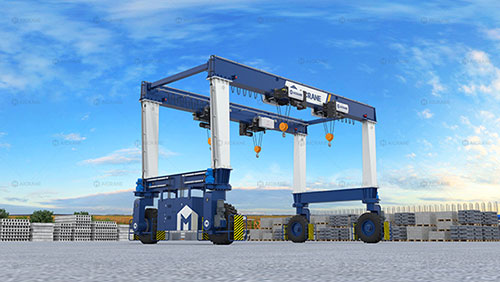
Rubber Tyred Gantry (RTG) cranes have become a cornerstone of modern container terminals, ports, and intermodal yards due to their versatility, mobility, and capacity for heavy lifting. These cranes are specifically designed to handle containers efficiently across expansive yard areas, combining lifting power with multi-directional movement capabilities. Central to their effectiveness is their structural design, and in recent years, modular design concepts have revolutionized how RTG cranes are manufactured, maintained, and customized. This article explores the principles, advantages, and considerations of modular structural design for RTG gantry cranes.
Modular structural design refers to the approach of constructing a crane using pre-engineered, standardized modules or sections that can be fabricated, transported, and assembled independently. Unlike traditional monolithic crane structures, which are built as a single integrated frame, modular RTG cranes are composed of discrete components such as girder modules, leg modules, trolley rails, and cross beams. These modules are designed for interconnection using bolts, high-strength welds, or hybrid fastening methods.
The modular approach is particularly suited for RTG cranes due to the following operational requirements:
Transportability: RTG cranes often need to be shipped to ports or container yards around the world. Modular sections can be transported using standard shipping methods, including trucks, ships, or rail, bypassing restrictions associated with oversized loads.
Ease of Installation: By assembling modules on-site, installation becomes more efficient, reducing downtime and labor costs. This also allows for cranes to be installed in constrained spaces where maneuvering a fully assembled crane would be impossible.
Flexibility in Customization: Modular design enables manufacturers to adjust the crane’s span, lifting height, or load capacity by changing or adding specific modules without redesigning the entire crane.
The modular design of an RTG crane focuses on several critical structural components:
The main girders form the backbone of the crane, supporting the trolley and hoisting mechanisms. In a modular RTG crane, girders are fabricated as segments that can be bolted or welded together on-site. High-strength steel, often S355 or Q355E (low-temperature steel), is used to ensure durability and resistance to bending under heavy loads. Modular girders may also incorporate built-in cable trays, lighting mounts, or maintenance walkways, making the crane more serviceable.
Legs are crucial for mobility and stability. RTG cranes typically have four legs, each mounted on rubber tires. In modular construction, legs are designed as detachable sections that can include built-in steering and drive systems. This approach allows for easier replacement or upgrading of wheel assemblies and steering mechanisms, as well as the incorporation of anti-sway or load-stabilization devices without affecting the main structure.
Cross beams connect the two side girders and provide lateral stability. Modular cross beams are pre-fabricated with precise dimensions and connection points, ensuring structural integrity when assembled. Diagonal bracing modules are often incorporated to resist torsional loads during lifting and movement, especially in windy conditions or uneven yard surfaces.
The trolley system, which moves containers along the span of the crane, is supported by trolley rails integrated into the girder modules. Modular trolley rails allow for accurate alignment during on-site assembly, reducing installation errors and wear over time. Hoist modules, including the hoisting drum, wire ropes, and lifting attachments, can also be pre-assembled and tested before installation, ensuring operational readiness.
Modern RTG cranes rely heavily on electrical systems for remote control, automation, and monitoring. Modular design extends to electrical and control components, which are pre-wired in compact enclosures that can be mounted onto structural modules. This facilitates faster commissioning and simplifies troubleshooting, as faulty modules can be replaced independently without dismantling the entire crane.
The modular approach offers several key advantages for RTG gantry crane manufacturers, operators, and maintenance teams:
By producing modules in parallel rather than sequentially assembling a monolithic frame, manufacturers can significantly reduce lead times. Modular fabrication also allows for standardization of parts, which lowers production costs and improves quality control.
Transporting a fully assembled RTG crane is challenging due to its size and weight. Modular cranes, in contrast, can be shipped in manageable sections, making global delivery more feasible and cost-effective. This approach also enables deployment to remote or urban port locations where oversized transport vehicles cannot access.
On-site assembly of modular RTG cranes is faster and safer. Pre-fabricated modules can be lifted into place using temporary cranes or gantries, minimizing the need for large, specialized installation equipment. This modular assembly also allows for phased installation, where the crane can be partially operational while additional modules are being installed.
One of the most significant benefits of modular design is the ability to scale or adapt the crane structure over time. For instance, if a terminal needs to handle taller containers or heavier loads, additional girder or leg modules can be added without requiring a complete redesign. Similarly, if a section becomes damaged, it can be replaced without scrapping the entire crane.
Maintenance becomes more straightforward with modular cranes, as individual components can be detached, serviced, and reinstalled. This reduces crane downtime and extends the lifespan of structural and mechanical elements. Additionally, modular design facilitates retrofitting, such as integrating advanced control systems or environmentally friendly drive technologies.
While modular design offers many advantages, several factors must be carefully considered to ensure structural integrity and operational efficiency:
The integrity of a modular crane depends on the connections between modules. Bolted connections, high-strength welds, or hybrid approaches must be designed to withstand operational loads, dynamic stresses, and environmental factors such as temperature changes or corrosion.
Modules must be manufactured with precise tolerances to ensure proper alignment during assembly. Misalignment in girders, trolley rails, or legs can lead to increased wear, reduced lifting accuracy, or structural failure.
Modular sections must be designed to evenly distribute loads across the crane’s frame. This requires careful structural analysis using finite element modeling to simulate lifting operations, lateral forces, and torsion under varying conditions.
Ports and container yards often expose cranes to harsh environmental conditions, including saltwater corrosion, high winds, and extreme temperatures. Modular RTG crane designs must incorporate corrosion-resistant coatings, low-temperature steel where necessary, and aerodynamic considerations to maintain stability.
Modular cranes must meet national and international standards for lifting equipment, including ISO, FEM, and OSHA guidelines. This involves ensuring redundancy in critical modules, fail-safe mechanisms in connections, and rigorous testing before deployment.
Modular structural design has transformed the engineering and operational landscape of RTG gantry cranes. By breaking down complex crane structures into manageable, pre-engineered modules, manufacturers can reduce production time, simplify transportation, enhance on-site assembly, and offer flexible solutions for diverse container handling requirements. From girders and leg modules to trolley rails and electrical enclosures, every component benefits from modularization, contributing to safer, more efficient, and scalable crane systems.
As container terminals continue to grow in size and complexity, modular RTG cranes offer a future-proof solution that can adapt to evolving operational demands. By leveraging modern engineering practices, advanced materials, and modular principles, crane manufacturers can deliver equipment that not only meets current lifting needs but is also prepared for future expansions, upgrades, and innovations.

© 2025 Crivva - Hosted by Airy Hosting Managed Website Hosting.