Market Overview:
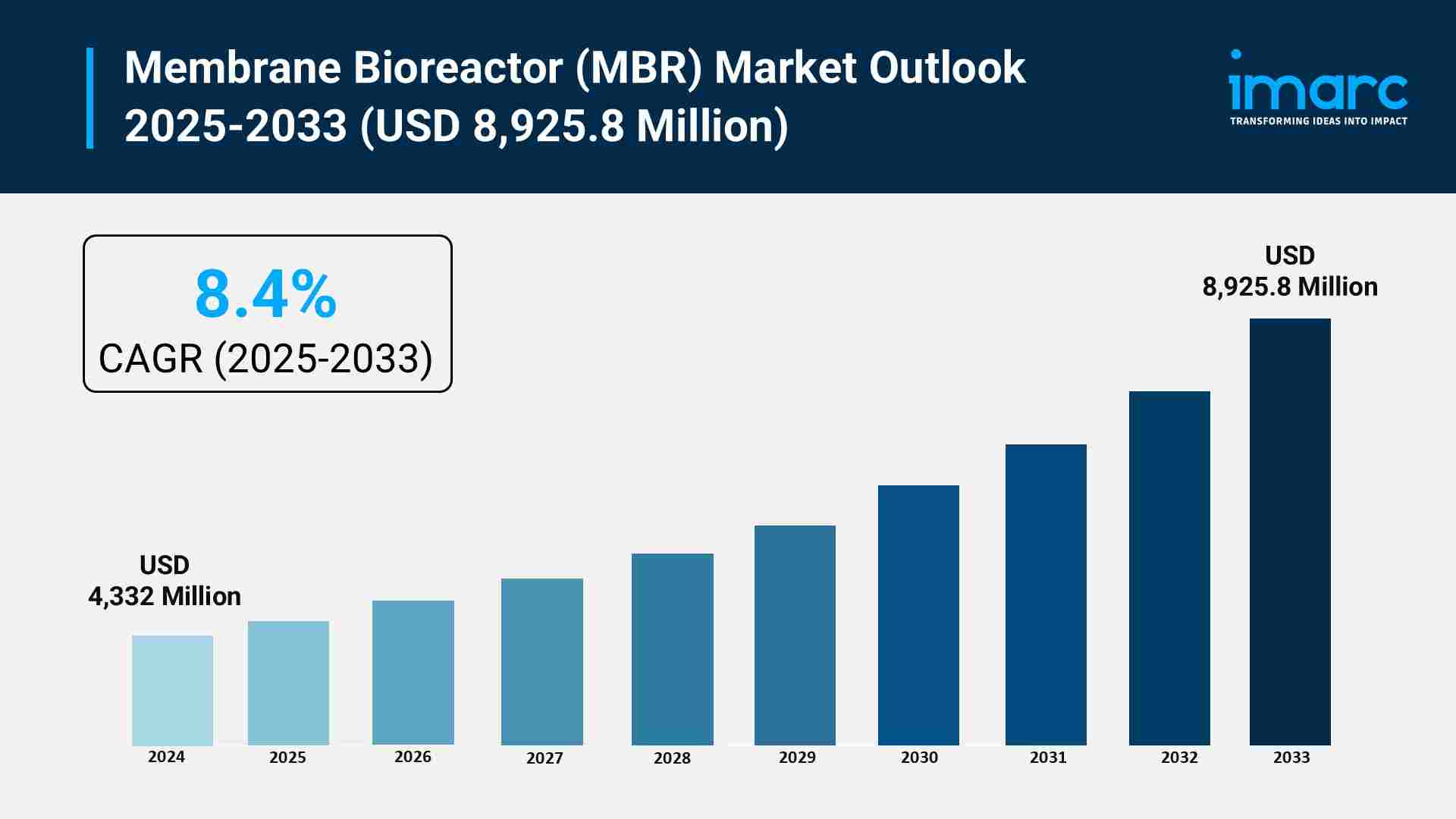
The membrane bioreactor (MBR) market is experiencing rapid growth, driven by stringent wastewater discharge regulations, rising global water scarcity and reuse initiatives, and urbanization and demand for compact footprint solutions. According to IMARC Group’s latest research publication, “Membrane Bioreactor (MBR) Market Size, Share, Trends and Forecast by System Configuration, Membrane Type, Application, and Region, 2025-2033”, The global membrane bioreactor (MBR) market size was valued at USD 4,332 Million in 2024. Looking forward, IMARC Group estimates the market to reach USD 8,925.8 Million by 2033, exhibiting a CAGR of 8.4% during 2025-2033.
This detailed analysis primarily encompasses industry size, business trends, market share, key growth factors, and regional forecasts. The report offers a comprehensive overview and integrates research findings, market assessments, and data from different sources. It also includes pivotal market dynamics like drivers and challenges, while also highlighting growth opportunities, financial insights, technological improvements, emerging trends, and innovations. Besides this, the report provides regional market evaluation, along with a competitive landscape analysis.
Download a sample PDF of this report: https://www.imarcgroup.com/membrane-bioreactor-market/requestsample
Our report includes:
The global MBR market is experiencing significant growth due to the implementation of increasingly stringent wastewater discharge regulations across major economies. Governments worldwide are enforcing stricter limits on pollutants like Biochemical Oxygen Demand (BOD), Chemical Oxygen Demand (COD), and nutrients such as nitrogen and phosphorus. For instance, the European Union’s Water Framework Directive sets high ecological status conditions, compelling industries and municipalities to adopt advanced treatment systems like MBR. Similarly, the Ministry of Ecology and Environment in China mandates upgrades for aging wastewater facilities, driving the installation of MBRs to comply with new standards. MBR technology’s superior effluent quality, which is virtually free of suspended solids and bacteria, directly supports compliance with these demanding rules, with the municipal wastewater treatment segment currently projected to contribute nearly 60% of the total MBR market value, underscoring the impact of regulatory compliance.
Increasing global water stress and the necessity for water reuse are fundamental drivers of the MBR market. With freshwater ecosystems degraded in a significant number of the world’s countries, the focus has shifted to recycling and reclamation. MBR systems produce high-quality treated water suitable for non-potable applications such as agricultural irrigation, industrial cooling, and toilet flushing. This capability is vital in arid and water-stressed regions. For example, countries in the Middle East and parts of Asia are actively incorporating MBRs into their national water strategies to boost water independence. In the United States, significant government funding, such as portions of the Bipartisan Infrastructure Law, is being allocated to upgrade water infrastructure, targeting advanced solutions like MBR for addressing emerging contaminants. This emphasis on resource recovery positions MBR technology as a key component for a circular water economy.
Rapid urbanization and industrialization, particularly in the Asia-Pacific region, drive the demand for MBR systems due to their significantly smaller physical footprint compared to conventional activated sludge plants. As urban populations expand, land availability for large wastewater treatment facilities becomes a major constraint. MBR technology can reduce the required installation area by a considerable margin—often up to 75% less space than traditional systems—making it the preferred choice for retrofitting existing plants or building new facilities in densely populated areas. The compact design is also beneficial for industrial applications where minimizing the space dedicated to water treatment is critical. This space efficiency, combined with high treatment capacity, makes MBR a highly compelling solution for municipal bodies in megacities like Beijing and Shanghai, as well as for space-constrained industrial parks globally.
A significant emerging trend is the integration of digitalization and Artificial Intelligence (AI) for optimizing MBR operation. Traditional MBRs can be prone to fouling, which increases maintenance and energy costs. The new trend leverages Machine Learning (ML) models to analyze complex, real-time sensor data on factors like transmembrane pressure, flow rate, and mixed liquor suspended solids (MLSS). Companies are deploying proprietary AI algorithms that can predict fouling events before they occur, automatically adjusting membrane scouring and cleaning cycles. This smart automation has been shown in pilot programs to potentially reduce MBR energy consumption—primarily from blowers—by around 15% to 20% while simultaneously prolonging membrane lifespan and reducing chemical usage, ushering in an era of truly intelligent wastewater infrastructure.
The development of advanced membrane materials is a pivotal trend, specifically focusing on improving anti-fouling characteristics and flux rates. The industry is moving beyond standard polymeric materials toward nanocomposite and modified membranes. For example, a key development involves membranes infused with materials like graphene oxide or other novel nanoparticles. These modifications create smoother, less hydrophobic membrane surfaces that are inherently more resistant to the adhesion of bio-foulants and colloidal material. Such next-generation membranes are demonstrating the ability to maintain a stable permeate flow, known as flux, at higher operating pressures for extended periods, reducing the need for chemical cleaning. Recent industry announcements highlight new reverse osmosis membranes that offer double chemical resistance and superior anti-fouling properties, demonstrating the commercialization of this trend.
There is a growing trend towards the adoption of Anaerobic MBR (AnMBR) systems, particularly within the industrial sector. Unlike conventional aerobic MBRs which are energy-intensive due to the need for constant aeration, AnMBR treats wastewater in the absence of oxygen. This configuration not only offers the characteristic high-quality effluent and small footprint of MBR technology but also provides the added benefit of energy neutrality or even energy generation. The anaerobic process breaks down organic pollutants into biogas, which is primarily methane, a valuable renewable energy source that can be used to power the treatment plant itself. This real-world application of resource recovery is highly attractive to energy-intensive industrial clients, such as those in the food and beverage or chemical sectors, by significantly reducing their operational expenditure and carbon footprint.
Leading Companies Operating in the Membrane Bioreactor (MBR) Industry:
Membrane Bioreactor (MBR) Market Report Segmentation:
By System Configuration:
Submerged systems dominate the market with 66.5% share in 2024 due to their compact design, high effluent quality, and efficiency in municipal and industrial wastewater treatment.
By Membrane Type:
Hollow Fiber membranes lead with 61.5% market share in 2024, known for their high surface area, efficient filtration, and cost-effectiveness in municipal and industrial applications.
By Application:
Municipal Waste-Water Treatment holds a 47.6% market share in 2024, driven by urbanization and the need for effective sewage treatment technologies that comply with strict regulations.
Regional Insights:
Asia Pacific leads the market with over 45.3% share in 2024, fueled by rapid urbanization, industrial growth, and significant investments in wastewater infrastructure and treatment technologies.
Note: If you require specific details, data, or insights that are not currently included in the scope of this report, we are happy to accommodate your request. As part of our customization service, we will gather and provide the additional information you need, tailored to your specific requirements. Please let us know your exact needs, and we will ensure the report is updated accordingly to meet your expectations.
About Us:
IMARC Group is a global management consulting firm that helps the world’s most ambitious changemakers to create a lasting impact. The company provide a comprehensive suite of market entry and expansion services. IMARC offerings include thorough market assessment, feasibility studies, company incorporation assistance, factory setup support, regulatory approvals and licensing navigation, branding, marketing and sales strategies, competitive landscape and benchmarking analyses, pricing and cost research, and procurement research.
Contact Us:
IMARC Group
134 N 4th St. Brooklyn, NY 11249, USA
Email: [email protected]
Tel No:(D) +91 120 433 0800
United States: +1-201971-6302

© 2025 Crivva - Hosted by Airy Hosting Managed Website Hosting.