

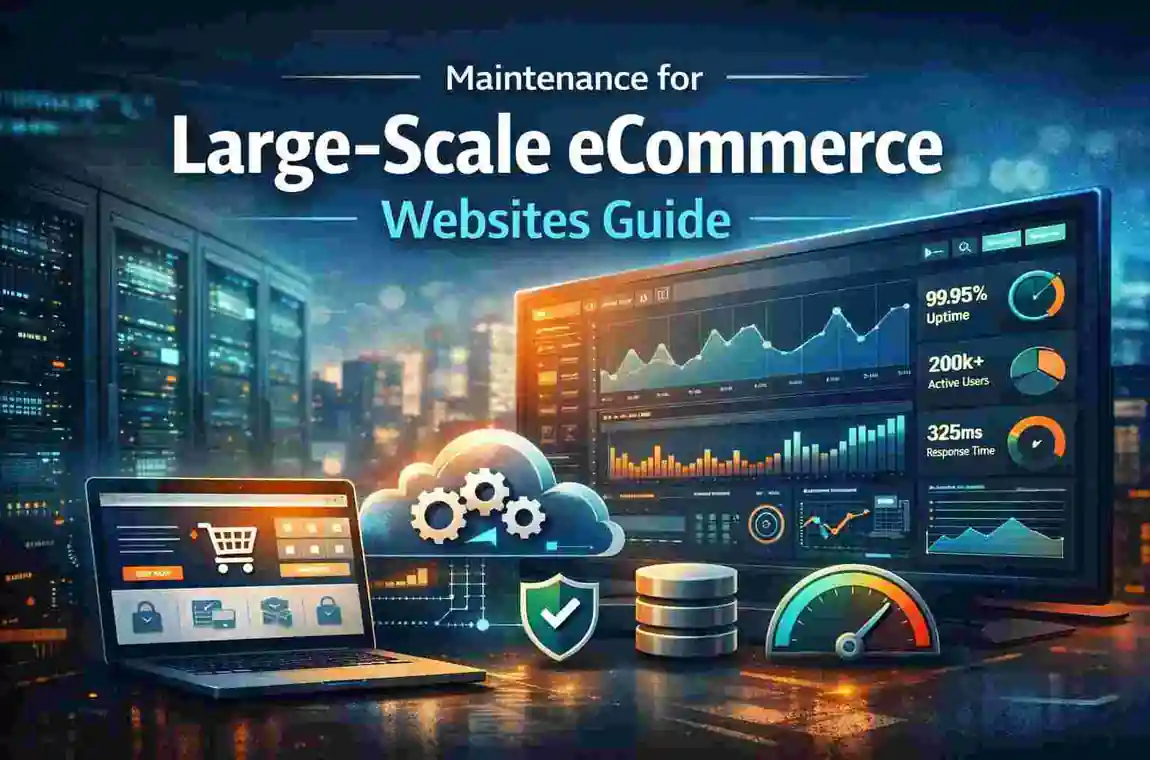
Maintaining a large-scale eCommerce website is a continuous, mission-critical operation rather than a periodic technical task. Enterprise platforms operate in high-pressure environments where traffic spikes, complex integrations, and customer expectations leave little room for error. A slow checkout, a failed payment, or a brief outage can instantly translate into significant revenue loss and long-term brand damage.
With complex architectures and high transaction volumes, enterprises rely on eCommerce website maintenance services to manage updates, monitor performance, and maintain system reliability at scale. This guide explores enterprise-grade maintenance in depth—covering technical foundations, operational best practices, and long-term strategies to keep large eCommerce platforms secure, fast, and scalable.
Unlike small or mid-sized online stores, enterprise eCommerce platforms typically deal with:
In this environment, maintenance is not about “fixing issues when they appear.” It is about anticipating failures, preventing disruptions, and continuously optimizing the system to support growth.
Performance directly affects conversion rates, customer retention, and search visibility. At enterprise scale, even small performance issues can multiply into major business problems.
Key maintenance activities include:
Enterprises often define performance budgets and enforce them during deployments to prevent gradual degradation over time.
Enterprise traffic patterns are unpredictable. Marketing campaigns, influencer promotions, and seasonal sales can cause sudden surges that overwhelm unprepared systems.
Scalability-focused maintenance covers:
Proactive infrastructure maintenance ensures that growth opportunities never turn into system failures.
Security is one of the most critical aspects of enterprise eCommerce maintenance. Large platforms are frequent targets for cyberattacks due to the volume of sensitive customer and payment data they handle.
Enterprise security maintenance includes:
Additionally, enterprises must maintain compliance with standards such as PCI-DSS, GDPR, and regional data protection laws, which require ongoing audits and documentation.
Large-scale eCommerce systems are built on complex technology stacks with numerous interdependent components. Unplanned updates can easily break critical functionality.
Best practices for update management:
This disciplined approach allows enterprises to innovate safely without risking operational stability.
Downtime at enterprise scale can cost thousands—or even millions—per hour. Maintenance strategies, therefore, focus heavily on availability and fast recovery.
Reliability-focused maintenance includes:
Post-incident analysis helps teams identify root causes and implement permanent fixes, reducing the likelihood of repeat incidents.
Enterprise eCommerce platforms rely on a wide range of external services, including payment gateways, shipping providers, tax calculation tools, and marketplaces.
Integration maintenance tasks involve:
Proactive integration monitoring helps prevent checkout failures and operational bottlenecks.
Transactional data—orders, payments, customer profiles, and inventory—is the backbone of any eCommerce business.
Enterprise data maintenance practices include:
Routine restore testing ensures that data can be recovered quickly during emergencies.
Large eCommerce websites generate dynamic pages at scale, making SEO maintenance an ongoing challenge.
Key SEO maintenance activities:
Consistent SEO maintenance protects organic visibility and improves crawl efficiency.
At enterprise scale, inefficient systems can significantly inflate operational costs.
Maintenance-driven cost optimization includes:
Regular cost audits help align technical performance with financial efficiency.
Daily:
Weekly:
Monthly:
Quarterly:
Annually:
Enterprise maintenance success depends as much on people and processes as it does on technology.
Organizations that treat maintenance as a strategic function consistently achieve higher reliability and customer satisfaction.
Avoiding these mistakes significantly reduces operational risk.
Maintenance for large-scale eCommerce websites is a strategic discipline that underpins growth, stability, and customer trust. With complex architectures and high transaction volumes, enterprises rely on eCommerce website maintenance services to manage updates, monitor performance, and maintain system reliability at scale.
When approached proactively, maintenance transforms from a defensive necessity into a competitive advantage—ensuring your platform remains secure, scalable, and ready to support future business demands.

© 2025 Crivva - Hosted by Airy Hosting Managed Website Hosting.