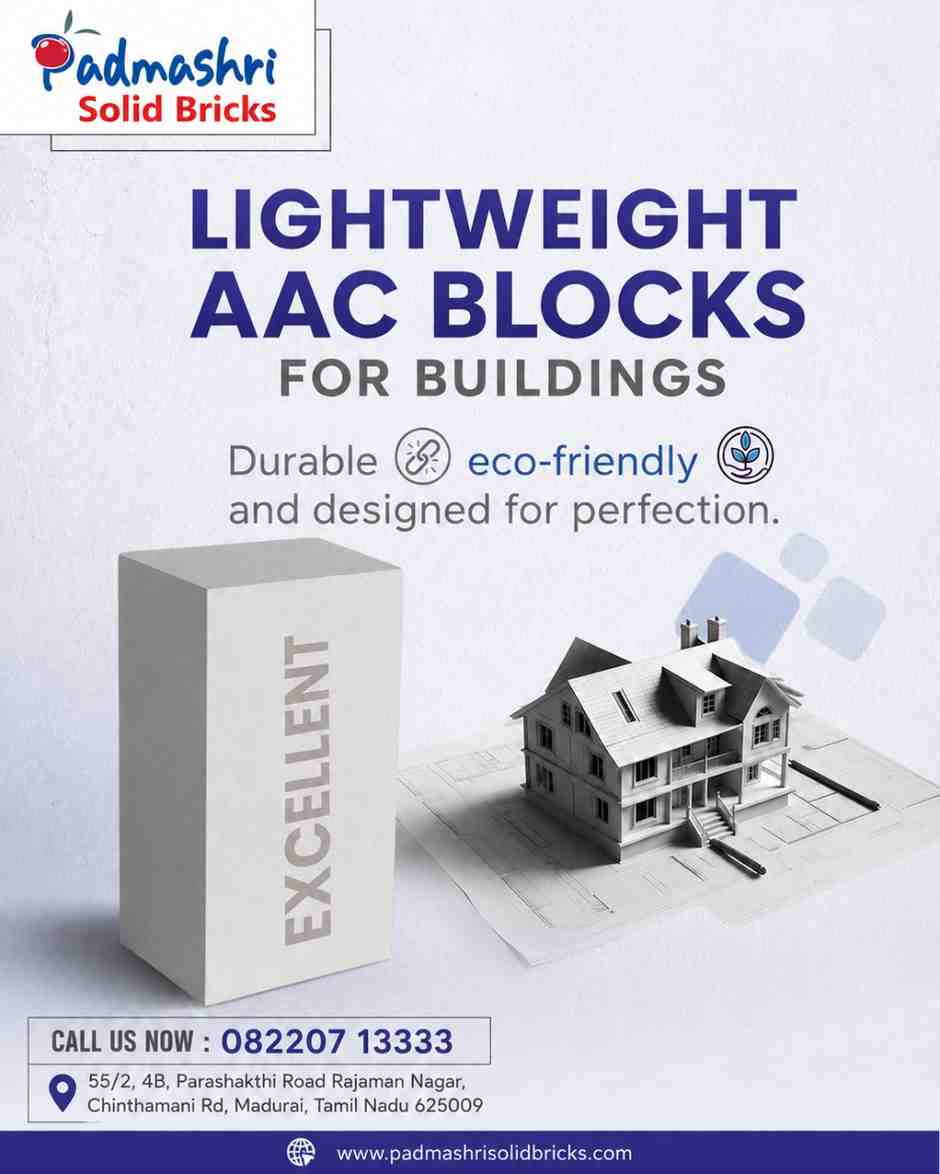
The construction industry stands at a pivotal crossroads where traditional building methods are being challenged by innovative materials that promise greater efficiency, sustainability, and long-term value. Among these revolutionary materials, lightweight AAC blocks for buildings have emerged as a transformative solution that addresses the growing demands of modern architecture while respecting environmental responsibilities. Autoclaved Aerated Concrete (AAC) blocks represent a significant leap forward from conventional clay bricks and dense concrete blocks, offering a unique combination of properties that make them increasingly indispensable in contemporary construction projects across residential, commercial, and industrial sectors.
Understanding the Science Behind AAC Blocks
Autoclaved Aerated Concrete is a precast building material manufactured through a sophisticated process that transforms simple natural ingredients into an exceptionally versatile construction product. The primary components include fine silica sand, Portland cement, lime, gypsum, and a small quantity of aluminum powder. When these materials are combined with water and mixed thoroughly, a chemical reaction occurs between the aluminum powder and the alkaline environment, producing hydrogen gas bubbles that create millions of microscopic air pockets throughout the concrete matrix.
This aeration process is what gives AAC blocks their characteristic lightweight nature and distinctive cellular structure. The wet mixture is poured into molds where it expands and partially sets, after which the resulting “cakes” are cut into precise dimensions using high-tension wires. The cut blocks are then transferred to autoclaves—large pressure vessels where they undergo steam curing at temperatures around 180 to 200 degrees Celsius and pressures of approximately 12 bars. This autoclaving process produces calcium silicate hydrate, which gives AAC blocks their exceptional strength, dimensional stability, and durability.
The finished product typically contains 60 to 85 percent air by volume, resulting in a density that ranges from 300 to 800 kilograms per cubic meter, significantly lighter than conventional concrete blocks that weigh approximately 2,400 kilograms per cubic meter. This dramatic weight reduction is the foundation of many of AAC’s most valuable performance characteristics.
Unparalleled Thermal Insulation Properties
One of the most compelling advantages of lightweight AAC blocks for buildings is their extraordinary thermal insulation performance. The millions of discrete air bubbles within each block act as tiny thermal barriers, dramatically reducing heat transfer through walls and roofs. This inherent insulation property gives AAC blocks thermal conductivity values typically ranging from 0.16 to 0.22 watts per meter-kelvin, compared to 0.7 to 1.3 for traditional clay bricks.
In practical terms, this means buildings constructed with AAC blocks maintain more stable interior temperatures regardless of external weather conditions. During hot summers, exterior heat penetrates slowly, keeping interiors cooler and reducing air conditioning loads. In cold weather, the warmth generated inside is retained more effectively, minimizing heating requirements. For building owners and occupants, this translates directly into substantial energy savings—studies indicate that AAC construction can reduce heating and cooling energy consumption by 30 to 50 percent compared to conventional masonry construction.
These thermal benefits extend beyond cost savings to encompass broader environmental impacts. Reduced energy demand means lower greenhouse gas emissions from power generation, contributing to climate change mitigation efforts. Additionally, the comfortable indoor environments created by AAC’s thermal stability enhance occupant wellbeing and productivity, particularly in commercial and educational settings where thermal comfort significantly impacts performance.
Structural Efficiency and Seismic Performance
The lightweight nature of AAC blocks offers profound structural advantages that influence both design flexibility and building safety. Because AAC blocks weigh approximately one-third to one-quarter of equivalent volumes of traditional concrete blocks, the dead load imposed on foundations, columns, beams, and floor slabs is substantially reduced. This weight reduction enables several engineering and economic benefits.
Foundation designs can be simplified, often requiring less excavation, reduced concrete volumes, and smaller reinforcement sections. The overall structural frame can be optimized with lighter sections, decreasing steel requirements and associated costs. For tall buildings, cumulative weight savings across multiple floors translate into significant structural efficiencies and material savings.
Perhaps most critically, the reduced mass of AAC construction provides enhanced seismic performance. In earthquake-prone regions, the inertial forces acting on a building during seismic events are directly proportional to its mass. Lighter buildings experience lower earthquake forces, reducing stress on structural elements and improving the probability of avoiding catastrophic failure. Following major earthquakes in countries like Japan, Turkey, and India, AAC buildings have demonstrated remarkable resilience, often remaining structurally intact while neighboring conventional buildings suffered severe damage.
Fire Safety and Acoustic Comfort
Safety considerations are paramount in building design, and lightweight AAC blocks for buildings excel in providing passive fire protection. AAC is classified as a non-combustible material with exceptional fire resistance ratings. Standard AAC blocks can withstand fire exposure for two to six hours depending on thickness, without releasing toxic fumes or contributing to flame spread. This performance exceeds that of most conventional building materials and provides critical time for evacuation and emergency response during fire incidents.
The acoustic properties of AAC blocks complement their thermal and structural benefits. The porous cellular structure effectively absorbs and dissipates sound energy, reducing noise transmission through walls. Sound insulation values typically range from 40 to 50 decibels for standard wall constructions, creating quieter indoor environments that enhance comfort and privacy. This acoustic performance is particularly valuable in urban residential buildings, hospitals, schools, hotels, and office complexes where noise control is essential for functionality and wellbeing.
Precision Manufacturing and Construction Efficiency
AAC blocks are manufactured under tightly controlled factory conditions with dimensional tolerances of ±1 millimeter. This precision contrasts sharply with the variability inherent in traditional clay bricks, which can vary significantly in size and shape due to firing process inconsistencies. The dimensional accuracy of AAC blocks enables several construction efficiencies.
Mortar joints can be reduced to 3 to 5 millimeters using thin-bed adhesive mortars specifically formulated for AAC applications, compared to 10 to 12 millimeters for conventional brickwork. Thinner joints reduce material consumption, minimize thermal bridging through mortar, and accelerate construction speed. Wall surfaces are straighter and more uniform, requiring less plaster thickness—often just 6 to 8 millimeters of gypsum plaster rather than 15 to 20 millimeters of cement sand plaster. These factors combine to reduce construction time by 20 to 30 percent while improving finished quality.
Environmental Sustainability and Lifecycle Value
The environmental credentials of AAC blocks are compelling across multiple dimensions. The raw materials are abundant natural resources with minimal processing requirements. The manufacturing process generates negligible waste, with production trimmings and rejects recycled back into the production cycle. The energy embodied in AAC production is significantly lower than that of clay bricks, which require energy-intensive kiln firing at over 1,000 degrees Celsius, or concrete blocks relying on cement-intensive formulations.
The transportation footprint of AAC is also favorable. Because the material is lightweight, more blocks can be transported per vehicle, reducing fuel consumption and emissions per unit of building material delivered. Over the building’s operational lifetime, the energy savings enabled by AAC’s thermal insulation far exceed the embodied energy of production, creating a strongly positive net environmental impact.
Conclusion
As global construction practices evolve to meet the challenges of sustainability, energy efficiency, and resilient design, lightweight AAC blocks for buildings have established themselves as a material of choice for discerning developers, architects, and builders. Their unique combination of thermal performance, structural lightness, fire safety, acoustic comfort, and environmental responsibility addresses the multifaceted demands of modern construction in ways that traditional materials cannot match.
For construction professionals and property owners seeking premium-quality AAC blocks manufactured to exacting standards, sourcing from reputable suppliers is essential. Explore detailed specifications, technical data, and pricing information by visiting
Lightweight AAC blocks for buildings to discover how these innovative materials can elevate your next construction project. You can also learn more about the complete range of building solutions and company expertise at
Padmashri Solid Bricks, a trusted name in sustainable construction materials.
Embracing AAC technology represents more than adopting a new building material—it signifies commitment to smarter, greener, and more resilient construction practices that will define the built environment of the future.