

Know your Business is a direct need to organizations recruiting vendors, corporation customers, merchants, and third-party partners. With the rise of cross-border trade and online onboarding, there is an increase in the chances of fraudulent actors, anonymous proprietors, or limited counterparties. A modern kyb business verification program assists in mitigating the risks of becoming exposed to financial crime, reputational loss as well as regulatory problems by demonstrating that a company exists, who owns it and also identifying the risk signs before a relationship goes into operation. Due to the possibility of a layered corporate structure and the ability to change rather quickly, kyb verification is becoming more of an ongoing discipline as opposed to a defined task that can be performed during the initial stages of the onboarding process.
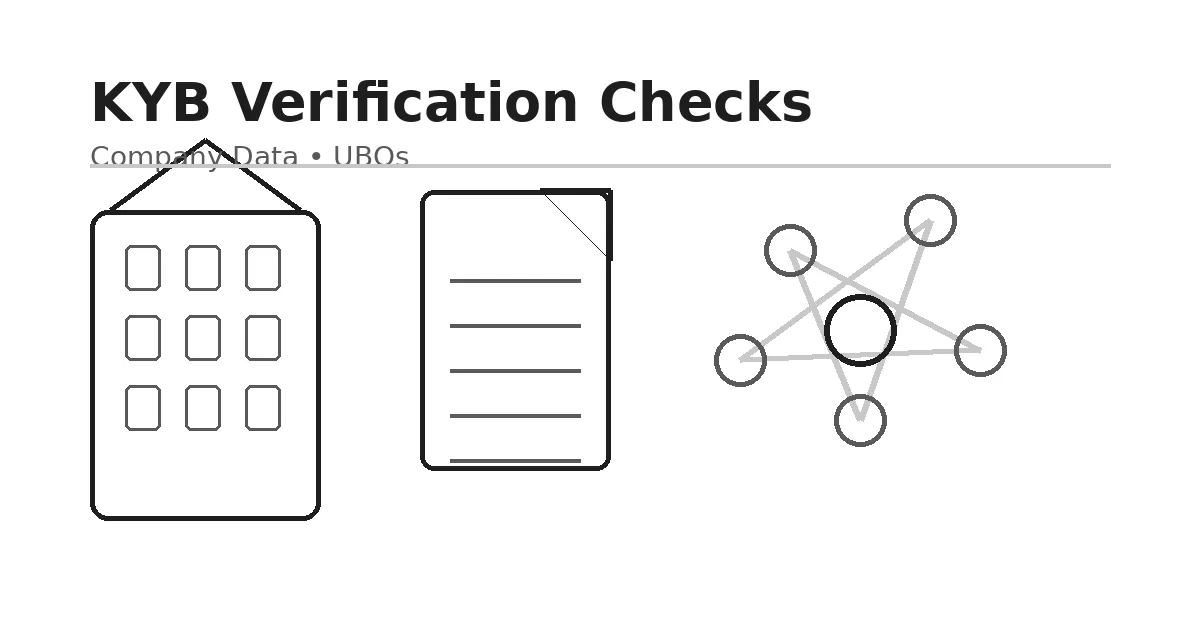
Kyb checks are usually on three pillars, verification of company data, verification of beneficial ownership and screening of watchlist. Company data verification guarantees that the entity exists and its key attributes are in line with its authoritative records including registration number, legal name, jurisdiction, and status. Beneficial ownership checks are aimed at establishing the ultimate beneficial ownership and control relationships that can be concealed with holding companies, nominees, or multi-layers. Watchlist screening compares the entity and other connected individuals against sanctions, restrictions and any other lists that are indicative of an increased compliance risk. These checks combined form a more comprehensive image compared to document-only reviews and contribute to the team making defensible onboarding decisions.
Kyb business verification has its basis on company data checks; this is due to the fact that company data checks enable you to know whether you are dealing with a legal entity or a non-legal entity. Such checks normally check registration information, date of incorporation, existing operation status, registered address, directors or officers and any filings that indicate that the entity is operational and in good standing. They also assist in raising red flags like discrepancies in registration numbers, addresses that do not match across the documentation or business entities that seem to have been established in the recent past without leaving any traceable business. In the case of procurement and B2B onboarding, checking the company information at the outset saves time and energy on areas that are not worth working on and also fastens the process of approvals as false applications will not go far into the workflow.
The most difficult part of kyb verification is usually the identification of ultimate beneficial owners, particularly in markets whereby ownership is spread out among several entities or jurisdictions. The purpose of UBO checks is to identify those people who are the ultimate owners or controllers of a business, either directly or indirectly, and how that control is executed. This is important in that risk may be above the immediate legal entity, as is the case when one of the parent companies, the presence of negative news, or a track record of malpractice. A robust know your business model views ownership as a risk lens not as a check box but as an exercise of linking the entity to the individuals who enjoy the benefits and make decisions based on actual control, as opposed to paperwork.
The interface between kyb verification and compliance and risk controls is in watchlist screening. Screening usually entails sanctions programs and other restriction lists, which may be modified regularly and it is therefore important to check them after onboarding. In addition to sanctions, several kyb services have extra screening indicators like enforcement measures, regulatory cautions and risk indicators that imply high scrutiny is needed. The business entity and other connected entities should be screened, since the exposure to risk may be brought about by the directors, UBOs, or controlling parties. When effectively implemented, watchlist screening allows making timely decisions on the low-risk cases as well as providing an opportunity to mark even possibly limited relationships at the early stages of consideration.
Since onboarding volume grows, kyb software can be critical to transform the know your business into a scalable process. Manual processes are also tedious, unpredictable and need several sources of data, human judgment and disjointed records. The Kyb software has the ability to normalize the flow by gathering information in structured forms, verifying the data in the entity against credible records, and enacting uniform regulations regarding escalation. It also assists in keeping the evidence audit ready as it documents what was audited, when and what sources were used to make the decision. In organizations that are regulated or face internal governance policies, this audit trail is a convenient benefit since it entails uniform enforcement of policy by teams and regions.
Kyb services are being considered by many organizations as an onboarding process, yet the risk is likely to change over time. The ownership may vary, a business may lose good standing, new sanctions may be imposed or unfavorable events may take place that redirect the risk profile of the relationship. That is why efficient kyb verification is usually accompanied by periodic renewal and constant surveillance. Constant check-up can be used to ensure that a relationship that was accepted half a year ago is up to the standards of the organization in the contemporary world. This lifecycle model is particularly significant in the case of vendor ecosystems, high-value B2B relationships, and international working platforms when risk may manifest itself without any warning, and reaction time is of utmost importance.
Inconsistent or incomplete information across jurisdictions, particularly where documentation formats differ, e.g. when registries are organized differently, is one of the largest problems in kyb business verification. The other challenge is the identity mismatch in which businesses will provide documents that cannot be matched with registration records or even variants of the entity name that makes matching difficult. The issue of complexity of ownership is also recurrent as the control can be veiled through the layers of entities and minority shares distributed among various parties or casual organization that is not reflected in general documents. The challenges are solved by effective know your business controls that present structured validation, ownership discovery and screening logic to focus on accuracy without making the workflow inefficient.
KYB verification checks comprising company data validation, UBO discovery, and watchlist screening develop a viable structure of safer onboarding and more efficient risk control measures. When organizations consider know your business as a lifecycle process with the help of kyb software, they can obtain speed without losing convectionality, and they make fewer trips to obscured ownership and limited counterparties.

© 2025 Crivva - Hosted by Airy Hosting Managed Website Hosting.