

Let me be honest with you for a second. When I first heard the term WhatsApp Business API solution, I thought it was just tech jargon for “WhatsApp, but fancier.” I ran a small logistics company back then, and I figured – we already reply to customers on WhatsApp, what more do we need?
Boy, was I wrong.
After we switched to a proper enterprise WhatsApp messaging setup about two years ago, our customer response time dropped from 6 hours to under 20 minutes. Our order confirmation rate went up. And weirdly, our customer complaints dropped – not because problems disappeared, but because people actually felt heard and informed.
So if you’re a business owner or marketing manager who’s still fumbling around with a personal WhatsApp number or even the basic WhatsApp Business app, this post is for you. Let’s talk about what you’re missing and why it actually matters.
I know – you probably already know the answer. But let’s just ground ourselves in the numbers for a moment.
That’s not marketing fluff. Those are real behavioural shifts. People don’t want to call a helpline. They don’t want to dig through their email for a delivery update. They want a quick message on an app they already have open 20 times a day.
But here’s the catch – you can’t serve thousands of customers effectively through a regular WhatsApp account. You hit limits, you lose threads, you burn out your support team. That’s where the WhatsApp Business API solution changes everything.
Think of it this way. The regular WhatsApp Business app is like a bicycle — great for getting around a small town. The WhatsApp Business API is a fleet of trucks. It’s built for scale, automation, and integration with the tools your business already uses.
With the API, you can:
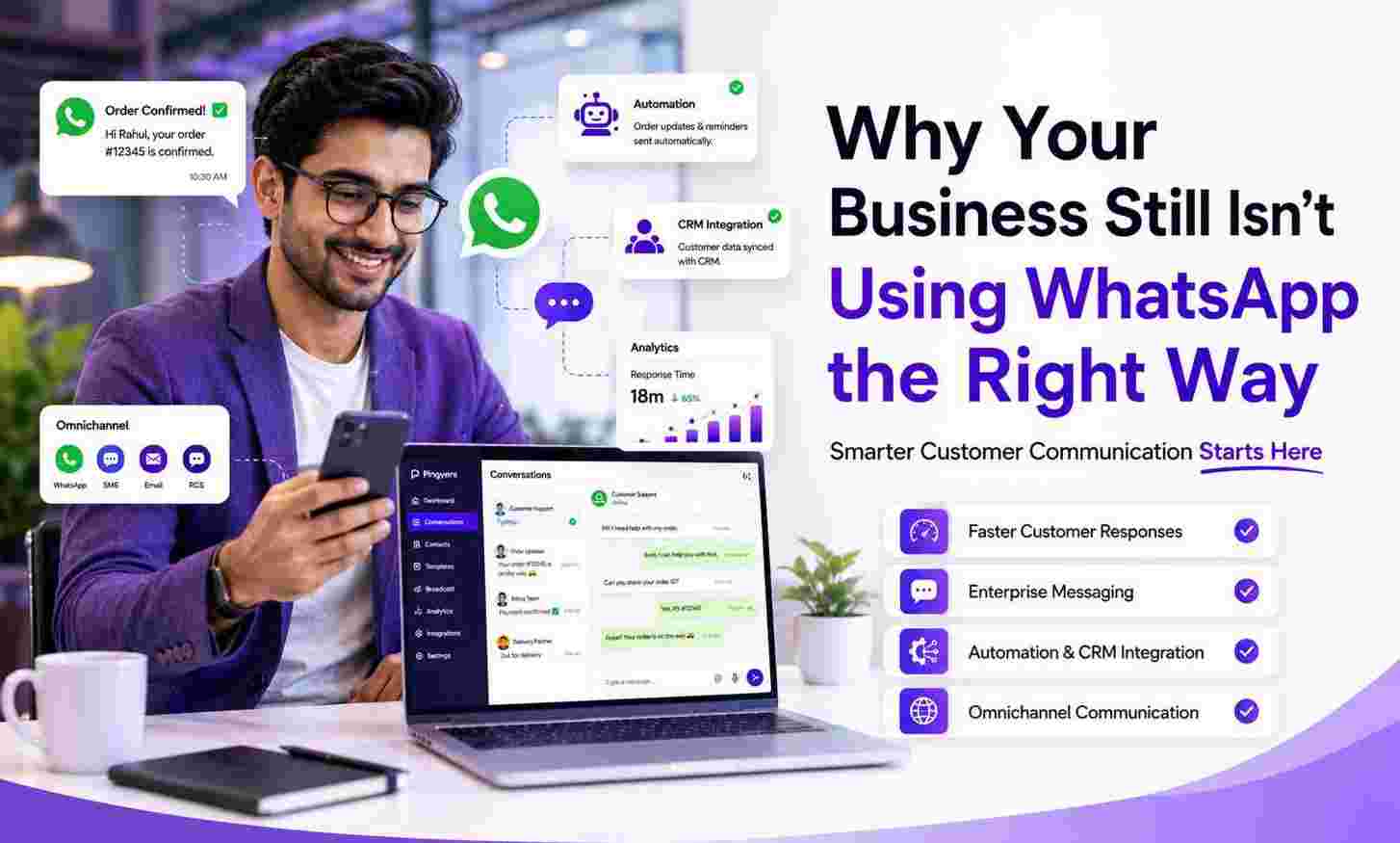
It’s not just messaging. It’s business-grade WhatsApp communication that becomes a core part of your customer experience.
A customer who gets a WhatsApp order update doesn’t need to call your support team. That’s one less agent hour spent on a question that could be answered automatically.
Here’s something I didn’t appreciate until we scaled up: your customers don’t stay on one channel.
They might discover your product on Instagram, ask a question on WhatsApp, receive an email receipt, and follow up via SMS if they don’t get a quick response. That’s four touchpoints – and if each one feels disconnected, you’re leaving money (and trust) on the table.
This is exactly why a WhatsApp omnichannel messaging platform matters so much. It’s not just about WhatsApp in isolation – it’s about making WhatsApp one seamless part of a bigger communication journey.
When your support team can see a customer’s entire history across channels in one place, they stop asking “Can you repeat your order number?” They already know. That kind of experience is what builds loyalty in 2025.
Cart abandonment messages on WhatsApp see significantly higher re-engagement than email. Instead of a cold “You left something behind!” email that gets ignored, a warm WhatsApp message with a product image and a quick link to checkout actually gets clicks.
Appointment reminders via WhatsApp have been shown to dramatically reduce no-shows. Patients respond, confirm, or reschedule – all within the chat. No phone tag, no missed calls.
OTP verification, policy updates, loan status – these are all things customers would rather receive on WhatsApp than wade through an app or wait for an email. And with end-to-end encryption, it’s actually secure.
Real-time delivery updates on WhatsApp reduce inbound “Where is my order?” calls by a significant margin. I’ve lived this one personally – it genuinely works.
What to look for in a WhatsApp Business API solution
Not all platforms are built the same. Here are a few things I’d look for if I were starting fresh today:
If a platform ticks these boxes, you’re in good shape. The goal is to make enterprise WhatsApp messaging feel effortless – for your team and your customers.
One thing people underestimate: template message approval. WhatsApp requires pre-approved templates for outbound messages. A good API provider will guide you through this process quickly and help you write templates that actually get approved.
Here’s my honest take after two years of using enterprise messaging tools: the technology is only half the equation.
The real shift is treating WhatsApp not as a cheap broadcast channel, but as a relationship channel. Send messages that are actually useful. Don’t blast promotions at 7 AM. Respect opt-outs. Personalise where you can.
Customers who feel respected on WhatsApp become loyal customers. And loyal customers are worth 10x more than a one-time buyer you acquired through paid ads.
Business-grade WhatsApp communication isn’t about volume – it’s about value. When you send someone the right message at the right time in the right channel, something clicks. They trust you. And trust is the only currency that compounds.
Pingverse is an AI-powered omnichannel communication platform that helps businesses deliver smarter messaging across WhatsApp, SMS, RCS, Email, and Voice – all from a single dashboard. If you’re serious about scaling your customer communication, it’s worth a look.
The WhatsApp Business app is a standalone app for small businesses – it’s free but limited to one device and lacks automation. The WhatsApp Business API is a developer-level solution designed for medium and large businesses, enabling automation, CRM integration, bulk messaging, and multi-agent support at scale.
Not necessarily. Many platforms – including Pingverse – offer no-code or low-code setups that let you connect, configure, and launch your WhatsApp messaging without writing a single line of code. The integration with your existing tools may require some technical input, but the day-to-day management is usually straightforward.
The cost depends on message volume, the number of active conversations, and the platform you choose. WhatsApp uses a conversation-based pricing model. When you consider the reduction in support costs, higher engagement rates, and improved customer retention, the ROI for most businesses is very positive – especially compared to traditional SMS campaigns.
Absolutely – and this is key. Automation works best for transactional messages (order updates, reminders, OTPs) where the content is relevant and expected. Promotional messages should be opt-in only, well-timed, and genuinely useful. When done right, automated WhatsApp messages actually improve customer experience rather than degrade it.
An omnichannel messaging platform lets your business manage customer communication across multiple channels – WhatsApp, SMS, email, RCS, voice – from a single interface. It matters because your customers don’t stick to one channel, and a unified view of their journey helps your team respond faster, more personally, and without dropping the thread.
Yes. WhatsApp uses end-to-end encryption for all messages, which makes it one of the more secure channels available for business communication. That said, your choice of API provider also matters – look for platforms that are official Meta Business Partners and comply with data protection regulations relevant to your region.

© 2025 Crivva - Hosted by Airy Hosting Managed Website Hosting.