


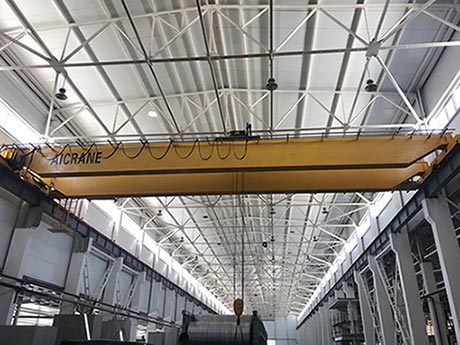
Overhead cranes are critical in industries such as manufacturing, logistics, warehousing, steel production, and construction. They enable the efficient and safe movement of heavy materials over long distances. Among the many factors that determine crane design, span length—the horizontal distance between the crane runway rails—is one of the most influential. For a 30-ton overhead crane, span length directly impacts structural design, deflection control, trolley and hoist performance, runway load distribution, and overall operational safety.
This article provides a comprehensive overview of how span affects structural requirements for 30 ton overhead cranes, offering insights for engineers, facility planners, and operators.
The span of an overhead crane is the horizontal distance between the centers of the runway rails on which the crane moves. It defines the width of the area that the crane can service. For industrial facilities, spans can range from as small as 6 meters in compact workshops to over 30 meters in large warehouses or production plants.
Span is more than a simple geometric parameter. It affects multiple aspects of crane performance and structural integrity, including:
Bridge girder sizing and strength
Deflection and stiffness of the crane bridge
Load distribution on trolley wheels and runway rails
Dynamic behavior during movement
Safety and operational efficiency
A proper understanding of span-related structural requirements ensures that a 30-ton crane can perform reliably over its operational lifetime.
The bridge girder is the primary structural component supporting the hoist, trolley, and load. Span length is a major determinant of girder design:
Simple I-beams or standard box girders are typically sufficient
Lower bending moments allow for lighter materials
Easier fabrication and installation
Require deeper or reinforced girders
Additional stiffeners or cross beams help control bending
Structural analysis is necessary to prevent excessive deflection
Significantly higher bending moments due to longer lever arms
Require advanced design solutions, such as box girders with increased depth and flange width
May incorporate lateral and torsional bracing to maintain rigidity
Bending Moment Calculation:
Where MM = bending moment, ww = uniform load, LL = span length. The equation highlights that even small increases in span can result in significantly higher stress on bridge girders.
Deflection refers to vertical or lateral movement of the crane bridge under load. Excessive deflection can lead to operational issues, reduced hoist accuracy, and accelerated wear on components.
Standards such as CMAA or ISO typically limit maximum deflection to L/800 to L/1000. For a 25-meter span, this corresponds to a maximum deflection of approximately 25–31 mm under full load.
Increasing girder depth and flange width
Using high-strength steel materials with higher modulus of elasticity
Adding cross bracing, stiffeners, or triangulated sections for lateral stability
Proper deflection control is especially critical in long-span 30-ton cranes to maintain safe and precise lifting operations.
The trolley and hoist ride on the bridge girder, and span length affects their performance:
Longer spans amplify girder bending, creating uneven wheel loads
Unequal load distribution can accelerate wear and reduce component lifespan
Excessive deflection may misalign the hoist, causing binding or operational difficulties
Misalignment affects lifting accuracy and increases maintenance requirements
Long-span cranes may require slower trolley speeds to minimize dynamic impact
Shock absorbers, vibration dampers, or trolley stabilizers can reduce the effects of deflection on the hoist
Engineers must ensure that bridge stiffness and deflection control maintain smooth trolley and hoist operation throughout the span.
The runway system supports the bridge and transmits loads to the building structure. Span length affects runway design in several ways:
Vertical reactions: Longer spans increase the forces applied to runway beams and supports
Lateral stability: Longer spans may induce horizontal forces requiring bracing or lateral supports
Thermal and structural expansion: Expansion joints and anchors must accommodate bridge movements and temperature-induced length changes
A well-designed runway system ensures the crane operates safely and reliably, even under full 30-ton loads.
Overhead cranes experience dynamic loads during operation, including:
Sudden starting or stopping of the bridge or trolley
Load swinging during lifting or lowering
Vibrations at high operational speeds
Longer spans reduce the natural frequency of the bridge, increasing susceptibility to vibration
Amplified bending moments and torsion can affect stability
Resonance or oscillation may occur if dynamic effects are not properly managed
Mitigation Strategies
Structural damping using specialized materials or connection techniques
Reinforced cross members for lateral stiffness
Shock absorbers or vibration-reducing trolley components
Dynamic analysis is critical for long-span 30-ton cranes to maintain operational safety and reduce structural fatigue.
Span length influences material choice, fabrication, and construction methods:
Steel grade: High-strength steel allows for longer spans without excessive girder depth
Fabrication type: Welded sections provide greater rigidity; bolted modular designs are often used for transport or assembly considerations
Cross-section design: Box girders or deep I-beams optimize stiffness and reduce torsional deflection
High-quality materials, accurate fabrication, and precise assembly are essential for maintaining structural integrity in long-span girder overhead cranes.
Span affects compliance with international standards and safety requirements:
ISO 4301 and CMAA 70 & 74 standards define limits for structural deflection, bending stress, and fatigue
Longer spans require additional measures such as anti-sway devices, lateral bracing, and safety redundancies
Properly designed long-span cranes reduce the risk of derailment, tipping, or overloading
Ensuring compliance with safety standards is particularly important for heavy 30-ton cranes in industrial environments.
Increasing span increases both material and construction costs:
Heavier girders and reinforced cross-sections require more steel and fabrication work
Reinforced runway systems increase structural investment
Transportation, lifting, and installation of long-span girders are more complex
Balancing span, structural requirements, and cost efficiency is essential to maximize ROI without compromising performance or safety.
Consider a 30-ton overhead crane in a facility with two span scenarios:
Standard I-beam or box girder can support load
Minimal stiffeners required
Trolley and hoist operate at normal speed
Requires deep, reinforced box girders with stiffeners
Additional lateral bracing and stiffening plates
Reduced trolley speed and added damping to minimize deflection and vibrations
Reinforced runway supports required to handle higher reactions
This comparison highlights how increasing span significantly affects structural design, safety, and operational efficiency.
The span of a 30-ton overhead crane is one of the most critical factors in structural design. Longer spans increase bending moments, deflection, dynamic effects, and trolley load variations, requiring:
Stronger and stiffer bridge girders
Deflection control using advanced materials and stiffening techniques
Reinforced runway systems to handle increased reactions
Dynamic mitigation strategies to prevent vibration and fatigue
By carefully considering span in design, engineers can ensure that a 30-ton crane operates safely, efficiently, and reliably over its intended service life. Proper attention to span-related structural requirements ensures operational accuracy, minimizes maintenance, and maximizes the return on investment in industrial lifting solutions.

© 2025 Crivva - Hosted by Airy Hosting Managed Website Hosting.