


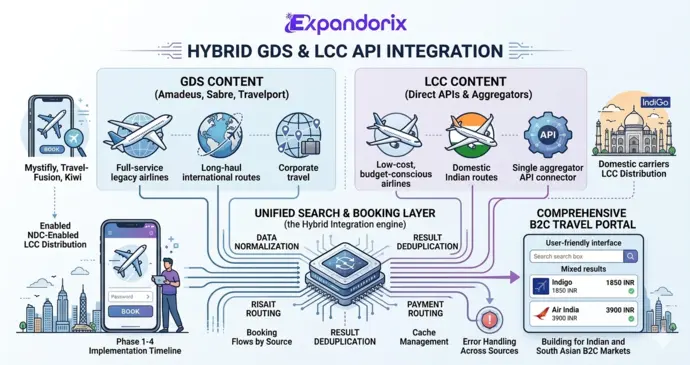
When travelers search for flights today, they are not loyal to a single type of airline. A business traveler might book full-service flights on Monday and a budget carrier for a weekend trip on Friday. A leisure traveler might mix a full-service international leg with a low-cost domestic connection. And a price-conscious B2C portal that cannot serve both segments is leaving a significant portion of the market untouched.
This is the fundamental business problem that hybrid GDS and LCC API integration solves. By combining the deep, real-time inventory of a Global Distribution System with the direct API access of Low-Cost Carriers and ultra-low-cost airlines, a travel portal can offer genuinely comprehensive flight search across the full market — not just the GDS-distributed segment.
This blog explores the architecture, business case, and implementation strategy for a hybrid GDS and LCC integration, and explains why it is increasingly the standard approach for serious B2C travel portals.
To understand why a hybrid approach is necessary, you first need to understand the content gap between GDS and LCC distribution models.
The major GDS platforms — Amadeus, Sabre, and Travelport — have comprehensive coverage of full-service carriers (FSCs) and many legacy airlines. They also cover some low-cost carriers that have chosen to distribute through GDS, including carriers like Southwest (partially), easyJet, and some budget airlines in Southeast Asia. GDS coverage is particularly strong for international and long-haul routes.
However, a significant and growing segment of the airline market distributes exclusively or primarily through direct channels — their own websites and proprietary APIs. This includes many ultra-low-cost carriers (ULCCs) in markets like India (IndiGo, SpiceJet), Europe (Ryanair, Wizz Air), Southeast Asia (AirAsia, Lion Air), and the Middle East (flydubai, Air Arabia). For routes where these carriers dominate, a GDS-only portal will consistently show higher prices or no availability at all for the most popular options.
LCC airlines typically offer API access through one of three models:
Some LCCs offer direct XML or REST API access for authorized distribution partners. These APIs give you real-time inventory, direct booking capability, and often access to ancillary services (seat selection, baggage, meals) that may not be available through third-party aggregators. The trade-off is that you need a separate integration and agreement with each airline.
Vendors like Mystifly, TravelFusion, Kiwi, and others aggregate LCC content from multiple airlines and expose it through a single API. This dramatically reduces integration complexity — one API connection gives you access to dozens of LCCs. The trade-off is a per-query or per-booking fee structure and sometimes a slight delay in inventory updates compared to direct connections.
IATA’s NDC standard is beginning to bridge the GDS-LCC gap. Some LCCs are publishing their inventory through NDC APIs, and GDS platforms are increasingly building NDC aggregation layers. This is creating more unified access to both FSC and LCC content through a single GDS connection — though the coverage is still incomplete in most markets.
For a B2C travel portal that wants to be the first choice for travelers across a broad market, hybrid integration is not optional — it is necessary. Here is why:
Building a hybrid integration requires careful architectural thinking to ensure that results from different sources can be searched, combined, compared, and presented consistently to the end user.
The unified search layer is the orchestration engine that fires parallel searches to the GDS API and the LCC aggregator (or multiple LCC APIs) simultaneously when a user submits a search request. It must handle different response formats, different data schemas, different response times, and different error conditions from each source, then normalize the results into a consistent format for the presentation layer.
GDS results come in complex XML with airline-specific fare rules, multi-segment itinerary structures, and extensive fare basis data. LCC aggregator results may come in a simpler JSON format but with a different field structure. Your normalization layer must map all of this to a common internal schema — same field names, same fare structure, same representation of journey segments — before the results are displayed.
The booking flow for a GDS-sourced itinerary is fundamentally different from the booking flow for an LCC-sourced itinerary. GDS bookings use PNR-based workflows with separate ticketing steps. LCC bookings are often direct — you create the booking and receive a confirmation in a single transaction. Your platform needs to manage these different flows while presenting a consistent user experience.
GDS bookings typically involve BSP (Billing and Settlement Plan) settlement with airlines. LCC bookings may require direct payment to the airline at booking time. Managing multiple payment relationships and reconciling them correctly is a significant operational and technical requirement.
The Indian domestic market is a particularly strong use case for hybrid GDS and LCC integration. IndiGo alone commands over 55 percent of the Indian domestic market, and SpiceJet, Air India Express, and Akasa Air together account for a large portion of the remaining market. A B2C travel portal targeting Indian consumers that does not have real-time LCC pricing for domestic routes is at a severe competitive disadvantage.
At the same time, full-service carrier coverage is essential for international routes, corporate travel, and premium leisure. The GDS provides the depth and reliability needed for this segment.
Hybrid integration — where Amadeus or Sabre provides FSC international coverage and a specialized LCC aggregator provides domestic LCC content — is the architecture that serves this market correctly.
Purpose-built GDS API integration services that include hybrid LCC integration are available for development companies familiar with the South Asian travel market’s specific requirements.
When an airline distributes through both GDS and an LCC aggregator (some carriers do both), you may receive duplicate results for the same itinerary at slightly different prices. Your integration needs deduplication logic that identifies and collapses these duplicates while preserving the best available price.
LCC APIs are often less tolerant of high query volumes than GDS APIs. Smart caching of availability and pricing data — refreshed at appropriate intervals — is essential for managing API costs and maintaining response time performance at scale.
When a GDS query returns an error but the LCC aggregator returns results, your platform should still display the available results rather than showing a complete failure. Building resilient error handling that degrades gracefully rather than failing completely is important for user experience and conversion rates.
Presenting GDS fares alongside LCC fares in a consistent, comparable format requires careful thought. GDS fares often include checked baggage; LCC fares typically do not. The presented price needs to be comparable on the same basis, or clearly labeled with what is included.
A typical hybrid GDS and LCC integration for a B2C travel portal might be structured in phases:
The B2C travel market has no room for portals that cover only part of the available inventory. Travelers who cannot find their preferred airline on your platform will find it on a competitor’s. Hybrid GDS and LCC API integration is the architectural approach that closes this gap and positions a travel portal to compete effectively across the full market.
The complexity of building and maintaining a hybrid integration is real — but it is manageable with the right technical partner and a phased implementation approach. The business case is clear: more inventory coverage means more search-to-booking conversion, more repeat users, and a stronger long-term competitive position.
Expandorix builds hybrid GDS and LCC integrations for B2C travel portals, OTAs, and travel startups, with deep expertise in both GDS XML APIs and LCC aggregator connectivity across the Indian and global markets.

© 2025 Crivva - Hosted by Airy Hosting Managed Website Hosting.