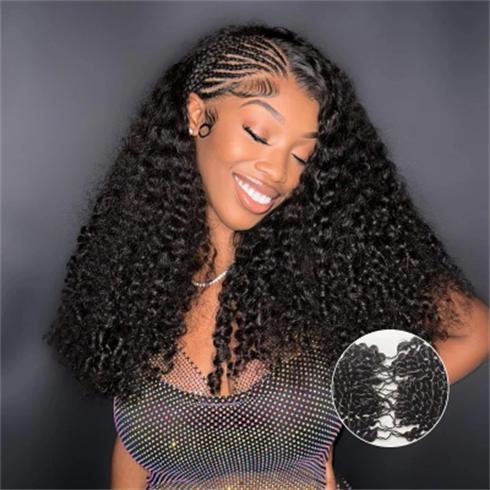
Human Crochet Hair for Black Women: A Blend of Tradition, Versatility and Personal Style. For Black women, hair ain’t just about looking good—it’s culture, identity and creativity all woven together. When it comes to styling options, human crochet hair extensions have become a real go-to. They hit that sweet spot between practicality and heritage, letting us protect our hair while serving looks. The technique—using a crochet hook to latch human hair onto cornrows—gives us that perfect mix of low-maintenance styling and natural vibes, and our community has fully embraced it.
Why Human Crochet Hair Just Works
At its core, crochet hair is a protective style—and let’s keep it real, our hair needs that break. All that daily styling, heat and tight braiding can do a number on our kinky, curly and coily textures. But with crochet, our own hair gets to chill tucked under those cornrows, safe from friction and the elements, so it can actually grow. Plus, you get instant length and volume without stressing your scalp or edges. It’s a win-win.
Where human crochet hair really shines is its versatility—kind of like BGMgirl glueless wigs and human hair wigs, which also give you that natural finish without the damage. Unlike synthetic hair that can look a little “extra,” human hair moves like it’s yours. You can flat-iron it, curl it, tie it up—whatever. And glueless wigs? They’re the ultimate easy-button style, especially when you’re pressed for time. For me, that flexibility changed the game. I could rock big, statement braids for the weekend and switch to a sleek low bun for Monday meetings—no commitment, no damage.
How to Get It Right: A Real Talk Guide
Putting in crochet hair is more DIY-friendly than a lot of salon methods. First, prep your natural hair: wash, condition and moisturize well, then braid it into loose cornrows. Pro tip: make smaller braids along the hairline to keep tension off your edges and keep everything laying flat.
Then, grab your crochet hook (a latch hook or beader works too) and start looping the extensions through the braids. I’m all about the pre-looped bundles—Janet Collection’s ones are my ride-or-die—they save time and keep the look consistent. Work from the back toward the front, lock each strand with a double knot so it stays put, but don’t go overboard. Oh, and here’s a hack I learned the hard way: lightly mist the hair with water before you separate it. Saves you from frizz and keeps the curls intact.
Once it’s in, style it like it’s your own. For my favorite kinky curly look, I add a little leave-in and curl cream, then gently finger-detangle. Keep it fresh with regular moisturizing and always wrap it up with a satin bonnet at night. Done right, a crochet install can last up to six weeks, and the hair can be reused. And if you ever need a style in a pinch? Throw on a glueless wig—no braiding needed. Human hair wigs give you that same heat-friendly flexibility, blending seamlessly whether you’re going to work or out for the night.
Where It All Started: A Cultural Mash-Up
Crochet hair’s origins are a global mix—no one person really “invented” it. Some trace similar techniques back to ancient China, where crafters used hook-like tools for hair weaving. That know-how traveled trade routes to the Caribbean, where it met up with the deep braiding traditions African women brought with them—and honey, we’ve always known how to make something beautiful out of what we have. Over time, it evolved into the quick, affordable, and fly style we know today, blowing up in Black communities in the late 90s and early 2000s. Now, it’s a staple, with everyone from your cousin to celebs like Issa Rae rocking it.
My Own Crochet Journey: From Struggle to Slay
Alright, let me take you back to my sophomore year of college. My natural hair was struggling—I mean, edges thin, ends crunchy, the whole nine. Between late-night study sessions and trying to keep up with straight-hair trends, I was doing the most, and my hair was paying the price。 I felt like I had to choose between my grades and my hair health—it was a whole mess。
Then my roommate, bless her, saw me fighting with a flat iron and was like, “Chile, you need to try crochet。” She sat me down in our tiny dorm room, showed me a YouTube tutorial, and helped me with my first install. We were up till 3 a.m., laughing, detangling, and probably making mistakes。 But when I looked in the mirror the next morning with those springy kinky curls framing my face? Game over. It was the first time in years I had length and volume without the damage. I didn’t just look different—I felt lighter. My hair was finally getting a chance to breathe。
That was just the start。 I got bold with it—tried a honey-blonde ombré for graduation(felt like a whole celebrity), rocked some sleek jet-black twists for my first big job interview(nailed it, by the way)。 But the moment that really hit different was at a family cookout。 I had these chunky boho braids with gold cuffs, and my grandma—who grew up in Kingston—stopped mid-sentence, touched one of my braids, and smiled. “You know,” she said in her soft patois, “my auntie used to do something like this with her own hair and a piece of thread. Same hands, different time.” I almost cried. It wasn’t just a style; it was a connection。
Why It’s More Than Just Hair
So yeah, for me and so many of us, human crochet hair is the truth。 It’s protection when our hair is tired, creativity when we’re bored, and a quiet nod to the aunties and grandmas who twisted beauty out of struggle。 It lets us switch up our vibe without the commitment, save our edges, and walk into any room feeling like ourselves—only amplified。 In a world that’s always had something to say about Black hair, crochet is one of the ways we write back, on our own terms。 And that? That’s forever in style。

© 2025 Crivva - Hosted by Airy Hosting Managed Website Hosting.