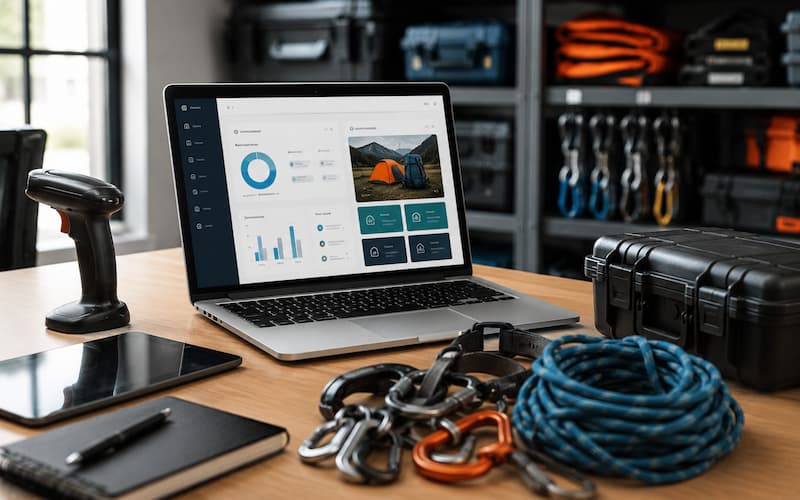
In rental-based businesses, equipment is the backbone of operations. Whether it is construction machinery, vehicles, audio-visual gear, or industrial tools, each asset gradually loses value over time due to usage, wear and tear, and technological obsolescence. This reduction in value is known as depreciation. Accurately tracking depreciation is essential for financial planning, tax compliance, pricing strategy, and long-term asset management. Modern businesses often rely on a rental equipment tracking system to simplify and automate this process.
Understanding how to track equipment depreciation effectively helps rental companies maintain profitability while ensuring transparency in asset valuation.

Equipment depreciation refers to the systematic reduction in the value of an asset over its useful life. For rental businesses, depreciation is not just an accounting concept—it directly impacts:
Every time equipment is rented out, it experiences wear and tear, which reduces its resale value. Tracking this decline accurately ensures that businesses recover costs over time.
Tracking depreciation is more than just bookkeeping. It plays a strategic role in business operations:
Depreciation helps reflect the true value of assets in financial statements. Without it, businesses may overstate their asset value.
When depreciation is tracked properly, rental companies can set prices that cover equipment wear and replacement costs.
Depreciation is often tax-deductible, reducing taxable income and improving cash flow.
Businesses can predict when equipment will need replacement or major repairs.
Untracked depreciation can lead to unexpected financial losses when equipment becomes unusable earlier than expected.
There are several standard methods used to calculate depreciation in rental equipment management:
This is the simplest method where depreciation is spread evenly over the useful life of the equipment.
Formula:
Annual Depreciation = (Cost of Equipment – Salvage Value) / Useful Life
This method is widely used because of its simplicity and predictability.
This method applies a higher depreciation rate in the early years of equipment usage and gradually reduces it over time. It is ideal for assets that lose value quickly.
Depreciation is calculated based on actual usage rather than time. This is highly relevant for rental businesses where equipment usage varies significantly.
Formula:
Depreciation per Unit = (Cost – Salvage Value) / Total Expected Usage Units
Tracking depreciation requires a structured approach. Below are the key steps rental businesses should follow:
Start by documenting the purchase cost of each piece of equipment, including taxes, shipping, and installation expenses.
Determine how long the equipment is expected to remain operational. This varies depending on usage intensity and equipment type.
Estimate the resale or scrap value at the end of its useful life. This helps calculate total depreciation.
Select a method that aligns with your business model—straight-line for simplicity or usage-based for accuracy.
Monitor how often each asset is rented, its condition, and maintenance history.
Adjust depreciation calculations based on real-time data such as heavy usage or unexpected damage.
Manual tracking of depreciation is prone to errors and inefficiencies. This is where technology transforms asset management.
Digital systems store all equipment details in one place, including purchase cost, rental history, maintenance logs, and depreciation schedules.
Software automatically calculates depreciation based on predefined rules, reducing human error.
Every rental transaction updates the asset’s usage and condition in real time.
Advanced systems can predict when equipment will need servicing, helping extend asset life and reduce depreciation speed.
Depreciation tracking becomes most powerful when integrated with day-to-day rental operations:
Each rental affects equipment condition. Systems can adjust depreciation rates based on usage frequency and intensity.
Regular maintenance can slow down depreciation by extending equipment life.
Any damage or repair history is recorded and factored into asset valuation.
Implementing a structured depreciation tracking system offers several advantages:
Businesses can ensure rental pricing covers both operational costs and asset value loss.
Companies can identify underused or overused equipment and optimize distribution.
Depreciation data helps determine when to repair, replace, or retire equipment.
Understanding asset value decline helps businesses plan capital expenditure more effectively.
Accurate depreciation records simplify audits and tax reporting.
Despite its importance, depreciation tracking comes with challenges:
Rental equipment usage varies widely, making standard depreciation models less accurate.
Spreadsheets and manual logs often lead to miscalculations.
Without automation, depreciation values may not reflect current asset conditions.
Different equipment types require different depreciation approaches.
To ensure accuracy and efficiency, rental businesses should follow these best practices:
The future of equipment depreciation tracking is becoming increasingly data-driven and intelligent. Emerging technologies like AI, IoT, and predictive analytics are reshaping asset management:
These innovations will make depreciation tracking more accurate, automated, and predictive.
Tracking equipment depreciation is essential for maintaining financial accuracy and operational efficiency in rental businesses. By understanding depreciation methods, following structured tracking processes, and leveraging modern technology, companies can significantly improve asset management.
With intelligent systems and real-time data integration, businesses can move away from manual calculations and toward fully automated, data-driven depreciation management. This not only ensures better financial control but also enhances long-term sustainability and profitability in the competitive rental industry.

© 2025 Crivva - Hosted by Airy Hosting Managed Website Hosting.