


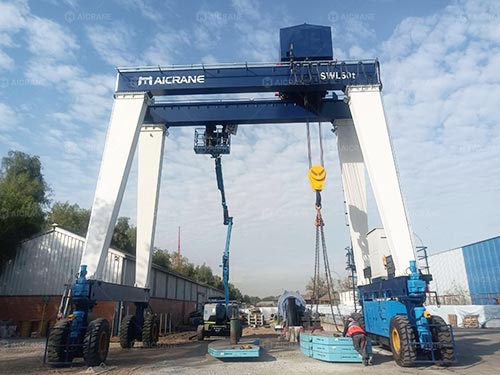
In the competitive landscape of port logistics, the acquisition of a Rubber Tyred Gantry (RTG) crane is a significant capital expenditure. While the purchase price is often the focus of negotiations, the “hidden” costs of shipping and on-site installation can account for a staggering percentage of the total project budget. For terminal operators, the challenge lies in balancing the need for high-performance equipment with the logistical nightmare of transporting structures that stand several stories high and weigh hundreds of tons.
By implementing strategic planning and leveraging the expertise of leading rubber tyred gantry crane manufacturers, terminal operators can significantly trim these peripheral costs. This article explores the most effective strategies for reducing the financial burden of RTG logistics and commissioning.
One of the most effective ways to lower shipping costs is to address the physical dimensions of the crane before it even leaves the factory. Historically, RTGs were often shipped in large, semi-assembled sections that required specialized heavy-lift vessels and oversized inland transport permits.
Modern engineering has shifted toward modular construction. By designing the RTG to be broken down into standardized, container-friendly modules, manufacturers can utilize regular container ships or Ro-Ro (Roll-on/Roll-off) vessels instead of chartered breakbulk ships.
Component Optimization: Critical components like the trolley, electrical house (e-house), and bogies are designed to fit within 40-foot High Cube containers.
Structural Sectioning: Main beams and sill beams are engineered with high-strength bolted connections rather than permanent welds, allowing them to be transported as flat-packs.
There is a constant debate in the industry: Is it cheaper to ship a crane fully assembled or in pieces? The answer depends on the destination’s infrastructure.
Fully Assembled Shipping: This involves rolling the completed RTG onto a specialized heavy-lift vessel. While the sea freight is significantly higher, the on-site installation cost is nearly zero. This is ideal for terminals with limited space for assembly or high local labor costs.
Disassembled (Knock-down) Shipping: This is the preferred method for long-distance international transit. By reducing the volume of the cargo, you can save millions in freight. However, this requires a robust on-site assembly team. To make this cost-effective, operators should partner with rubber tyred gantry crane manufacturers that provide comprehensive “easy-build” kits and remote technical supervision to speed up the process.
Shipping a large RTG isn’t just about the ocean crossing; the “last mile” inland can be the most expensive segment. A 100-mile truck journey for an oversized load can cost more than the 5,000-mile sea voyage due to:
Escort Vehicles: Often required by law for wide loads.
Utility Disruptions: The need to temporarily move power lines or traffic signals.
Permit Fees: Which vary wildly by jurisdiction.
To mitigate this, route surveys should be conducted months in advance. Choosing a delivery port that has direct rail access or is closest to the final terminal can eliminate the need for complex road transport.
Installation costs are driven primarily by time and specialized equipment rentals. An RTG that sits in pieces for six weeks consumes yard space and incurs heavy crane rental fees.
Ground stability is a major factor. If the assembly area isn’t properly leveled or reinforced, the installation crew will face delays. Ensuring that the “runway” or assembly pad is ready before the components arrive prevents “standby” charges from contractors.
A major portion of installation time is spent on wiring. Top-tier manufacturers now use pre-terminated cabling and quick-connect industrial plugs. Instead of technicians spending days pulling wires through the structure, the e-house is simply “plugged in” to the motors and sensors.
With the rise of Industry 4.0, many manufacturers now use “Digital Twins.” Before the crane is shipped, its software is fully tested in a virtual environment. This means that once the physical structure is bolted together on-site, the software commissioning—which used to take weeks—can be completed in a matter of days.
To visualize where the savings occur, consider the following comparison between traditional methods and optimized strategies:
| Cost Factor | Traditional Method | Optimized Strategy | Potential Savings |
| Ocean Freight | Breakbulk/Chartered Vessel | Modular/Containerized | 30% – 50% |
| Inland Transport | Oversized Road Convoy | Standard Flatbed/Rail | 20% – 40% |
| On-site Labor | 4-6 Weeks Assembly | 2 Weeks (Modular/Pre-wired) | 50% |
| Equipment Rental | High-capacity Mobile Cranes | Standard Lifting Equipment | 15% – 25% |
| Commissioning | Manual Troubleshooting | Digital Twin/Pre-testing | 60% |
Reducing gantry crane costs also involves smart procurement of labor and materials.
Local Crane Hire: Negotiating long-term contracts with local mobile crane providers for the duration of the assembly can yield better rates than daily rentals.
Customs and Duties: Work with a logistics partner who understands “Temporary Importation” rules. In some regions, if equipment is brought in for a specific project, certain duties can be deferred or reduced.
Ultimately, the most successful cost-reduction strategies are those developed in collaboration. When engaging with rubber tyred gantry crane manufacturers, it is vital to include the logistics team in the early design phase. Asking for “Shipping-Optimized Designs” during the RFP (Request for Proposal) process forces manufacturers to compete not just on the quality of the steel, but on the efficiency of the delivery.
Reducing the shipping and installation costs of large RTGs requires a holistic approach that starts at the drawing board. By embracing modularity, optimizing transport routes, and utilizing modern “plug-and-play” technologies, terminal operators can slash their total cost of ownership. In an era where every cent per TEU (Twenty-foot Equivalent Unit) counts, these logistical savings can be the difference between a project that breaks even and one that drives long-term profitability.
Investing in an RTG is a decade-long commitment. Don’t let the first 60 days of that commitment—the shipping and installation—drain your budget before the crane has even moved its first container.
Are you looking to optimize the shipping costs for a specific terminal layout, or are you in the early stages of comparing manufacturer designs?

© 2025 Crivva - Hosted by Airy Hosting Managed Website Hosting.







