

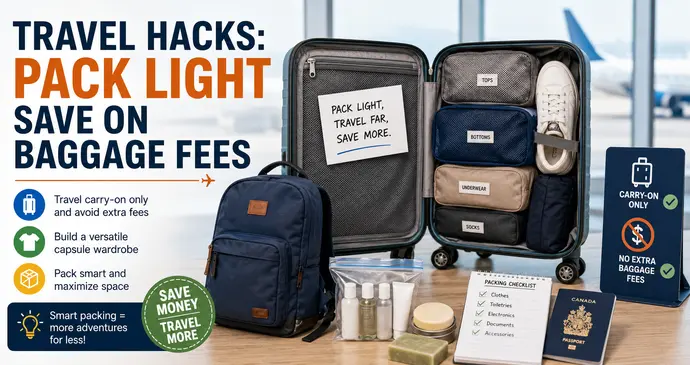
Baggage fees have become one of the most significant hidden costs of modern air travel. What looks like a genuinely cheap fare can rapidly inflate when checked baggage charges are added — sometimes costing as much as the ticket itself on budget carriers. Learning to travel with only carry-on luggage is therefore not just a convenience but a genuine financial strategy, capable of saving travelers substantial amounts of money on every trip. This guide covers everything you need to know about packing light effectively, from choosing the right luggage to building a versatile travel wardrobe that works for any destination.
Before developing a packing strategy, it helps to understand exactly what you are trying to avoid. Legacy carriers like Air Canada and WestJet typically include one or two checked bags in their standard fares on international routes, though economy fares on short-haul or transborder routes may not. Low-cost carriers in North America and Europe commonly charge for every checked bag separately, with fees typically ranging from twenty-five to sixty dollars per bag per direction. For a round trip with two checked bags, this can add up to over two hundred dollars — money that could fund several nights of accommodation at your destination.
The foundation of a carry-on-only travel strategy is having the right bag. Most airlines allow a carry-on bag measuring approximately 22 x 14 x 9 inches and a personal item such as a backpack or laptop bag, though dimensions and weight limits vary by carrier — always check before packing. Modern hard-shell spinner suitcases in carry-on size maximize packing space while protecting contents, while soft-sided bags can compress slightly to fit in tighter overhead bins. For more flexible travel, a well-designed travel backpack that meets carry-on dimensions offers the added benefit of hands-free mobility through airports and at your destination.
The biggest challenge in carry-on-only travel is clothing. The key is building a capsule wardrobe of versatile, mix-and-match pieces in a consistent color palette that allows multiple different outfits from a small number of items. Choose a base of neutral colors — navy, grey, black, white — and add one or two accent pieces or accessories to create variety. Every item should work with at least three other items in your bag; anything that only works with one specific combination does not earn its limited packing space.
Merino wool is the frequent traveler’s fabric of choice for its remarkable combination of natural temperature regulation, odor resistance, and quick drying. A merino t-shirt worn twice between washes in a cool climate does not smell — something that cannot be said of synthetic fabrics. Though merino items have a higher upfront cost, the ability to pack fewer items overall more than compensates. Similarly, quick-dry travel trousers and underwear allow items washed in a hotel sink to be dry and ready to wear by the following morning.
Rolling clothes rather than folding them is the most consistently effective packing technique for maximizing space and minimizing creasing. Rolling creates compact cylinders that stack efficiently and use every corner of the bag. Packing cubes — lightweight nylon mesh or fabric organizers in various sizes — take this further by compressing rolled items and maintaining organization within the bag, making it easy to find specific items without unpacking everything.
Heavy items like shoes and toiletries should be packed at the base of the bag (closest to the wheels on a rolling bag, or against your back in a backpack) to keep the center of gravity low and the bag manageable. Pack shoes in shower caps or dedicated shoe bags to prevent dirt from transferring to clothing. Stuff socks and small items inside shoes to use every available cubic inch.
Liquids in carry-on baggage are subject to the 100ml rule at most airports globally: all liquid, gel, and aerosol items must be in containers of 100ml or less, placed in a single clear resealable bag of maximum one litre capacity. This restriction forces travelers to either decant products into travel-size containers or purchase at the destination, both of which are manageable with a little planning. Solid alternatives to liquid toiletries — solid shampoo bars, solid conditioner bars, solid body soap — bypass the liquids rule entirely and are becoming increasingly available and effective.
The packing light mindset requires ruthless editing of what you bring. Full-size hairdryers, straighteners, and styling tools are almost always available at hotels and should be left at home. Books are heavy and space-consuming — a tablet or e-reader with downloaded titles is a much better solution. Multiple pairs of shoes represent the biggest space drain in most people’s packing; most trips can be managed with two pairs at most: one versatile walking shoe and one smart/dressy option. Packing just-in-case items that are easily purchased at your destination — an umbrella, a forgotten charger, basic over-the-counter medication — adds weight for an unlikely eventuality.
For all its advantages, carry-on-only travel is not always the right choice. Ski trips, beach holidays with significant snorkeling equipment, winter travel requiring heavy outerwear, or trips longer than two weeks where doing laundry frequently is not practical may genuinely require checked baggage. When a checked bag is necessary, compare the total price — base fare plus baggage fees — across airlines on Fareslist to ensure you are making an accurate cost comparison. Sometimes an airline that charges for baggage still comes out cheaper overall than one that includes it in the fare.
Packing light is a skill that rewards practice and pays financial dividends on every trip. By investing in the right carry-on bag, building a versatile capsule wardrobe, mastering efficient packing techniques, and adopting solid toiletry alternatives, most travelers can eliminate checked baggage entirely and save significantly on every journey. Combined with smart flight searching on Fareslist to find the best available base fares, the carry-on-only approach is one of the most effective strategies for reducing total travel costs without reducing the quality of your experience.

© 2025 Crivva - Hosted by Airy Hosting Managed Website Hosting.