


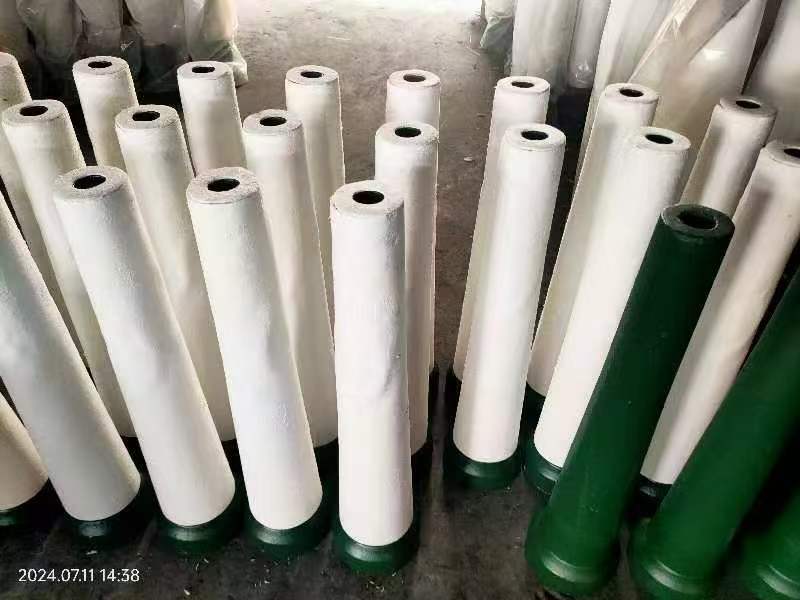
Sub-entry nozzle (SEN) clogging is one of the most persistent operational challenges in the continuous casting process. It directly affects steel flow stability, casting speed, slab quality, and tundish life. In severe cases, it forces early strand stoppage, leading to significant production losses. For steel grades requiring ultra-low inclusion content—such as automotive sheets, pipeline steel, electrical steel, and bearing steel—SEN clogging becomes even more critical due to strict cleanliness requirements.
SEN clogging is caused by the accumulation of solid inclusions, reaction products, or solidified steel along the internal surface of the nozzle. Over time, these deposits grow and reduce the flow area, resulting in unstable casting conditions.
Alumina clogging is the most common issue in aluminum-killed steels. During deoxidation, dissolved oxygen reacts with aluminum to form fine Al₂O₃ particles. These inclusions have poor wettability to the nozzle’s refractory materials and tend to accumulate in areas with turbulent or low-velocity flow.
Mechanisms include:
Inclusion agglomeration and collision near the SEN inlet
Deposition on the nozzle wall due to poor Al₂O₃ wetting
Growth of deposit layers by continuous trapping of inclusions
This type of clogging is dangerous because it develops quietly and becomes noticeable only after the flow becomes restricted.
Calcium treatment modifies solid alumina inclusions into liquid or semi-liquid CaO–Al₂O₃–SiO₂ phases. However, improper calcium control results in:
solid CaS
high-melting CaO-rich compounds
unstable liquid phases during temperature drops
These phases solidify inside the SEN and form sticky layers that grow rapidly.
Insufficient superheat or high heat loss through the nozzle wall leads to partial freezing of steel:
low casting speed
long ladle-change time
inadequate tundish heating
high heat extraction by the refractory
Solidified steel narrows the nozzle bore and disturbs the flow pattern.
SEN materials such as ZrO₂-C or Al₂O₃-C may react with molten steel, forming:
FeO-based reaction layers
ZrO₂ agglomerates
carbon oxidation regions
These reaction products create rough surfaces that trap more inclusions.
Avoiding clogging requires an understanding of the process variables that trigger or accelerate it.
High inclusion content increases clogging frequency. Factors include inadequate ladle refining, slag carryover, and poor desulfurization.
Both insufficient and excessive calcium cause nozzle buildup.
Argon gas helps reduce clogging but must be carefully controlled:
too low → inadequate inclusion flotation
too high → nozzle erosion and mold level oscillation
Inconsistent casting speed causes fluctuating flow regimes inside the SEN, affecting attachment rates.
Low superheat increases the risk of solid-steel deposition.
The chemical and physical characteristics of SEN material influence inclusion adhesion capability.
A successful strategy integrates metallurgy, refractory technology, tundish operation, and caster control.
Processes such as RH, VD, and LF refining improve inclusion removal by:
deep vacuum deoxidation
argon stirring for inclusion flotation
desulfurization and slag-metal reactions
Slag composition must ensure:
low FeO (< 0.5%)
strong basicity
good absorption capacity for Al₂O₃ and CaO inclusions
Tundish equipment that enhances cleanliness:
turbulence suppressors
weirs/dams
gas curtains
slag retaining furniture
Cleaner steel means significantly fewer particles available to form clogging layers.
Calcium treatment aims to modify Al₂O₃ inclusions into liquid phases at casting temperature.
Proper timing after desulfurization
Control of Ca/Al ratio
Maintain steel temperature to keep inclusions molten
Prevent over-calcium leading to CaS solidification
Use high-purity CaSi wire
Apply consistent wire feeding speed
Perform real-time inclusion morphology analysis (if available)
Proper calcium treatment dramatically reduces SEN clogging in Al-killed steel grades.
Modern SENs are engineered with materials offering improved resistance to deposition and reaction.
high thermal stability
excellent corrosion resistance
improved non-wetting behavior for alumina
Surface coatings significantly reduce inclusion adhesion, such as:
BN (boron nitride) coatings
graphite-based layers
newly developed anti-Al₂O₃ coatings
Some SENs incorporate:
a smooth inner bore
an anti-clogging coating
reinforced zirconia working layer
Such layered designs extend nozzle life and delay clogging.
Argon injection is a critical parameter for minimizing clogging and stabilizing steel flow.
reduces inclusion adhesion by generating a protective gas barrier
helps float inclusions into the tundish or mold
prevents steel solidification near the nozzle wall
Maintain flow rates within 5–25 L/min depending on steel grade and nozzle size
Monitor for gas leakage in slide gates and joints
Avoid sudden argon flow fluctuations
Use dual-line argon supply for reliability
A stable and optimized argon system is essential for preventing nozzle deposition.
Temperature control is essential in avoiding steel solidification clogging.
Typical superheat during casting: +20°C to +40°C
Higher superheat required for ultra-clean or high-alloy steels
Use ladle and tundish preheating
Ensure insulation of SEN and tundish walls
Minimize time between tapping and casting
Temperature changes increase inclusion formation and solid deposition.
Stable operation minimizes turbulence, which reduces inclusion re-entrainment and adhesion.
Casting speed should remain constant to maintain steady flow in the SEN.
Misalignment or erratic adjustments increases turbulence and accelerates clogging.
Avoid extended tundish waiting time which cools the steel and increases clogging potential.
Stable casting leads to a substantially lower clogging rate.
Refractory manufacturers continue to innovate SEN designs for anti-clogging performance.
optimized inlet transition
smooth internal bore
controlled outlet port angles
hydrodynamic designs for laminar flow
These designs introduce argon at various heights to maintain stable bubbles and reduce clogging.
Advanced coatings can prolong SEN life by preventing alumina buildup.
The most effective method to avoid SEN clogging is to treat it as a metallurgical and operational system problem instead of a single-parameter issue. A successful strategy includes:
producing clean steel in the ladle
optimizing calcium treatment to modify inclusions
using high-quality SEN refractories
stabilizing argon flow for inclusion removal
maintaining constant superheat
enforcing stable casting operation
applying advanced SEN geometry designs
When these factors are controlled together, SEN clogging can be reduced dramatically—by up to 50–80% in many industrial plants.
SEN clogging remains a major challenge in continuous casting, especially for high-grade steel production. However, with proper metallurgical treatment, refractory selection, tundish operation, argon optimization, and casting stability, clogging can be significantly minimized.
Avoiding SEN clogging is not a single action but a coordinated approach involving steel refining, nozzle technology, thermodynamic control, and precise process operation. By adopting the strategies described in this article, steel plants can achieve:
improved casting stability
longer SEN service life
fewer strand interruptions
better surface and internal steel quality
higher productivity and reduced cost
More information please visit HYRE

© 2025 Crivva - Hosted by Airy Hosting Managed Website Hosting.