

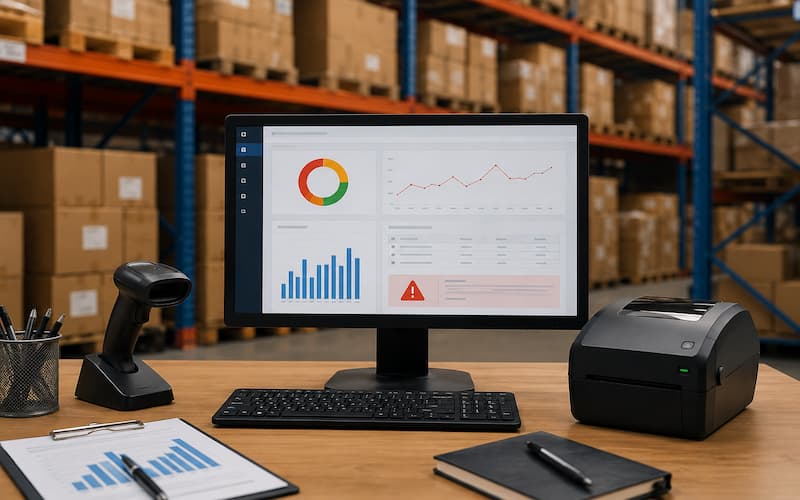
Dead stock is one of the most silent profit killers in retail, wholesale, and distribution businesses. Products sitting unsold for long periods tie up working capital, increase storage costs, and reduce overall business efficiency. Modern businesses are now turning to automation tools like stock and sales management software to prevent inventory pile-up and improve stock movement using real-time alerts and data-driven insights.
Instead of relying on manual checks or outdated reports, smart inventory systems help businesses detect slow-moving items early and take corrective actions before products become completely unsellable. This proactive approach is transforming how companies manage inventory, forecast demand, and optimize purchasing decisions.
This blog explains how dead stock forms, why it is dangerous for business growth, and how smart inventory alerts can help eliminate it effectively.

Dead stock refers to inventory that remains unsold for a long period and has little to no chance of being sold in the future at full value. These products often become obsolete due to:
Dead stock is not just unused inventory—it is locked capital that could otherwise be invested in profitable products.
Many businesses underestimate the financial impact of dead stock. However, its effects extend beyond storage issues.
Money invested in unsold inventory cannot be used for operations, marketing, or expansion.
Warehousing, maintenance, and handling costs continue even when products are not moving.
Discounting or writing off dead stock reduces overall profitability.
Products may expire, become outdated, or lose market demand entirely.
High dead stock reduces inventory turnover ratio, indicating inefficient stock management.
Dead stock does not appear overnight. It builds gradually due to poor inventory control practices.
Businesses often order excess stock based on assumptions instead of real demand data.
Without real-time sales tracking, it becomes difficult to understand which products are slowing down.
Businesses that do not use reorder thresholds end up overstocking slow-moving items.
Without SKU-level tracking, it is hard to identify underperforming products early.
Smart inventory alerts are automated notifications that inform businesses when stock levels, sales velocity, or product movement falls below or above predefined thresholds.
These alerts help businesses act before inventory becomes dead stock.
These alerts notify when a product is not selling at expected speed within a specific timeframe.
Businesses are alerted when inventory exceeds safe holding levels.
Products that are not moving as expected are flagged for immediate action.
The system suggests when and how much to reorder based on demand patterns.
Modern inventory systems continuously analyze sales and stock data in real time.
The system collects data from sales, returns, purchases, and stock movements.
Businesses define rules such as minimum stock levels, maximum stock limits, and sales benchmarks.
The system tracks inventory performance across all SKUs.
When a product crosses a threshold, alerts are triggered instantly.
Advanced systems suggest actions such as discounting, bundling, or stock redistribution.
Businesses can identify potential dead stock before it becomes a financial burden.
By reducing overstocking, companies free up capital for more profitable items.
Data-driven alerts help procurement teams order based on real demand.
Lower inventory levels mean reduced warehousing expenses.
Faster movement of goods improves overall profitability and efficiency.
Define clear thresholds for every product category based on demand patterns.
Track how long each product typically stays in inventory before selling.
Classify products into high, medium, and low-value categories to focus attention on critical stock.
4. Apply Time-Based Alerts
Trigger alerts when products remain unsold for a specific number of days.
5. Enable Automatic Reorder Suggestions
Use system-generated recommendations instead of manual purchase decisions.
Sales data is the foundation of intelligent inventory management.
By analyzing:
Businesses can predict which items are likely to become slow-moving.
When integrated with smart alerts, this data helps prevent unnecessary purchases and reduces inventory risk.
Businesses often ignore early warning signals, leading to full stock stagnation.
Ordering based on assumptions instead of data results in excess inventory.
Without periodic analysis, dead stock goes unnoticed.
Bulk purchasing without demand validation increases storage risk.
Automation plays a critical role in reducing human error and improving efficiency.
With automated systems, businesses can:
Automation ensures that inventory decisions are based on real-time data rather than guesswork.
The future of inventory control is moving toward predictive intelligence. AI-powered systems will soon be able to:
Businesses adopting these technologies early will gain a strong competitive advantage.
Dead stock is a costly problem that silently impacts profitability, cash flow, and operational efficiency. However, with the right strategies and tools, it can be effectively prevented.
Smart inventory alerts provide real-time visibility into stock movement, helping businesses identify slow-moving items early and take corrective action before losses occur. By leveraging automation, data analysis, and intelligent forecasting, companies can significantly reduce dead stock and improve overall inventory performance.
In a competitive market, businesses that rely on manual tracking risk falling behind. Embracing smart systems is no longer optional—it is essential for sustainable growth and efficient inventory management.

© 2025 Crivva - Hosted by Airy Hosting Managed Website Hosting.