

The global transition toward renewable energy has sparked an unprecedented boom in the wind power sector. As turbines grow taller and blades stretch longer to capture more energy, the logistics of moving these massive components has become one of the most significant hurdles in the industry. From the manufacturing floor to the staging port, the traditional methods of handling wind energy assets are being pushed to their limits.
Enter the Rubber Tyred Gantry (RTG) crane. Originally the workhorse of container terminals, a new generation of industrial RTGs – specifically engineered for heavy-duty energy logistics – is revolutionizing how wind turbine components are managed. By providing a blend of immense lifting capacity and rail-free mobility, RTGs are streamlining the supply chain and reducing the “soft costs” of green energy projects.
Wind turbine components are among the most difficult items to transport and store. A modern offshore wind blade can exceed 100 meters in length, while nacelles (the housing for the generator and gearbox) can weigh upwards of 400 tons.
Despite their size, these components are precision-engineered assets. Wind blades are made of composite materials susceptible to structural damage if supported incorrectly. Towers and nacelles contain sensitive electronics and bearings that cannot withstand the jarring movements often associated with traditional truck cranes.
In many staging yards, the reliance on tandem lifts using two crawler cranes or large truck cranes creates a logistical bottleneck. These operations require massive amounts of space for outrigger deployment, hours of synchronization between two operators, and are highly sensitive to wind conditions—ironic, given the industry they serve.
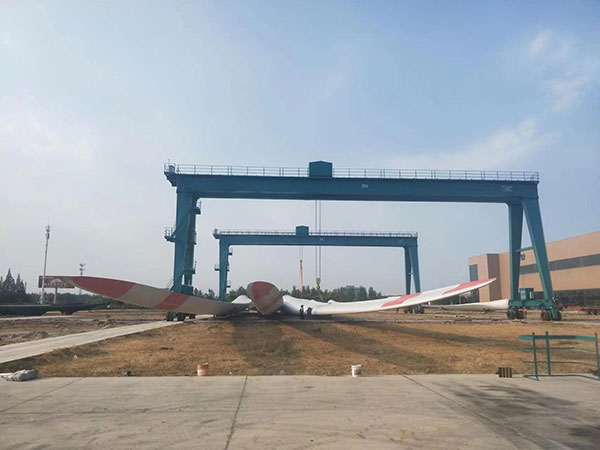
Unlike fixed-track systems or multi-crane setups, a mobile RTG offers a “single-unit” solution for wind component handling. These straddle carrier cranes straddle the load, providing a stable, controlled environment for lifting and moving.
Most RTGs designed for the energy sector feature dual-trolley or dual-hoist systems. For a 100-meter wind blade, an RTG can lift from two points simultaneously. Because both hoists are controlled by a single integrated PLC (Programmable Logic Controller) system, the lift is perfectly synchronized. This eliminates the risk of “load tilt” or uneven stress distribution, which is a constant danger when using two independent cranes.
Wind turbine components often need to be moved through narrow corridors in manufacturing plants or densely packed storage yards at ports. The steering versatility of an RTG—including 90-degree pivot turns and crab steering (diagonal movement)—allows these cranes to glide through tight spaces that would be impassable for a truck crane with a trailing load.
The “staging yard” is the critical link between the factory and the installation site. Here, components are stored before being loaded onto specialized vessels or transport trailers.
Because an RTG straddles the components it moves, it does not require the “swing radius” or outrigger space that mobile cranes do. This allows for much tighter storage configurations. In a typical wind port staging area, switching from crawler cranes to RTGs can increase storage capacity by up to 25% to 35%, as components can be organized in neat, accessible rows with minimal space between them.
In the energy sector, project requirements change rapidly. A manufacturing plant may switch from producing 60-meter blades to 90-meter blades mid-year. Because RTGs are not tethered to rails (unlike RMGs), the entire yard layout can be redesigned overnight. The crane simply drives to the new operational zone, providing a level of future-proofing that fixed infrastructure cannot match.
To handle the unique demands of wind energy, RTGs are built to specific industrial standards that exceed standard port requirements.
Duty Class (A5-A7): Wind logistics involve high-frequency lifting, often operating 24/7 to meet shipping windows. A higher duty class ensures the crane’s structural integrity and motor life remain intact over decades of use.
Specialized Spreaders: Instead of container spreaders, these RTGs are equipped with custom “lifting beams” or “vacuum lifters” specifically shaped to cradle the aerodynamic curves of wind blades or the cylindrical shape of tower sections.
Anti-Corrosion Protection: Since most wind staging happens in coastal environments, these cranes are treated with high-grade marine paint and feature stainless steel electrical cabinets to withstand high salinity and humidity.
The ultimate goal of the wind industry is to reduce the cost per kilowatt-hour. Logistics typically account for 10% to 15% of the total cost of a wind farm project. By streamlining these operations, RTGs contribute directly to the project’s bottom line.
Labor Savings: A single RTG operator can replace a team of two crane operators and multiple ground signalmen required for tandem lifts.
Reduced Downtime: Modern RTGs feature advanced diagnostic systems that predict maintenance needs before a failure occurs. In an industry where a missed shipping window can cost hundreds of thousands of dollars, this reliability is priceless.
Safety as a Cost-Saver: By minimizing the “human element” in complex tandem lifts, RTGs significantly reduce the risk of workplace accidents and expensive cargo damage, leading to lower insurance premiums and fewer project delays.
Consider a wind tower manufacturing facility that produces sections for 5MW turbines. Using traditional methods, moving a tower section from the welding bay to the painting area required a complex coordination of multiple trailers and cranes.
By implementing an 8-wheel mobile RTG with a custom steering logic, the facility was able to:
Pick up the tower section directly from the production line.
Rotate the section 90 degrees within the hall’s footprint.
Drive the section through a standard industrial door to the outdoor storage yard. This eliminated three handling steps and reduced the internal transport time by 60%.
As the wind industry promotes “green energy,” there is increasing pressure to make the supply chain itself more sustainable. We are seeing a shift in RTG power systems:
Electric RTGs (eRTGs): Powered by cable reels or busbars, these eliminate diesel emissions entirely in the yard.
Battery-Powered Hybrids: These use smaller diesel engines to charge battery packs, reducing fuel consumption by up to 30-40% and allowing for silent operation near residential areas.
The wind energy sector is a game of scale. As components continue to grow in size and complexity, the logistics infrastructure must keep pace. The mobile Rubber Tyred Gantry crane has proven to be the “missing link” in the supply chain—offering the strength of a heavy-duty crane with the agility of a smaller vehicle.
By investing in RTG technology, manufacturers and port operators are doing more than just moving heavy objects; they are building a faster, safer, and more cost-effective bridge to a renewable future. For any project manager looking to optimize their wind turbine logistics, the question is no longer if they should use an RTG, but how soon they can integrate one into their workflow.

© 2025 Crivva - Hosted by Airy Hosting Managed Website Hosting.