

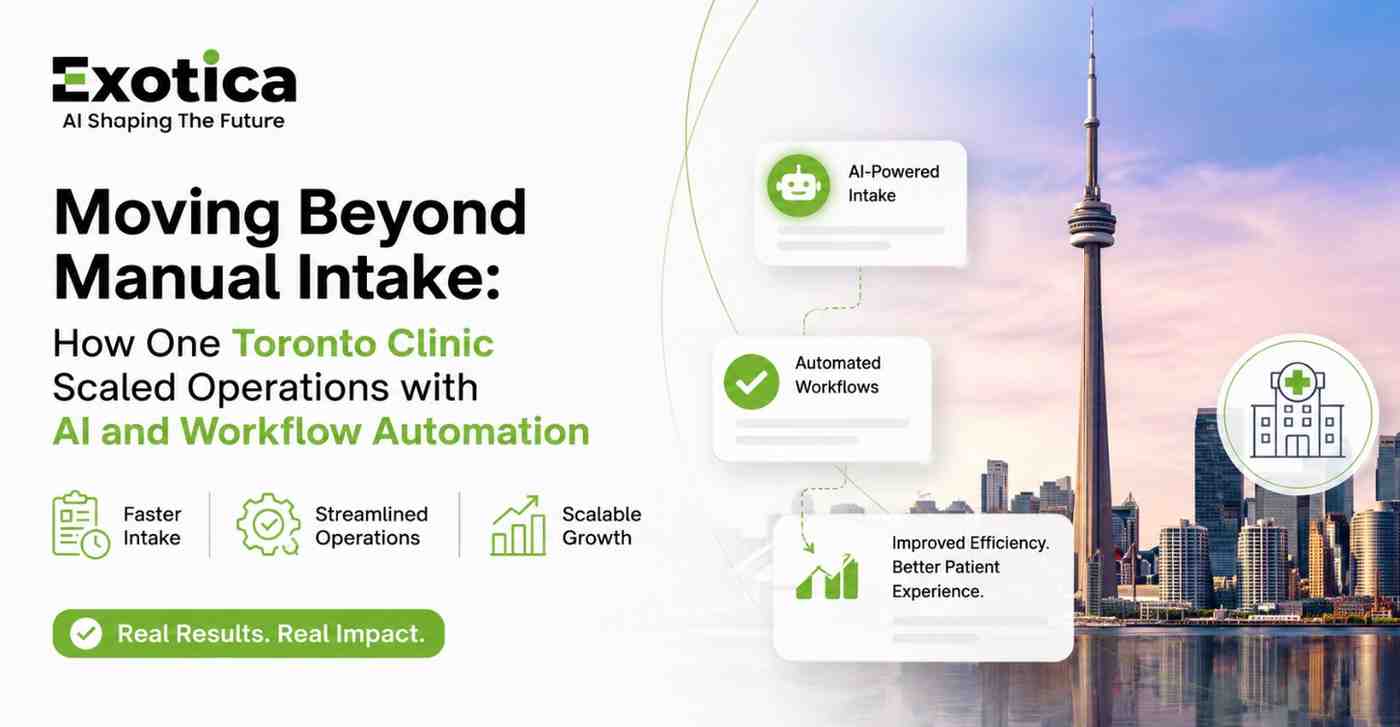
Small businesses in 2026 are no longer choosing between personalized service and operational efficiency. By connecting patient management software directly to communication channels and AI triage tools, local clinics are reducing administrative overhead by upwards of 40% while maintaining the human touch.
When you run a healthcare practice, patient care is the product, but administration is the engine. For years, the engine at Apple Tree Dental sputtered. If you walked into our Toronto clinic in 2023, you would have seen two front-desk coordinators juggling three ringing phone lines, manually copying data from clipboards into our practice management software, and trying to smile at the patient standing in front of them. It was a recipe for burnout and data entry errors.
Today, that same front desk is a quiet, organized hub focused entirely on face-to-face patient interactions. We didn’t double our administrative payroll, nor did we invest in a massive, proprietary software build. Instead, we overhauled our operations using off-the-shelf artificial intelligence tools and middleware. The result? We eliminated 15 hours of redundant manual work per week and reduced our patient onboarding time by half.
For local business owners wondering if AI is just a buzzword for Silicon Valley enterprises, this is a look under the hood at how we actually applied it to a neighborhood dental clinic.
The tipping point for our practice wasn’t a sudden crisis; it was the slow friction of growth. As we expanded our services to include cosmetic dentistry and orthodontics, our inbound inquiries multiplied. Potential patients were emailing us at 10:00 PM asking about Invisalign pricing, and our staff wouldn’t see the message until 8:30 AM the next day. By the time we replied, the patient had often already booked a consultation with another clinic down the street.
Furthermore, the manual transfer of information was costing us. A patient would fill out a digital PDF form, and a staff member would spend ten minutes retyping that exact information into our internal database. When you multiply that by twenty new patients a week, the wasted hours become staggering.
Recent data from the Canadian Chamber of Commerce shows that 82% of small businesses using AI and automated systems have successfully grown their operations without proportionally increasing their overhead. We needed to be part of that statistic.
We realized that our software stack—our website form, our email, our calendar, and our patient management system—were all operating in silos. They didn’t talk to each other. To bridge this gap, we turned to no-code integration tools.
While mapping out the processes that consumed the most time, we realized we needed specialized help to build stable connections. By consulting with Toronto Zapier integration specialists, we learned how to securely pass data between our isolated applications without writing custom code.
Here is the exact three-phase system we built.
Previously, website inquiries went to a generic info inbox. It was a graveyard of missed opportunities.
Now, when a prospective patient fills out the contact form on our website, a webhook immediately captures that data. Instead of sitting in an inbox, the data is automatically parsed. If the inquiry is about an emergency (e.g., a chipped tooth), an SMS alert is instantly triggered to our on-call coordinator’s phone, regardless of the time of day.
If it’s a routine inquiry, the automation cross-references our scheduling software and sends an immediate, personalized email back to the patient with a link to book an opening for that specific service. By removing the manual email triage, our response time dropped from an average of 14 hours to less than two minutes.
Once the basic plumbing was in place, we introduced AI to handle the nuance of patient communication. Not every email fits neatly into a “routine” or “emergency” box.
We set up an automated workflow that passes incoming email queries through the ChatGPT API before they ever hit our front desk. The AI is trained on our clinic’s specific documentation—our pricing structures, our insurance policies, and our frequently asked questions.
When a patient emails asking, “Do you accept Sun Life insurance for pediatric sealants?” the AI reads the email, verifies the answer against our database, and drafts a reply. It doesn’t send the reply automatically—we maintain human oversight for quality control. Instead, it drops the pre-written draft into our coordinator’s outbox. What used to be a five-minute task of researching the policy and typing a response is now a five-second task of clicking “Approve and Send.”
The most labor-intensive part of our week used to be onboarding. To fix this, we created a localized workflow tailored to the realities of our city. When a new patient books an appointment in our system, the automation sequence begins.
First, a digital, PIPEDA-compliant intake form is texted to the patient. Once they hit submit, the automation extracts the text and populates the patient’s profile in our practice management software—no manual typing required.
Second, knowing that navigating the GTA can be unpredictable, we set up location-aware reminders. Twenty-four hours before the appointment, the patient receives an SMS reminder that includes specific parking instructions for our building and a heads-up about current TTC streetcar detours in our neighborhood. This small, automated touch drastically reduced our no-show rate and the number of patients arriving flustered because they couldn’t find parking.
The return on investment for this transition wasn’t just financial; it was behavioral.
Zero Data Entry: Our front desk staff no longer type patient names, addresses, or insurance numbers. That data flows directly from the patient’s smartphone into our encrypted database.
Higher Conversion: Because our response time for high-value services like Invisalign dropped to under two minutes, our consultation booking rate increased by 28% in the first quarter of implementation.
Better Patient Experience: Staff now have the physical time to stand up, greet patients by name, and answer complex treatment questions without rushing to answer a ringing phone.
When we first looked into automating workflows with Zapier in Toronto, we assumed the biggest hurdle would be the cost of software subscriptions. The reality is that the tools themselves cost less than $200 a month. The true investment was the time spent mapping out our internal logic so the automation would work flawlessly.
As a healthcare provider in Ontario, data privacy is not optional. The Personal Health Information Protection Act (PHIPA) dictates strict rules on how patient data is handled.
A common misconception is that off-the-shelf AI and automation tools are inherently non-compliant. This is false, but it does require careful architecture. We ensured that our data extraction and transfer protocols utilized enterprise-grade encryption. We do not pass sensitive medical history through open AI APIs; the AI is restricted strictly to administrative triage and scheduling logic. The actual health records move directly from our secure intake portal to our compliant practice management software.
For local businesses dealing in sensitive information—whether you are a law firm on Bay Street or a clinic in Etobicoke—you cannot afford to set up automations blindly. It requires structured planning and an understanding of data residency laws.
You do not need to be a tech startup to operate like one. The technology required to build an autonomous, highly efficient administrative system is readily available and increasingly affordable.
If you are a business owner feeling buried under the weight of repetitive tasks, start small.
Audit your week: Keep a notepad on your desk for three days. Write down every task you or your staff do more than three times a day.
Identify the triggers: Look at those repetitive tasks. What triggers them? An email? A phone call? A form submission?
Connect the dots: Find the straightest digital line between the trigger and the desired outcome.
Often, the most impactful changes come from linking two platforms you already pay for. By researching expert Zapier automation strategies for Toronto businesses, you can map out workflows that fit your specific operational bottlenecks.
Artificial intelligence and intelligent automation are no longer competitive advantages; they are rapidly becoming the baseline standard for operating a business efficiently. The businesses that thrive over the next five years won’t be the ones that work the longest hours. They will be the ones that engineer their operations so thoughtfully that their staff can focus 100% of their energy on the human interactions that actually matter.
At Apple Tree Dental, our technology stack is invisible to our patients. All they experience is a clinic that replies instantly, remembers their preferences, and greets them with a relaxed smile. And at the end of the day, that is exactly what technology should do.
About the Author
Dr. Sarah Lin is the lead practitioner and clinic director at Apple Tree Dental, a family and cosmetic dentistry practice located in downtown Toronto. With over 12 years of clinical experience, Dr. Lin actively integrates modern health-tech solutions to improve both patient care outcomes and administrative efficiency. When she isn’t treating patients, she consults with local healthcare providers on scaling their clinic operations securely through smart workflow design.

© 2025 Crivva - Hosted by Airy Hosting Managed Website Hosting.