


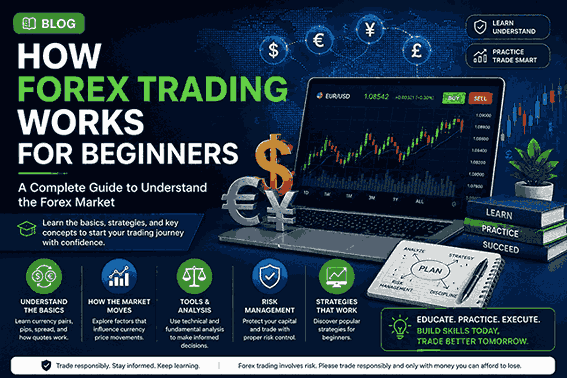
The foreign exchange market, commonly known as the Forex market, is the largest financial market in the world, with over $7 trillion in average daily trading volume. It enables banks, businesses, governments, and individual traders to exchange one currency for another.
If you’re new to trading, you may wonder:
1. What is forex trading?
2. How does forex trading actually work?
3. Can beginners learn forex trading?
4. Is forex trading suitable for me?
Understanding how forex trading works for beginners is the first step before placing your first trade. While forex trading offers exciting opportunities, it also involves risks. Successful traders rely on education, disciplined strategies, and proper risk management—not luck.
This beginner-friendly guide explains the fundamentals of forex trading, key terminology, how currency prices move, and practical tips to help you build a solid foundation.
Visit: https://www.delta.exchange/blog/is-forex-trading-legal-in-india-beginners-guide-to-rbi-rules-legal-trading
What Is Forex Trading?
Forex (Foreign Exchange) trading is the process of buying one currency while simultaneously selling another. Currencies are traded in pairs because the value of one currency is always relative to another.
For example:
USD/INR
EUR/USD
GBP/USD
USD/JPY
If you believe the first currency in the pair will strengthen against the second, you may take a position based on that expectation.
Unlike investing in company shares, forex trading focuses on changes in exchange rates between currencies.
Why Does Forex Trading Exist?
The forex market exists because governments, businesses, banks, travelers, and investors need to exchange currencies for international trade, investments, tourism, and other cross-border transactions.
Retail traders participate by speculating on future price movements rather than exchanging currency for commercial purposes.
How Forex Trading Works
Imagine you expect the US Dollar to strengthen against the Indian Rupee.
If the USD/INR exchange rate rises after you enter a trade, your position may generate a profit. If the exchange rate moves in the opposite direction, your position may incur a loss.
The profit or loss depends on:
Price movement
Trade size
Market volatility
Transaction costs
Understanding Currency Pairs
Every forex trade involves two currencies.
For example:
EUR/USD
Base Currency: EUR
Quote Currency: USD
If EUR/USD is trading at 1.1500, it means 1 Euro equals 1.15 US Dollars.
Similarly:
USD/INR = 85.20
This means 1 US Dollar equals ₹85.20.
Types of Currency Pairs
Major Currency Pairs
These involve the US Dollar and are among the most actively traded.
Examples:
EUR/USD
GBP/USD
USD/JPY
USD/CHF
Minor Currency Pairs
These exclude the US Dollar.
Examples:
EUR/GBP
EUR/JPY
GBP/JPY
Exotic Currency Pairs
These combine a major currency with a currency from an emerging economy.
Examples:
USD/TRY
USD/ZAR
USD/MXN
These pairs often experience higher volatility and wider spreads.
What Makes Currency Prices Move?
Currency prices fluctuate because of changes in supply and demand.
Several factors influence exchange rates, including:
Interest rate decisions
Inflation
Economic growth
Employment reports
Political stability
Central bank announcements
International trade
Geopolitical events
Market sentiment
What Is a Pip?
A pip (Percentage in Point) is the standard unit used to measure changes in currency prices.
For most currency pairs:
1 Pip = 0.0001
For example:
EUR/USD moves from:
1.1200 → 1.1205
This represents a 5-pip movement.
For some currency pairs, the pip calculation differs based on market conventions.
What Is the Spread?
The spread is the difference between:
Buy (Ask) Price
Sell (Bid) Price
Example:
Buy: 85.22
Sell: 85.20
Spread = 0.02
Lower spreads generally reduce transaction costs for traders.
What Is Leverage?
Leverage allows traders to control a larger market position using a smaller amount of capital.
For example, a leverage ratio of 10:1 enables a trader to control a position worth ₹10,00,000 with ₹1,00,000 in margin.
While leverage can amplify potential gains, it also increases potential losses. Beginners should use leverage cautiously and understand the associated risks.
What Is Margin?
Margin is the amount of money required to open and maintain a leveraged trading position.
It acts as a security deposit rather than a transaction fee.
If market movements significantly reduce the value of your account, you may receive a margin call, requiring you to deposit additional funds or reduce your exposure.
Forex Market Trading Sessions
The global forex market operates almost continuously from Monday to Friday because financial centers around the world open and close at different times.
Major trading sessions include:
Session Major Financial Centers
Asian Tokyo, Singapore
European London
North American New York
Periods when sessions overlap often experience higher trading activity and liquidity.
Types of Forex Trading
Day Trading
Open and close positions within the same trading day.
Swing Trading
Hold positions for several days to capture medium-term price movements.
Position Trading
Maintain trades for weeks or months based on long-term trends.
Scalping
Execute multiple short-duration trades to capture small price movements.
Scalping typically requires advanced experience, quick execution, and disciplined risk management.
Basic Forex Order Types
Understanding order types is essential for beginners.
Market Order
Executes immediately at the current market price.
Limit Order
Executes only when the market reaches your specified price.
Stop-Loss Order
Automatically closes a position if the market moves against you beyond a predefined level, helping manage risk.
Take-Profit Order
Automatically closes a position once your target profit level is reached.
Technical Analysis for Beginners
Technical analysis studies historical price movements to identify potential trading opportunities.
Common tools include:
Moving Averages
RSI (Relative Strength Index)
MACD
Bollinger Bands
Support and Resistance
Trendlines
These indicators should be used alongside sound risk management rather than in isolation.
Fundamental Analysis for Beginners
Fundamental analysis evaluates economic and financial events that can influence currency prices.
Key factors include:
Interest rate decisions
Inflation reports
GDP growth
Employment data
Trade balances
Central bank policies
Geopolitical developments
Staying informed through an economic calendar can help traders anticipate market-moving events.
Risk Management Tips
Risk management is one of the most important aspects of successful trading.
Best practices include:
Risk only a small percentage of your trading capital per trade.
Always use stop-loss orders.
Avoid excessive leverage.
Diversify your trading strategies.
Keep a trading journal to review and improve your decisions.
Never trade based solely on emotions or rumors.
Common Mistakes Beginners Make
Many new traders:
Start trading without a plan.
Ignore risk management.
Overuse leverage.
Chase losses after losing trades.
Follow unverified trading tips on social media.
Expect guaranteed profits.
Learning from these mistakes can improve long-term trading discipline.
Forex Trading vs Stock Trading
Forex Trading Stock Trading
Trade currency pairs Trade company shares
Global market Stock exchanges
Influenced by macroeconomic events Influenced by company performance
High liquidity Liquidity varies by stock
Nearly 24-hour market (weekdays) Exchange-specific trading hours
Can Beginners Learn Forex Trading?
Yes. Many successful traders started with little or no prior experience.
However, becoming a consistently profitable trader requires:
Continuous learning
Practice using demo accounts
Understanding market fundamentals
Developing a trading plan
Strong emotional discipline
Effective risk management
There is no shortcut to mastering forex trading.
Frequently Asked Questions
How does forex trading work for beginners?
Forex trading involves buying one currency while selling another. Traders aim to profit from changes in exchange rates using analysis, strategy, and disciplined risk management.
What is the easiest currency pair for beginners?
Many beginners start with highly liquid currency pairs because they often have tighter spreads and abundant market information. The most suitable pair depends on your trading goals and market access.
Can beginners trade forex with small capital?
Yes. Many brokers allow beginners to start with relatively small amounts. The appropriate capital depends on your financial situation, trading strategy, and risk tolerance.
Is forex trading risky?
Yes. Forex trading carries significant market risk. Prices can move rapidly, and leveraged trading may amplify both gains and losses.
Should beginners use leverage?
Beginners should understand leverage thoroughly before using it. Higher leverage increases potential returns but also increases potential losses.
How long does it take to learn forex trading?
The learning curve varies by individual. Consistent study, practice, and disciplined trading habits over time are generally more important than rushing into live trading.
Final Thoughts
Learning how forex trading works for beginners is about building knowledge before risking capital. By understanding currency pairs, market mechanics, trading sessions, leverage, order types, and risk management, you can approach the forex market with greater confidence.
Remember that successful trading is not about making quick profits. It is about developing a disciplined process, continually improving your skills, and managing risk effectively. Start with education, practice on a demo account where available, and only trade with funds you can afford to risk.

© 2025 Crivva - Hosted by Airy Hosting Managed Website Hosting.