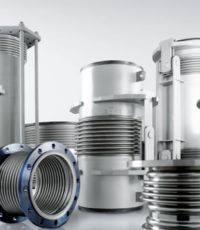
Every time someone brings up pipe systems staying intact, thoughts jump right to strength under pressure or what metals they’re made from. True enough, those matter a lot. Still, heat making pipes grow gets ignored way too much – even though that growth splits flanges, breaks nozzles, ruins seals completely. Here’s how stretchy metal sleeves act like bendable links inside your setup, giving room when things swell. Finding good ones across India? That part needs careful steps.
Steel Moves Because Physics Makes It
Start with the issue, not the gear. Heat makes things grow – that’s just how physics works. Pipes carrying hot stuff inside them? The tiny bits building the metal wake up, push outward, shift positions, stretch the whole thing longer without asking. Nothing can stop that..
Besides the change in length, piping systems are very complicated. They rarely move in a single direction.
If you exclude any of these three kinds of movement, your system is guaranteed to fail. It just seems to me that procurement departments only consider axial movement simply because it is the easiest to compute whereas real-world factors such as vibration and seismic displacement in Northern India make lateral and angular movement equally important.
A flexible, lightweight, thin corrugated element, the “convolutions” component is what an expansion below essentially is. It is the one that can withstand high pressure while also allowing different types of movements.
The answer to a simple thing is the main task. It must have a spring-like property. It is the bellows where the pipe gets hot and grows and hence they are compressed. When the temperature goes down, they expand back again. The bellows do this to keep the heat load from the fixed points or equipment nozzles.
Compressor and turbine are just two examples of the mechanical equipments producing high-frequency vibrations. The transfer of these vibrations through rigid piping will lead to fatigue failure. Acting as a vibration isolator, expansion bellows effectively break the vibration path to protect sensitive devices.
Let’s honestly talk about the fact that things are not always done perfectly in construction. There are instances when two pipe ends are not joined perfectly. Although an expansion bellow cannot be used as a patch for engineering flaws, it can provide a small margin of tolerance for minor misalignments, hence easing the stress on the joints.
There is quite a bit of difficulty in sourcing Expansion Bellows India due to the vast difference in quality. There are Tier-1 manufacturers, who have been certified by international regulatory bodies such as EJMA (Expansion Joint Manufacturers Association), on the other hand, we have smaller shops that just weld some corrugated sheet metal and hope it passes the quality checks. B2B transactions should no longer be based on the term “hope.”
Worth noting, corrosion troubles many industries across India.
As a procurement or engineering professional, you have to delve deeper than the advertising brochure. You have to probe the aspects of design and testing. To be frank, I have come across numerous projects that were delayed simply because the supposedly “cost-effective” joint broke during the hydro-test.
EJMA standards can be compared to the Bible in the world of expansion joints. These regulations specify the equations used to estimate the fatigue life and pressure-carrying capability of bellows. If a manufacturer in the Expansion Bellows India market does not demonstrate the EJMA calculations for your working conditions, then it’s better to stay away.
Fatigue Life As Unseen Factor
One thing lasts only so long – like a bellow. Its endurance goes by another name: cycle life. That term means how often it can extend and retract until wear sets in, leading to cracks. Think about building something meant to handle two thousand movements. Or maybe ten thousand. Picture operations start and stop all day, every day. Places like peak-power stations face that rhythm. They need tougher bellows. Steady refineries run without pause, so their parts endure less stress over time.
Squirm is a term that describes the scenario of bellows buckling under the influence of internal pressure. It is a nightmare only a few lucky ones can see. Typically, there are internal liners or external shrouds that a well-engineered joint is equipped with to prevent squirming from happening especially when dealing with high-pressure steam applications.
Expansion Bellows India supplier from which you get a top-quality component can be misconstrued by your site staff if they fail to implement it properly in which case the product will be needless to say, an extremely costly scrap.
It’s a recurring scenario I’ve witnessed: a worker uses the bellows to “pull” a pipe into line, or—what’s even worse—fails to remove the shipping bolts. As you know, shipping bolts are those brightly colored bars that keep bellows at the right length during transport. Keeping the bolts on during operation means that the bellows won’t be able to move. The pipe length increases, the bolts remain stiff, and either the pipe buckles or rips the anchor out of the concrete.
Key Installation Rules:
The L1 (Lowest Bidder) mindset is something that we find dominating B2B sectors in India quite often. I know well enough how much pressure you have to keep the CAPEX low. But with expansion joints, the cost of the component is so minor compared to the cost of a failure.
The main steam line of 24-inch in size at a power plant is an example to imagine. There, if one bellow fails, killing the steam suddenly, and unc[]n[]t[]ro[]l[]led discharge of high-pressure is the case. Production loss can be brought to the cutting of the entire unit. The price of a hundred bellows gets negated by the productivity loss and can be added to the cost of a failure if the bellows fail occurs in a production line that is still running.
Looking at cost alone misses what you actually pay over time. A closer look shows hidden expenses shape real value. What seems cheap today might cost more later.
Industries that have been identified as the engines of growth in India presently require piping solutions that are tailored to their individual needs.
We are engaged in colossal solar thermal initiatives and thus, our bellows requirements are for bellows that can sustain severe temperature differences such as day and night long. The joints are required to have a very high fatigue life since they are subject to a large number of cycles.
Along coastal areas, new LNG facilities are being built, which means more need for cryogenic bellows. These parts work where it’s minus 162 degrees Celsius. When it gets that cold, regular carbon steel loses toughness, snaps like glass. What holds up under such conditions? Stainless steel, cleaned following tight rules. Any leftover damp inside the folds of a bellow could turn to ice. Ice forms pressure.
A good manufacturer would inquire about your anchor points. They will ask for your piping ISOs so they can perform a movement verification. If a supplier only asks for pressure and diameter, they are not assisting you but rather paving the way for more problems.
In my opinion, one of the best decisions you can make is to bring in your bellows expert at the initial stage of the project. Let them not be the afterthought. For example, a slight change in the piping layout can result in the elimination of a universal joint that is complex and expensive which, in turn, means that a simpler, more robust axial below can be used.

© 2025 Crivva - Hosted by Airy Hosting Managed Website Hosting.