

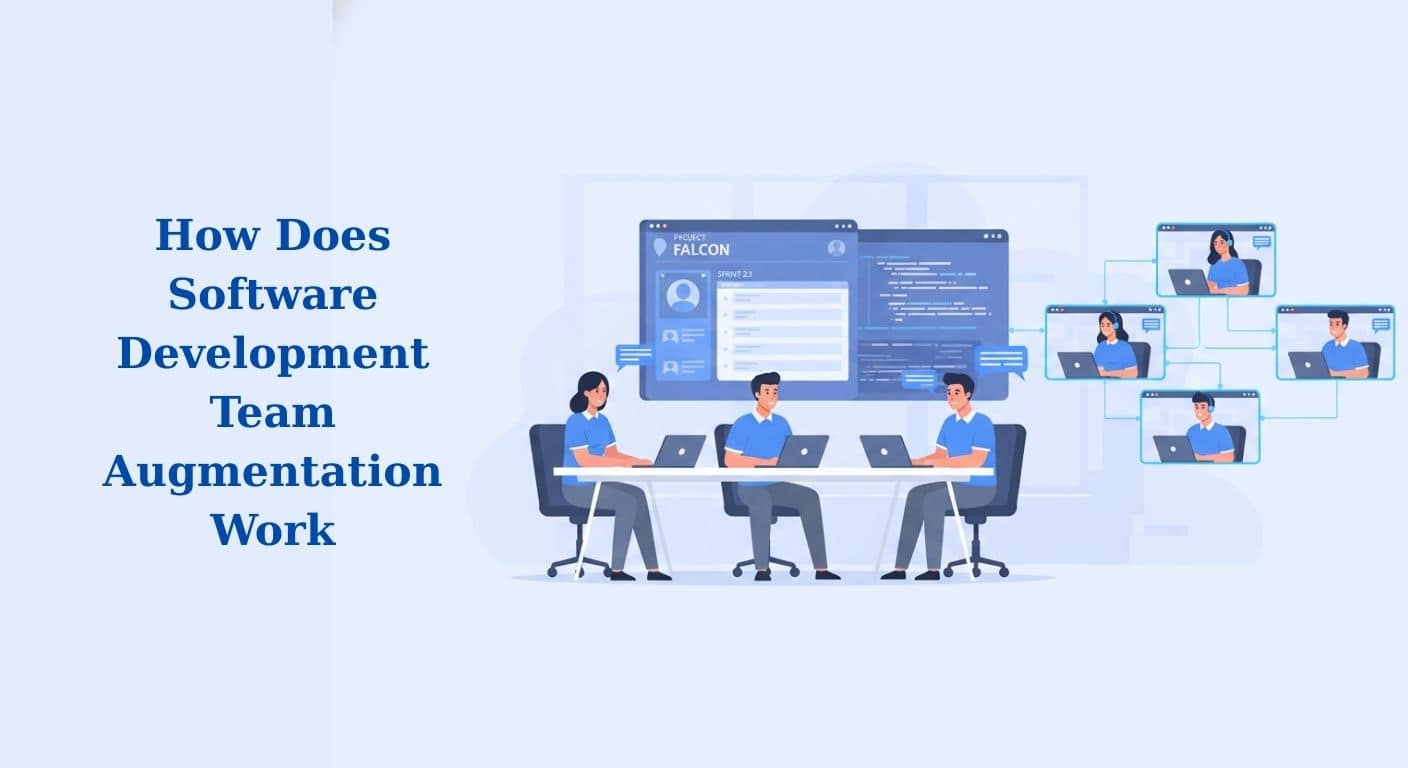
Team augmentation is a strategy that involves hiring external experts to support your team throughout the software development process. When you hire top software developers on contract, you boost the overall potential of your team and solve employee shortage problems without committing to full-time hiring.
This approach has become increasingly popular among businesses that need flexibility, faster delivery, and access to specialized technical skills. Instead of spending months recruiting full-time employees, companies can quickly scale their development capacity by adding experienced professionals exactly when they are needed.
If you were wondering exactly how team augmentation for software development works, this blog is for you. In this blog, we will explain how software development team augmentation works step by step, from identifying your needs to supporting developers after onboarding.
Software development team augmentation is a hiring model where businesses temporarily extend their in-house team by adding skilled external developers. These developers work as part of your existing team and follow your processes, tools, and management structure.
Unlike traditional outsourcing, where a third-party vendor takes complete ownership of the project, team augmentation allows you to retain full control. Your internal team leads the project while augmented developers contribute their expertise and capacity. This makes team augmentation ideal for companies that want flexibility without sacrificing quality or oversight.
Common reasons companies choose team augmentation include:
Shortage of skilled developers
Tight project deadlines
Need for expertise in specific technologies
Budget constraints for full-time hiring
Short-term or project-based workload increases
First, identify the gaps in your current developer team. Determine which skills your team lacks that you require, whether it is expertise in a specific technology or just more developers to deliver on time.
This step is critical because the success of team augmentation depends on how clearly your requirements are defined. You should evaluate your existing team’s strengths and identify areas where additional support is needed.
Key questions to consider at this stage include:
Which technologies or programming languages are missing?
Do you need frontend, backend, mobile, or full-stack developers?
Are you looking for senior-level expertise or additional execution capacity?
Is the requirement short-term or long-term?
A clear understanding of your needs helps ensure that the augmented developers can start contributing quickly and effectively.
Next, find a software development team augmentation service in the USA. Such agencies usually maintain a pool of skilled and pre-vetted developers across multiple technologies. Look for an agency that has proven experience in the type of project you are working on.
Choosing the right agency plays a major role in the success of team augmentation. A reliable agency does more than provide developers, it helps match the right talent to your specific technical and business requirements.
When selecting an agency, consider:
Industry and project experience
Availability of developers with relevant skills
Transparent engagement and pricing models
Communication practices and time zone alignment
Client reviews and past success stories
A strong agency partnership ensures smoother onboarding, better communication, and long-term project success.
Once you shortlist suitable candidates that meet your criteria, review each candidate’s profile and portfolio to determine how they fit your project. Conduct interviews to select the most suitable software developer. Test the candidate on the technology needed for your project, communication skills, and other important areas.
The selection process helps ensure that developers are not only technically competent but also capable of collaborating effectively with your internal team. Reviewing portfolios and past projects provides insight into their problem-solving approach and real-world experience.
During interviews, assess:
Technical expertise and coding standards
Experience with similar projects or industries
Communication and teamwork skills
Ability to work independently and meet deadlines
A rigorous interview process will allow you to eliminate incompetent candidates and save you training time in the future.
After a successful interview, integrate the new developers into your team. Integrate them into the current workflows, transfer essential company knowledge, and document.
Proper onboarding ensures that augmented developers can adapt quickly to your environment. Even experienced professionals need clarity around project goals, coding practices, and collaboration tools.
Effective integration includes:
Providing access to tools, repositories, and documentation
Introducing developers to team members and stakeholders
Sharing development workflows and quality standards
Clearly defining roles, responsibilities, and expectations
Well-structured onboarding reduces friction and helps new developers become productive faster.
Provide necessary support to the developer as long as they are working on your project. Sometimes, talented and experienced professionals also need guidance when they are in a new environment.
Ongoing support is essential to maintain productivity and alignment. Regular check-ins, clear feedback, and open communication help developers stay focused on project objectives.
Ways to support augmented developers include:
Assigning a dedicated point of contact
Conducting regular progress reviews
Encouraging collaboration with internal team members
Addressing challenges early to avoid delays
Providing consistent support ensures long-term success and better project outcomes.
Software development team augmentation offers several advantages:
Faster project delivery
Reduced recruitment and operational costs
Access to specialized technical skills
Flexibility to scale teams up or down
Improved development efficiency
This model allows businesses to stay agile while maintaining control over their development process.
Team augmentation is commonly used for:
Launching new software products
Adding features to existing applications
Migrating legacy systems
Handling peak workloads
Supporting long-term development initiatives
It is especially beneficial for startups and growing companies that need to scale quickly without long-term hiring commitments.
Staff augmentation for software is not only a quick strategy but also an approach that enables you to build agile, skilled teams. It allows businesses to fill skill gaps, meet deadlines, and adapt to changing project requirements without the burden of permanent hiring.
By clearly defining requirements, selecting the right agency, choosing qualified developers, integrating them effectively, and providing ongoing support, companies can successfully implement software development team augmentation.
If you are looking to hire developers for your project, you can contact Satva Softech. They specialise in helping businesses scale rapidly by providing skilled, experienced developers, making them one of the highest-rated software development agencies in the USA.

© 2025 Crivva - Hosted by Airy Hosting Managed Website Hosting.