


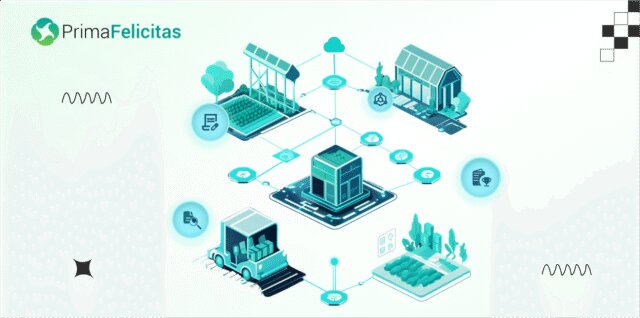
How Blockchain Technology Functions to Ensure Security?
Traditional financial databases and digital transaction systems pose various challenges when recording financial transactions, such as security vulnerabilities and a lack of transparency. This is where the role of blockchain technology becomes significant.
Systems built on blockchain act as a secure ledger. Each transaction is recorded in sequence in the form of a block, which expands to form a chain of blocks. Each block is secure using a cryptography mechanism to maintain integrity with all transaction records. This advanced database mechanism processes information faster and is ideal for financial systems. The blocks comprising the list of transitions are added to the chain only when they successfully meet decentralized consensus procedures.
Blockchain Technology: Core Components & Features that Help Build Secure Systems
Blockchain technology is designed to maintain security supported by components and features such as decentralisation, immutability, distributed consensus, cryptographic hashing, Traceability and more. Let’s explore how it functions–
Distributed Ledger
Blockchain is a shared, immutable ledger that facilitates the process of tracking digital assets and recording transactions. Once a transaction is added to the blockchain, it is unalterable. This ensures that the ledger is immutable and that there is a permanent record of all transactions.
The distributed ledger acts as the Single Source of Truth that enables real -time tracking by all participants on the network. Once the transaction is recorded on the ledger, it cannot be reversed or altered, thus ensuring transparency and accountability with payment tracking.
Decentralisation
Blockchain technology uses a decentralized network, which means that no central authority or organization controls the system. Instead, the network is made up of multiple nodes that work together to validate transactions and maintain the ledger.
Cryptographic Hashing
Cryptographic hashing is one of the most important elements of blockchain security. A hash function converts plain text data into a fixed-length string of characters known as a hash value or transaction ID.
For example, when a transaction occurs on the blockchain, the transaction details such as sender name, receiver address, timestamp, and transaction amount are converted into a unique hash value. Even a small change in the data (like changing one letter) will completely change the hash value. This makes tampering almost impossible.
Blockchain uses strong cryptographic algorithms like SHA-256 (used in Bitcoin) to ensure data security. Each transaction is digitally signed using a private key, and the signature is verified using a public key. This ensures:
Only the rightful owner can authorize a transaction
The data cannot be altered without detection
The transaction remains secure and verifiable
Consensus Mechanism
A blockchain network is decentralized, meaning no single authority controls it. Instead, transactions are validated through a consensus mechanism.
A consensus mechanism ensures that all participants (nodes) agree on the validity of transactions before they are added to the blockchain. This prevents double-spending and fraudulent activities.
Different blockchain platforms use different consensus models, such as:
Proof of Work (PoW)
Proof of Stake (PoS)
Delegated Proof of Stake (DPoS)
Regardless of the method used, the main goal is to achieve agreement across the network while maintaining security and integrity.
Hashing Process in Block Creation
When multiple transactions occur, they are grouped together to form a block. Before being added to the blockchain:
Transactions are verified.
Verified transactions are grouped into a block.
The block data is converted into a hash value.
Each block contains:
Its own hash value
The hash value of the previous block
This creates a chain-like structure called the blockchain. If someone tries to alter a previous block, its hash changes, which breaks the chain and alerts the network.
Proof of Work (PoW)
Proof of Work is a consensus mechanism used in networks like Bitcoin. In this process:
Miners pick up the block’s hash value.
They solve complex mathematical problems using computational power.
When a miner finds the correct solution, they generate a valid hash.
This hash must match the required difficulty level and link correctly to the previous block’s hash.
Once verified by other network participants, the block is added to the blockchain. Because solving these problems requires massive computational effort, it becomes extremely expensive and difficult for attackers to manipulate the system.
Smart Contracts
Smart contracts are self-executing programs stored on the blockchain. On platforms like Ethereum, they are commonly written in Solidity.
Smart contracts automatically execute predefined actions when certain conditions are met. For example:
Automatically releasing payment when goods are delivered
Executing financial agreements without intermediaries
Once deployed, smart contracts cannot be edited or altered. This ensures trust, automation, and transparency in decentralized applications (DeFi, NFTs, supply chain systems, etc.).
Transparency
One of the most powerful features of blockchain is transparency. Every participant in the network can view the transaction history stored on the ledger.
Key benefits of transparency include:
Real-time transaction visibility
Reduced corruption
Increased stakeholder trust
Improved operational clarity
Since the ledger is distributed across multiple nodes, it becomes nearly impossible for bad actors to secretly manipulate data.
Accountability
Blockchain provides a clear and traceable transaction history. Every action is recorded permanently and can be audited at any time.
This ensures:
Easy auditing
Prevention of counterfeiting
Fraud detection
Clear ownership tracking
If suspicious activity occurs, it can be traced back to its source, increasing accountability among participants.
Data Integrity
Data integrity is one of blockchain’s strongest advantages. Once data is added to the blockchain:
It cannot be edited
It cannot be deleted
It cannot be overwritten
Any attempt to modify the data automatically changes the hash value, alerting the entire network. This immutability ensures the highest level of data protection and reliability.
Secure blockchain systems find applications across industries like–
Investing early in blockchain technology is the best way to unlock new opportunities with secure digital innovation. It enables organizations to add trust through transparency in a decentralized environment. As digital ecosystems expand, early adopters are in a better position to stay competitive and support transformation with the successful implementation of blockchain systems
Overall, blockchain technology is designed to provide a secure and trustworthy way to transfer and store digital assets. Its decentralized nature, along with the utility of cryptography, consensus mechanism, immutable ledger, and transparency, work together to ensure that the network is secure.
Blockchain systems are already revolutionizing several industries such as financial services, supply chain, food and hospitality, real estate, and more.
Market leaders across the globe are adopting blockchain technology to outperform the competition.
Build a secure and scalable blockchain solution. Collaborate with trusted partners for end-to-end blockchain solutions development. Connect with PrimaFelicitas, a premier blockchain development company that can help you harness the power of blockchain technology.

© 2025 Crivva - Hosted by Airy Hosting Managed Website Hosting.