

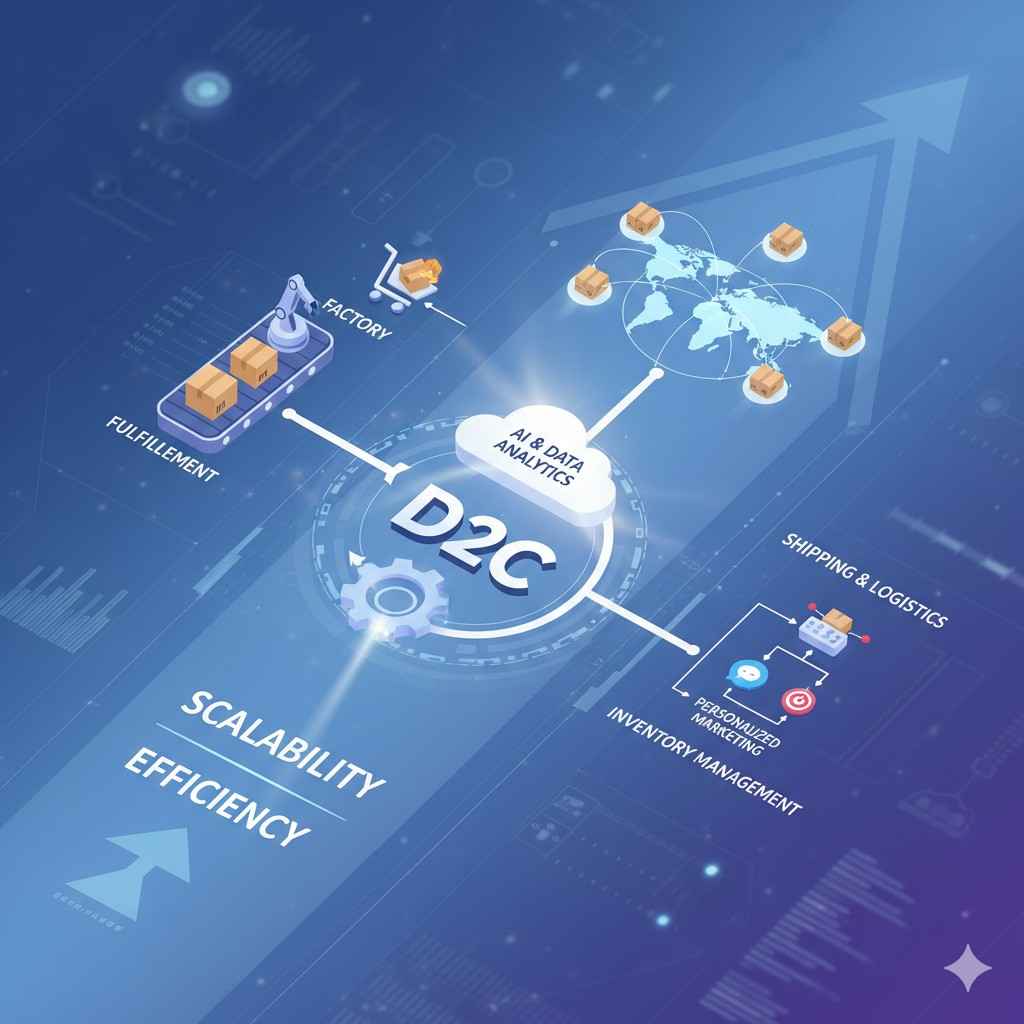
The Direct-to-Consumer (D2C) model has transformed how brands interact with customers. By selling directly through online channels, brands maintain control over product presentation, pricing, and customer experience. However, with growth comes complexity—more product listings, rising order volumes, expanding customer inquiries, and increasing fulfillment needs. Managing all of this manually can quickly overwhelm a small team.
Traditionally, the next step would be to hire more staff. But scaling through hiring alone increases operational costs and introduces management challenges. Instead, D2C brands are increasingly turning to automation to expand their capabilities without expanding their headcount.
In the early stages, handling tasks manually—like updating product listings, processing orders, and responding to customer queries—may work. But as demand grows, these manual workflows become slow and vulnerable to errors.
Brands often face issues such as:
These issues compound as order volumes rise. Hiring can offer temporary relief, but also requires additional training, onboarding time, and administrative oversight—none of which directly drive revenue.
Automation solves these problems by replacing repetitive, manual tasks with self-running workflows that operate reliably at scale.
Automation allows teams to remain lean while operating like a larger organization. Key areas where D2C brands benefit include:
Order management is one of the most resource-intensive parts of D2C operations. If done manually, errors and delays are almost guaranteed. Automation centralizes order processing and reduces manual handling by:
This ensures that even during high-volume seasons, order processing remains smooth without additional staffing.
Inventory accuracy directly affects customer trust. Automation helps prevent overselling or running out of stock by:
This creates a consistent shopping experience and reduces customer complaints.
Engaging customers consistently is challenging when handled manually. Marketing automation enables brands to deliver personalized communication at scale, including:
These targeted messages improve conversion and loyalty—without increasing marketing team size.
For brands collaborating with suppliers or multiple sales channels, managing product data can be time-consuming. A Seller Management System helps streamline catalog updates, pricing control, and seller performance tracking. This ensures product information stays accurate, consistent, and compliant across platforms, without endless manual adjustments.
Growth produces data—but data is only useful when it is organized and accessible. Automation centralizes insights from different systems, enabling brands to:
Instead of reacting to problems, brands make proactive decisions that guide sustainable growth.
Scaling through automation provides long-term benefits such as:
This allows teams to focus on value-adding work—product improvement, brand storytelling, customer relationships—rather than operational overload.
As D2C brands expand into multiple sales channels—such as marketplaces, social commerce, and their own online store—the operational workload increases significantly. Each channel has its own product upload rules, pricing guidelines, and order processing timelines. Without automation, teams often end up duplicating work and manually updating each channel, which is time-consuming and prone to mistakes. Automation centralizes multi-channel workflows, ensuring consistency and reducing manual labor while enabling brands to scale across platforms smoothly.
Another area where automation delivers value is in post-purchase experience, which has a major impact on customer loyalty and repeat sales. Automated delivery updates, scheduled follow-ups, NPS or feedback surveys, and proactive support workflows ensure customers feel supported throughout their journey. Instead of chasing customer queries manually, the brand can rely on an automated system to provide timely updates and flag issues early—reducing support tickets and building customer trust.
Automation also helps internal teams work more efficiently by removing repetitive, low-value tasks. When data entry, report creation, catalog management, and order routing are automated, teams can focus on strategic priorities—like new product development, brand campaigns, and improving the customer experience. This shift from operational workload to value-driven work allows brands to grow faster without increasing their workforce, enabling lean teams to deliver high performance at scale.
For D2C brands aiming to scale, automation is not just a productivity tool—it is a strategic foundation for sustainable growth. By streamlining order management, inventory synchronization, marketing engagement, seller coordination, and data analysis, brands can expand seamlessly without needing to hire additional staff.
In a competitive digital commerce landscape, the brands that scale intelligently—not just quickly—are the ones positioned to succeed. Automation gives D2C businesses the capacity to grow efficiently, maintain quality, and deliver exceptional customer experiences at every stage of expansion.
Scaling also means accommodating higher order volumes without delays or errors. When order volumes surge—during festive seasons, influencer campaigns, or product launches—manual coordination often breaks down. Automation ensures that every new order is instantly validated, routed to the correct warehouse or fulfillment partner, and processed without human intervention. This reduces dispatch delays and prevents inventory overselling, protecting both customer experience and brand credibility.
Moreover, automation provides real-time visibility across operations, enabling better and faster decision-making. When leaders have instant access to insights such as best-selling products, low-stock alerts, return reasons, and customer purchase patterns, they can adapt strategies quickly. Instead of waiting for weekly or monthly reports, they can take proactive actions like restocking fast-moving items or optimizing product bundles. This intelligence-driven approach ensures the brand stays agile and competitive—even as growth accelerates.

© 2025 Crivva - Hosted by Airy Hosting Managed Website Hosting.