

Our largest client — a relationship I had personally built over six years — sent a formal notice that they were opening a vendor review process. Not because our work was poor. Not because our pricing was high. Because their procurement team had flagged our client portal as a security liability during a routine audit. The portal ran on a framework that had not received a security patch in over two years. Their compliance department would not approve renewal without remediation.
I had seventy-two days to fix a system that had taken four years to build — or lose a contract worth roughly $420,000 annually.
That Friday evening I did what I should have done three years earlier. I started looking for a modernization partner who could move fast without making things worse. What I found surprised me. The modernization landscape had changed so fundamentally that the project I had been dreading — the one I kept pushing off because it seemed too big, too costly, too disruptive — was not what I expected at all.
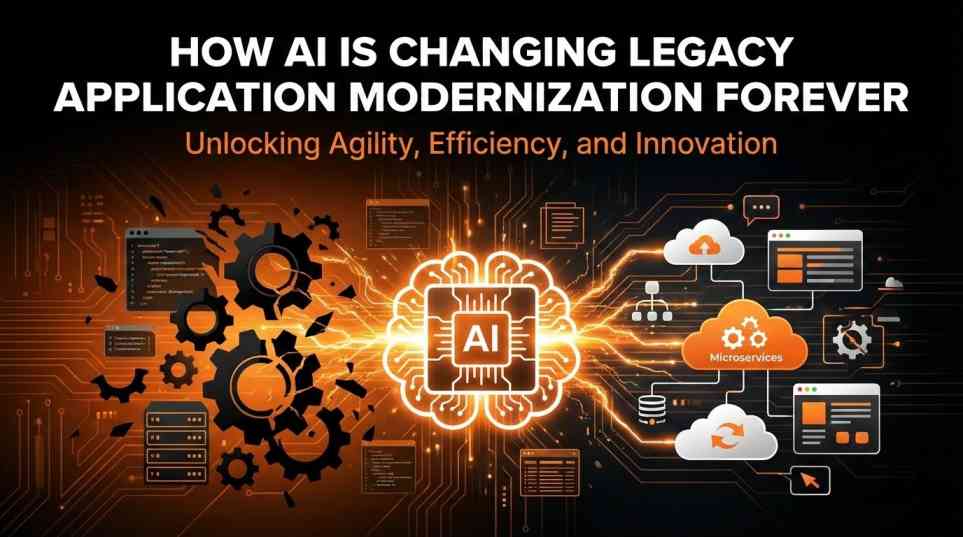
AI had changed everything. And the legacy system modernization services I engaged delivered something I had been told was impossible: a completed portal modernization in under ten weeks, with zero downtime, under budget, and in time to satisfy my client’s compliance deadline.
Here is exactly how that happened.
My wake-up call came from a client. Yours might come from a regulator, a security breach, or a system failure during your busiest period. The trigger varies. The underlying reality does not.
Most organizations spend 60 to 80 percent of IT budgets maintaining legacy systems. Eighty-seven percent run software with known exploitable vulnerabilities — the exact kind of finding that triggered my client’s audit flag. The developers who understand aging codebases retire at roughly 10 percent annually. And enforcement of the EU AI Act beginning August 2026 is adding governance requirements that legacy architectures simply cannot meet.
You may not have received your Friday afternoon email yet. But the conditions that generate it are already present in your systems. The question is whether you address them proactively or reactively. The cost difference between those two options is significant
I did not have the luxury of an eighteen-month timeline. I had seventy-two days. Here is what AI-powered modernization delivered under that constraint.
Complete system understanding in eight days. AI discovery tools mapped our portal’s entire architecture — every dependency, every data flow, every integration with our internal systems. They found that the portal was connected to our invoicing engine, our project management tool, and our document storage through five separate integrations. Two of those had been configured by a freelance developer in 2020 who had since moved abroad. No documentation existed for either one. Finding those connections in eight days would have been impossible through manual review. It would have taken months.
Targeted migration in seven weeks. Generative AI handled the code translation — converting our portal from its outdated framework to a modern, security-patched architecture. The human engineers focused on the decisions AI could not make: which security protocols to implement, how to restructure the authentication flow, where to optimize performance. The division of labor was clean. AI did volume. Humans did judgment.
Validation that caught what we never would have. AI testing tools generated over 1,800 test scenarios. One of them discovered that our portal was not properly expiring session tokens for users who navigated away without logging out — a vulnerability that had existed since the portal launched. Another caught a timezone handling error that caused document timestamps to display incorrectly for clients in Pacific time zones. Both issues would have survived a manual testing phase because nobody would have thought to check for them.
AI maps the technical environment in days. But also talk to your staff. Our project coordinator mentioned that she manually resent automated client notifications every Monday because “about a third of them just do not go through.” That failure had been accepted as normal for over a year. It turned out to be a configuration error in how the portal connected to our email service — fixable in hours once identified, invisible for months because nobody escalated it.
Beyond hosting and licensing — include emergency support, workaround labor, compliance exposure, and revenue at risk. My $420,000 client relationship was not on any IT risk register. It should have been. A swimming pool maintenance company I know completed this analysis and discovered their legacy scheduling platform cost $6,800 per month when all hidden expenses were included. Their operations manager put it plainly: “That is a full-time technician we are paying to not exist.”
I did not have the option to start with whatever was easiest. I had to start with the system a $420,000 client had flagged. That urgency turned out to be the right framework even without a deadline. The system that threatens your most important relationships or your largest revenue streams should always go first. An independent optometry practice made the same choice — modernizing their patient records and insurance billing system before their internal scheduling tool. Within two months, claim rejection rates dropped from 12 percent to under 2 percent. That alone covered the modernization cost.
Seven weeks for our portal. AI handled translation and testing. Engineers handled architecture and security. Every component validated individually before integration. Every milestone documented and reviewed. Speed without discipline is recklessness. Speed with discipline is what AI makes possible.
We ran both portals simultaneously for sixteen days. AI tools compared every page render, every data call, every session behavior. They caught the session token issue and the timezone error before any client encountered them. My compliance team reviewed the parallel testing results and approved the transition without a single objection. My client’s procurement team received the security remediation documentation on day sixty-one. Eleven days ahead of deadline.
Real-time monitoring. Automated security scanning. Quarterly performance reviews. A dedicated documentation owner — not a shared responsibility that belongs to everyone and therefore no one. Our portal has been running for eight months without a security flag, an unplanned outage, or a single client complaint related to system performance. My $420,000 client renewed. Without a vendor review process this time.
Systems that pass compliance audits instead of triggering them. Client experiences that reinforce trust instead of undermining it. Maintenance costs that drop 30 to 40 percent. Development timelines measured in weeks. A technology foundation that supports growth instead of constraining it. And the ability to respond to a Friday afternoon email with confidence instead of panic.
Phased modernization means you are never overexposed. One system at a time. Results validated before the next commitment. ROI within twelve to eighteen months for most organizations. Legacy systems running in parallel as a safety net throughout. Full rollback capability at every stage.
The financial risk of modernization is manageable and predictable. The financial risk of another compliance flag, another lost client, or another security vulnerability is neither.
Sparkout Tech operates with the urgency and discipline this kind of work demands. AI-powered discovery, business-aligned prioritization, phased execution with continuous validation, and sustained support after launch.
Their legacy application modernization services are designed for organizations facing real deadlines and real consequences — not theoretical modernization exercises. Whether you have seventy-two days or twelve months, their methodology scales to the timeline without sacrificing thoroughness.
Get a complimentary assessment from Sparkout Tech. A clear evaluation of your systems, your risk exposure, and your modernization options — with no obligations and no extended proposals.
My email arrived at 4:47 on a Friday. I had seventy-two days. I made it with eleven to spare — but only because the tools and the team available in 2026 made it possible.
You have the advantage of choosing when to start. That advantage has an expiration date. Use it while the choice is still yours.

© 2025 Crivva - Hosted by Airy Hosting Managed Website Hosting.