

India’s chemical manufacturing sector has expanded rapidly over the past decade. New production capacities in Gujarat, Maharashtra, and Andhra Pradesh have established the country as a serious global player in specialty chemicals, agrochemicals, and pharmaceutical intermediates. With that growth, however, has come a set of operational and environmental challenges that many facilities are still working to address systematically.
Among the most pressing of these is halogen gas management – specifically the handling, containment, and recovery of gases like hydrogen chloride and bromine that are generated as byproducts in a wide range of chemical synthesis processes.
These aren’t minor housekeeping issues. Uncontrolled halogen gas emissions create serious worker safety risks, contribute to atmospheric pollution, and increasingly attract regulatory attention from the Central Pollution Control Board and state-level environmental agencies. For plant operators, getting this right has moved from a compliance checkbox to a genuine operational priority.
Hydrogen chloride gas is generated in several common industrial chemistry scenarios. Chlorination reactions – widely used in pharmaceutical intermediate synthesis, agrochemical production, and PVC manufacturing – produce HCl as a reaction byproduct. So do certain condensation reactions, acid-catalyzed processes, and operations involving chlorinated solvents at elevated temperatures.
Bromine-related gases arise in bromination processes used to make flame retardants, pharmaceutical compounds, and specialty chemicals. Elemental bromine and hydrogen bromide are both volatile and hazardous, and their behavior in production environments requires careful management to prevent atmospheric release.
In both cases, the chemical plant isn’t generating these gases intentionally – they’re the consequence of useful chemistry happening elsewhere in the process. The question isn’t whether they’ll appear, but what happens to them when they do. How a facility answers that question has direct consequences for safety, compliance, and operating economics.
Most plant managers are aware of their halogen gas streams. They know which reactors generate HCl, which process lines produce bromine-containing off-gases, and roughly what volumes are involved. The awareness isn’t the problem.
The gap is typically in the infrastructure to manage those streams systematically rather than reactively.
Reactive management looks like this: gas is released into a scrubbing system sized for average conditions rather than peak loads, the scrubber runs with inconsistent liquid flow rates, and emissions during process upsets go partially untreated because the system isn’t designed for variability. The facility stays within permit limits most of the time, but process efficiency suffers and the risk of exceedances during high-load periods remains real.
Systematic management looks different. The gas generation profile of each contributing process is characterized. The containment and treatment infrastructure is sized for actual peak loads with appropriate safety margins. And wherever possible, the captured gas is converted into a recoverable or saleable product rather than simply neutralized and discarded.
This shift – from treating halogen off-gases as a waste management problem to treating them as a recoverable resource – is where the more forward-thinking facilities in India’s chemical sector are moving.
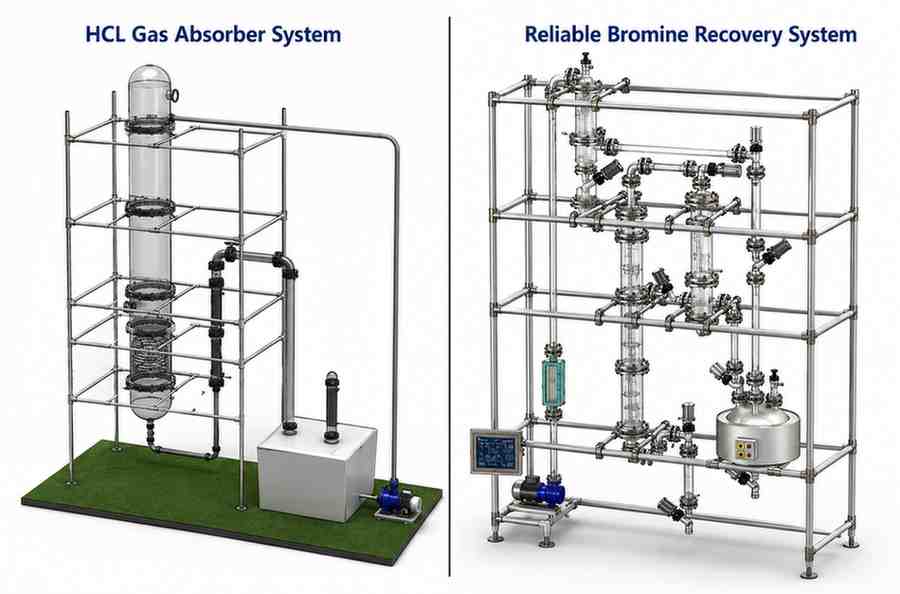
For hydrogen chloride specifically, the gas can be absorbed into water to produce hydrochloric acid – a commercially useful product that can be sold, reused in other plant processes, or used for pH adjustment in effluent treatment. The economics of this depend on the concentration and purity of the HCl stream and the local market for hydrochloric acid, but for facilities generating significant volumes, the absorption approach converts a waste stream into a revenue or cost-offset opportunity.
The quality of that conversion depends on the absorption system. A well-designed system for absorption hcl captures gas efficiently across variable flow rates, produces acid at consistent concentration, and handles the temperature management that HCl absorption generates. Systems that aren’t properly designed for these variables produce dilute or inconsistent acid product and may allow breakthrough during concentration spikes.
For bromine recovery, the logic is similar but the chemistry is different. Bromine is expensive – significantly more so than hydrochloric acid on a per-kilogram basis – which means recovery has a strong economic case independent of environmental considerations. A bromine recovery plant that recaptures elemental bromine from process off-gases and returns it to production can meaningfully reduce raw material costs for operations that use bromine at meaningful scale. For facilities running continuous bromination campaigns, the cumulative value of recovered material across a full production year is substantial.
India’s environmental regulatory framework for chemical manufacturing has been tightening progressively. The shift from general emission standards toward process-specific and sector-specific norms has increased the scrutiny on halogen gas management in particular.
For chlorine and HCl, the standards specify both ambient air quality limits near facility boundaries and stack emission concentrations. For bromine-containing emissions, regulatory interest has grown as brominated compounds have attracted attention in environmental monitoring programs.
The facilities that will be well-positioned as these standards continue to tighten are the ones building proper gas management infrastructure now – not waiting until a compliance notice forces a reactive response under time pressure.
Beyond compliance, there’s the practical reality of insurance and financing. Environmental risk assessment has become a standard part of industrial finance and insurance underwriting in India. Facilities with documented, functional gas management systems present a materially different risk profile than those relying on informal or undersized treatment arrangements.
If your facility generates hydrogen chloride or bromine off-gases and your current management approach is primarily reactive, the place to start is a systematic characterization of your gas streams – volume, concentration, variability, and timing relative to production cycles.
That characterization tells you what you’re actually dealing with, which is necessary before any infrastructure decision makes sense. Facilities that skip this step often invest in systems sized for average conditions that fail during peaks, or invest in recovery infrastructure before understanding whether their stream quality is suitable for the recovered product.
The investment case for proper halogen gas management has never been stronger, because the cost of the alternative – reactive compliance, inconsistent emissions, and foregone recovery value – keeps rising. The direction of regulation, disposal costs, and raw material prices all point the same way. Facilities that treat halogen gas management as a strategic operational decision rather than a reactive compliance obligation are the ones building the most durable long-term advantage.

© 2025 Crivva - Hosted by Airy Hosting Managed Website Hosting.