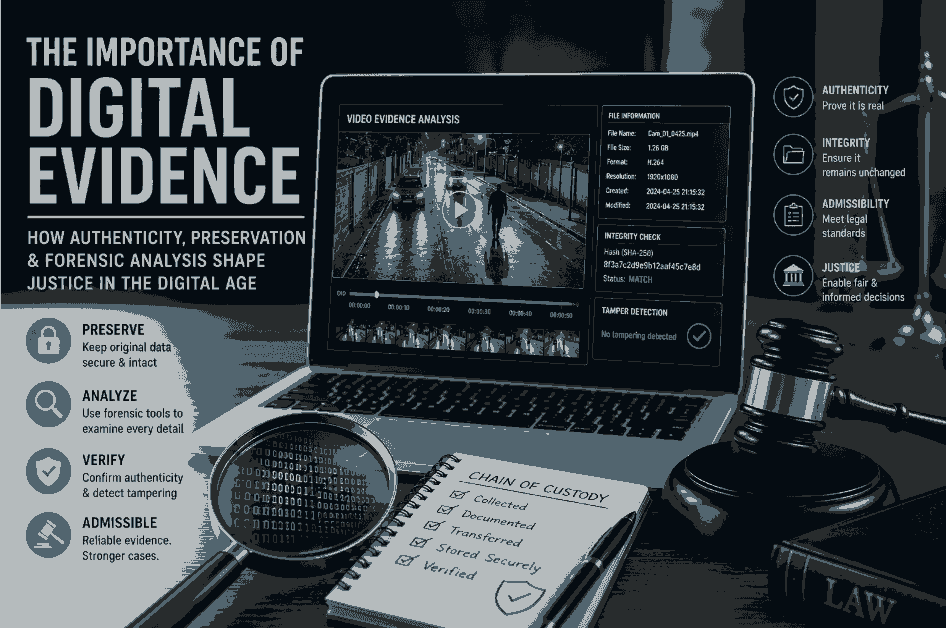
Digital evidence has transformed the way investigations are conducted across the world. From CCTV footage and mobile phone recordings to emails, surveillance systems, cloud storage, and instant messaging platforms, electronic records now play a central role in criminal investigations, corporate disputes, insurance claims, and civil litigation.
Unlike traditional evidence, digital information is extremely easy to copy, modify, or distribute. A video can be edited in minutes, timestamps can be changed, and metadata may be altered without affecting what appears on the screen. This creates an important challenge for investigators and legal professionals. Before digital evidence can support a legal argument, they must establish that it is authentic and has remained unchanged since it was originally created.
Understanding how digital evidence is collected, preserved, and verified has therefore become essential not only for forensic professionals but also for lawyers, businesses, law enforcement agencies, compliance officers, and even ordinary individuals.
Many people assume that if a video clearly shows an event, it will automatically be accepted as proof. Unfortunately, digital investigations are rarely that straightforward.
Every electronic file contains two layers of information. The first is the visible content that people watch or read. The second is hidden technical information that tells the story of the file itself. This includes when it was created, what device generated it, whether it has been modified, and sometimes even where it originated.
Investigators pay close attention to this technical information because it often reveals facts that cannot be identified simply by watching a recording.
For example, a surveillance video may appear completely genuine. However, if forensic analysis shows that the recording was modified after its creation, its credibility may immediately be questioned.
Collecting evidence is only the beginning of an investigation. Preserving it correctly is equally important.
Digital files should always remain in their original form whenever possible. Converting a surveillance recording into another format, editing its brightness, trimming unnecessary sections, or using third-party software may unintentionally modify important forensic information.
These changes are not always visible to the human eye, but they can affect the digital characteristics that investigators rely upon during examination.
For this reason, organizations often establish evidence preservation procedures immediately after an incident occurs. Original files are securely copied, protected from modification, and documented throughout every stage of the investigation.
This process helps ensure that investigators can later demonstrate that the evidence remained unchanged.
Every electronic file possesses characteristics that make it unique.
One of the most widely used verification methods is cryptographic hashing. A hash value acts like a digital fingerprint for a file. Even the smallest modification, such as changing a single frame or adjusting a few pixels, creates an entirely different hash value.
Investigators generate hash values when evidence is first collected and compare them throughout the investigation. Matching values provide confidence that the file has remained intact.
Although hash verification cannot explain why a file changed, it immediately alerts investigators that some alteration has occurred.
Because of its reliability, hash verification has become a standard practice in digital forensic examinations around the world.
Metadata is often described as “data about data.”
Most digital files contain information that users never normally see. Depending on the recording device, metadata may include:
This information helps investigators reconstruct events surrounding the evidence.
For example, if someone claims that a recording was captured directly from a CCTV system, metadata may confirm whether the file originated from that surveillance device or whether it was exported using another application at a later date.
Such details can become extremely valuable during legal proceedings.
Visual inspection alone is rarely sufficient when determining whether a digital recording is authentic.
Modern forensic software performs highly detailed examinations that include frame-by-frame analysis, compression evaluation, codec inspection, and detection of inconsistencies introduced during editing.
Sophisticated editing software can remove objects, combine clips, insert artificial audio, or manipulate timelines while leaving very little visible evidence behind.
Fortunately, forensic analysis focuses on technical characteristics that are much harder to conceal.
Investigators therefore rely on scientific examination instead of assumptions based solely on appearance.
Digital evidence often passes through several hands before reaching a courtroom.
It may be collected by security personnel, transferred to investigators, reviewed by forensic specialists, and eventually submitted during legal proceedings.
Each transfer must be carefully documented.
This documentation, commonly known as the chain of custody, records who handled the evidence, when it was transferred, how it was stored, and whether any authorized examination took place.
Without this documented history, questions may arise regarding the integrity of the evidence.
Even genuine recordings can become difficult to defend if investigators cannot explain exactly how the evidence was managed throughout the investigation.
Maintaining proper documentation therefore remains one of the most important responsibilities during evidence handling.
Recent advances in artificial intelligence have significantly increased the complexity of digital investigations.
AI-powered software can now generate highly realistic videos, replace faces, clone voices, and create convincing visual content within a short period of time.
These developments have made forensic verification more important than ever before.
Investigators now examine lighting consistency, facial movements, audio characteristics, compression signatures, and numerous technical indicators when evaluating potentially manipulated recordings.
As AI technology continues to improve, forensic methodologies continue evolving to identify increasingly sophisticated forms of digital manipulation.
Most investigations involve multiple forms of electronic evidence rather than relying upon a single source.
Emails, cloud storage records, browser histories, chat applications, call logs, server logs, photographs, and system activity frequently help investigators establish complete timelines.
Among these, email evidence often provides critical communication history.
When technical examination of email messages becomes necessary, an Email Header Analyzer Tool helps investigators interpret routing paths, identify mail servers, verify sender information, and understand delivery details that remain hidden from ordinary users.
Combining multiple evidence sources often produces stronger investigative findings than relying upon a single recording alone.
Organizations can significantly improve the reliability of their investigations by following well-established forensic practices.
Some important recommendations include:
Following these practices helps reduce the possibility of accidental modification while improving confidence in the evidence.
Digital evidence is not limited to criminal investigations.
Businesses increasingly rely upon electronic records during internal investigations involving fraud, data theft, policy violations, intellectual property disputes, employee misconduct, cybersecurity incidents, and regulatory compliance.
Organizations that maintain proper evidence handling procedures are generally better prepared to respond when disputes arise.
Clear documentation and reliable forensic practices may save significant time, cost, and legal uncertainty during future investigations.
Technology continues to reshape modern legal systems.
As digital information becomes more common, professionals from many different industries benefit from understanding how electronic evidence is evaluated.
Lawyers need confidence that the evidence they present can withstand scrutiny.
Corporate investigators require procedures that preserve digital records.
Compliance professionals must ensure that organizational data remains trustworthy.
Individuals may also find themselves needing to preserve important electronic records following accidents, disputes, or cyber incidents.
Developing awareness of digital forensic principles helps everyone make better decisions when handling electronic information.
Readers interested in learning more about the legal standards governing electronic recordings can explore Admissibility of Tampered Video Evidence in Court, which provides a detailed explanation of how forensic verification, legal requirements, and evidence integrity influence whether digital video is accepted during judicial proceedings.
Electronic evidence has become one of the most valuable assets in modern investigations. However, its usefulness depends entirely upon its authenticity, integrity, and proper preservation.
A video, email, or digital document may appear convincing, but investigators must verify that it has remained unchanged from the moment it was created. Scientific examination, careful documentation, and secure evidence handling procedures provide the foundation for establishing that confidence.
As technology continues to evolve, digital investigations will become even more sophisticated. Organizations, investigators, legal professionals, and individuals who understand these principles will be better equipped to preserve reliable evidence, support accurate investigations, and contribute to fair legal outcomes.
Protecting digital evidence is ultimately about preserving trust. When electronic records remain authentic, properly documented, and scientifically verified, they become powerful tools for uncovering facts and supporting the pursuit of justice.

© 2025 Crivva - Hosted by Airy Hosting Managed Website Hosting.