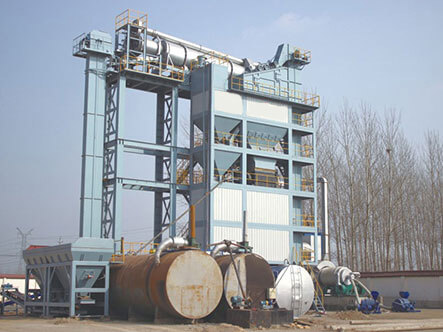
RAP is the core material of asphalt recycling equipment, which is mainly obtained from old asphalt pavement through milling, crushing, and other processing techniques.
To ensure the performance of recycled asphalt mixtures:
RAP must be kept dry and clean, and should not contain impurities such as base layer waste, debris, soil, etc.
The max. particle size of RAP should be less than the max. nominal particle size of the recycled asphalt mixture.
The asphalt content in RAP is an important indicator, as both excessively high and low asphalt content can affect the performance of recycled asphalt mixtures.
Based on the working principles, structural features, and recycling methods, asphalt recycling equipment can be primarily classified into hot recycling equipment and cold recycling equipment, stationary recycling equipment and mobile recycling equipment.
For large-scale projects, stationary hot recycling device can be prioritized to ensure the recycling effect. For small-scale/highly mobile projects, mobile cold recycling equipment is more suitable.
To prevent clumping and asphalt aging, RAP should be stacked on a flat, solid, and hard surface, and long-term stacking should be avoided.
Before use, RAP should undergo preprocessing steps such as crushing and screening to remove impurities and adjust the particle size distribution to meet the requirements of the recycled asphalt mixture. (Refer to the table below for specific details.)
Based on the working principles, structural features, and recycling methods, asphalt recycling equipment can be primarily classified into hot recycling equipment and cold recycling equipment, stationary recycling equipment and mobile recycling equipment.
For large-scale projects, stationary hot recycling device can be prioritized to ensure the recycling effect. For small-scale/highly mobile projects, mobile cold recycling equipment is more suitable.
Asphalt recycling equipment is a crucial technical tool for achieving the circular utilization of asphalt pavement materials. With the global increasingly emphasis on sustainable development and environmental protection, the development prospects of asphalt recycling equipment are extremely promising. Technological Breakthroughs
Researchers have successfully developed various efficient and environmentally friendly rejuvenators. These rejuvenators significantly enhance the performance of recycled asphalt, providing strong support for the recycling of asphalt pavements.
By incorporating advanced control systems and sensor technology, asphalt recycling equipment has achieved automated and precise production process control. This not only improves production efficiency but also reduces energy consumption and emissions.
New-generation flue gas treatment systems effectively remove harmful gases and dust generated during the recycling process, ensuring the environmental friendliness of the recycling operation.
As global investment in infrastructure construction and maintenance continues to increase, the demand for asphalt pavement repair and renovation is also growing strongly. This provides a vast market opportunity for asphalt recycling equipment. Especially in developing countries such as India and Southeast Asian nations in Asia, Nigeria and Kenya in Africa, and Brazil and Mexico in South America, the acceleration of urbanization and the continuous improvement of road networks will further promote the growth in demand for asphalt recycling equipment.
From a cost-benefit perspective, asphalt recycling equipment exhibits significant investment value, mainly in the following aspects:
RAP (Recycled Asphalt Pavement) can be recycled and utilized on or near the construction sites, which greatly reduced the related transportation expenses, lowered the overall project cost, and enhancing the construction efficiency.
The use of asphalt recycling equipment extends the service life of pavements, reduces the frequency of repair and maintenance, and consequently lowers the life cycle cost of roads. The accumulation of these long-term benefits further highlights the investment value of the equipment.
In the current market, products that are environmentally friendly, energy-efficient, and highly effective are highly preferred. Asphalt recycling equipment is one of the representative products that align with these market trends. Introducing this equipment can enhance the market competitiveness of business owners and project contractors, assisting them in expanding their market share.
The advantages of asphalt recycling plants are manifested in multiple aspects, including environmental protection, resource conservation, and operational costs.
Asphalt recycling plants significantly reduce the environmental pollution caused by waste asphalt pavement materials. By recycling and reusing recovered RAP (Recycled Asphalt Pavement), the accumulation and landfilling of large quantities of waste pavement materials are avoided, thereby minimizing the occupation and waste of land resources. Simultaneously, harmful gases and dust potentially generated during the recycling process are purified through the flue gas treatment system before being emitted, drastically reducing pollution to the atmosphere and water system.
Asphalt recycling plants enable effective resource conservation and circular utilization. Aged asphalt and aggregates in RAP, after undergoing recycling treatment, can be reapplied in the construction of asphalt pavements, substituting for the mining demand of some new asphalt and aggregates. This not only contributes to conserving limited natural resources but also reduces dependence on raw material markets, carrying profound strategic significance.
From the perspective of operational costs, asphalt recycling plants also demonstrate considerable economic benefits. Although their initial investment is relatively high, they can utilize RAP on-site for recycling production, eliminating the transportation and procurement costs of raw materials. Additionally, the production cost of recycled asphalt mixtures is typically lower than that of brand-new asphalt mixtures, further reducing the maintenance and repair costs of pavements. Over the long term, the comprehensive cost advantage of asphalt recycling plants will gradually become prominent.
Asphalt recycling equipment is a crucial technical tool for achieving the circular utilization of asphalt pavement materials. With the global increasingly emphasis on sustainable development and environmental protection, the development prospects of asphalt recycling equipment are extremely promising.
Researchers have successfully developed various efficient and environmentally friendly rejuvenators. These rejuvenators significantly enhance the performance of recycled asphalt, providing strong support for the recycling of asphalt pavements.
By incorporating advanced control systems and sensor technology, asphalt recycling equipment has achieved automated and precise production process control. This not only improves production efficiency but also reduces energy consumption and emissions.
New-generation flue gas treatment systems effectively remove harmful gases and dust generated during the recycling process, ensuring the environmental friendliness of the recycling operation.
Market Demand
As global investment in infrastructure construction and maintenance continues to increase, the demand for asphalt pavement repair and renovation is also growing strongly. This provides a vast market opportunity for asphalt recycling equipment. Especially in developing countries such as India and Southeast Asian nations in Asia, Nigeria and Kenya in Africa, and Brazil and Mexico in South America, the acceleration of urbanization and the continuous improvement of road networks will further promote the growth in demand for asphalt recycling equipment.

© 2025 Crivva - Hosted by Airy Hosting Managed Website Hosting.