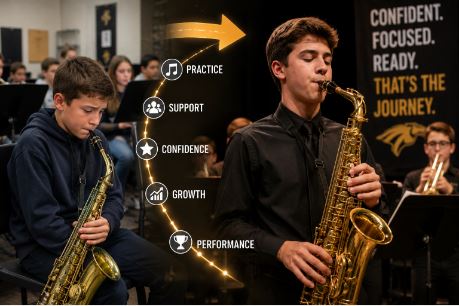
I remember this kid from years ago—let’s call him Marcus. He was a seventh grader who’d just picked up the saxophone. Super into it, practiced at home, showed up to every rehearsal. But the moment we had to play in front of anyone, and I mean anyone—even just the music teacher walking by—he’d lock up. His hands would shake. He’d miss notes he could play perfectly in a private lesson.
Fast forward to his senior year. That same kid was first chair, soloing at concerts, and talking about auditioning for college jazz programs.
That transformation doesn’t happen by accident. And it’s not something that only naturally talented kids experience. It’s something you can actually help create.
Let me be honest about where we’re starting. Middle school is rough. Your kids are dealing with body changes, social anxiety, hormones making everything feel like a catastrophe, and the overwhelming pressure of fitting in. Then you throw a demanding activity like band into the mix where they have to perform in front of people.
It’s a lot.
Some kids handle it fine. Some kids show up and act like they’re just there hanging out. But a surprising number of them are genuinely terrified. They’re comparing themselves to everyone else, convinced they’re the worst player, and absolutely certain that everyone’s judging them.
And here’s the thing: you can see it. The ones who are struggling with confidence are the ones who look down at their music stand during the concert. They’re the ones who play quieter when there’s an audience. They’re the ones who ask to sit in the back where nobody can hear them.
You know who I’m talking about. You probably have three or four in your band right now.
The biggest mistake we make as directors is thinking we can shame or encourage kids out of being nervous. Like if we just tell them to be confident, suddenly they will be. That’s not how it works.
Confidence for a middle school kid isn’t this magical thing they either have or don’t have. It’s built. And it’s built through small wins, repetition, and actually feeling competent.
So here’s where you start: make sure they can actually play their part. I mean really play it. Not fumble through it. This sounds obvious, but you’d be amazed how many kids are sitting in your band who haven’t actually mastered their part because they fell behind early on and got embarrassed about asking for help.
Schedule individual meetings with these kids. Keep them short—ten minutes. Just you and them in a practice room. Have them play their part for you. Find the spot that’s giving them trouble. Work on it together. Then have them play the whole thing again so they leave that room knowing they just played it correctly.
That single experience changes something in their head. They walked in thinking “I can’t do this.” They walked out having done it.
Here’s a secret weapon that most directors don’t use enough: tiny solos.
Not the big flashy solos. I’m talking about the moment in rehearsal where you say, “Okay, just the clarinets on this line. Let me hear you.” Or “Saxophones, I want to hear your section on this measure.” Two measures. Eight counts. That’s enough.
What happens is they get used to being heard. They realize it’s not actually scary. They learn what their voice sounds like within the ensemble. And it removes the mystique of “soloing” from being this huge terrifying thing that only happens at concerts.
I had a trombone section years ago where I’d do these little section calls every single rehearsal. Nothing fancy. Just making sure each person’s voice could be heard on a section solo. By the time we got to concert season, they weren’t nervous about standing up and playing in front of people because we’d been doing it in rehearsal for months.
This is huge. Kids need to see that playing a wrong note is not a tragedy. It’s not a reflection on who they are as a person. It’s just something that happened.
When I’m rehearsing, if someone makes a mistake, I point it out, we fix it, and we move on. I don’t stop and shame them. I don’t sigh and look disappointed. I just treat it like the small thing it actually is. Gradually, your kids start learning that mistakes aren’t the end of the world.
Then take it a step further. Have them solo during rehearsal and deliberately make a mistake. Let them recover. This sounds weird, but it works. They need to practice what it feels like to mess up in front of people and keep going.
I remember this one girl who was absolutely petrified of solos. So I had her play a solo during rehearsal, and I intentionally had her mess up a note. Then I said, “Keep going.” She did. She finished the solo. And something just clicked for her. She realized she could recover.
The next concert, she flew through her solo. No nervousness. She’d already lived through the worst-case scenario and been fine.
Here’s something I notice with confident performers: they’re usually the ones who feel like what they’re doing actually matters. Like their part makes a difference.
So tell them specifically. Don’t just say “nice job.” Say “Hey, that section solo you did? That line was what made that transition work. Without you, that whole passage would’ve fallen apart.” Make them understand that they’re not just note-readers. They’re part of making something real happen.
For the kids who are still building confidence, pick a part where they can genuinely contribute something. Maybe it’s not a major melody line. Maybe it’s a counter-melody or a bass line or keeping the rhythm solid. But make sure they know why their specific part matters and what they’re responsible for making happen.
Kids will walk through fire if they feel like it actually means something.
Building confidence isn’t a quick fix. It’s something you’re working on the entire year, the entire time they’re in your program. It’s the reason why middle school is so important—because these early experiences either build their confidence or crush it for years.
Some of your kids will naturally come out of their shells. Some will still be working on it at graduation. That’s okay. You’re not trying to make everyone an extrovert. You’re just helping them get to a place where they can do their best without being paralyzed by fear.
The coolest part is watching it happen. You’ll have a kid who could barely play a solo in front of ten people sophomore year standing on stage senior year performing something beautiful in front of hundreds of people. They’ll have this confidence in their posture, in how they play, in how they present themselves.
That’s the transformation. And you made that happen.
If you’re really focused on building a culture where every kid feels like they can develop confidence and grow as a performer, sometimes it helps to have outside perspective on your rehearsal structure and performance approach. Looking at how you’re organizing your ensembles, selecting material, and building progression—that’s something a music education consultant can help you think through.
Resources like Dr. Ward Miller’s music education consulting focus on this exact thing: designing band programs that actually develop students, not just get through the material. Having someone who specializes in this help you structure your program for student growth can make a huge difference in how many kids actually develop that confidence and stick with music.
Marcus became that confident performer because someone—hopefully me, but maybe multiple people in his musical journey—believed he could do it and gave him the tools and the safe space to try.
Your middle school band kids are sitting in your class right now, scared, uncertain, wondering if they can do this. Some of them will become your most confident performers. Some of them will walk away from music. The difference often comes down to whether they felt safe enough to try.
Make that space for them. Build those small wins. Celebrate their growth. And watch what happens when a scared seventh grader turns into a confident musician.
That’s the real payoff of this job.

© 2025 Crivva - Hosted by Airy Hosting Managed Website Hosting.