

Industrial chemical processing has always been defined by its ability to isolate, purify, and recover materials with precision. Two technologies that represent this capability at its most demanding are fractional distillation and precious metal refinery systems. Though they serve different end purposes – one separates liquid mixtures by boiling-point differences, the other recovers high-value metals from complex solid and liquid feeds – both share the same fundamental engineering philosophy: controlled chemistry, material-matched construction, and repeatable results at commercial scale.
This article covers how each technology works, where each is applied across industry, and what organisations evaluating capital equipment in these categories need to understand before making procurement decisions.
Distillation is one of the oldest and most widely used separation techniques in chemical manufacturing. Simple distillation – a single cycle of heating, vaporisation, and condensation – works adequately when the two components of a mixture have a boiling-point difference greater than 25°C. Below that threshold, the vapour leaving the heated flask still contains a significant proportion of the higher-boiling component, and no amount of careful operation will bring the collected distillate to specification.
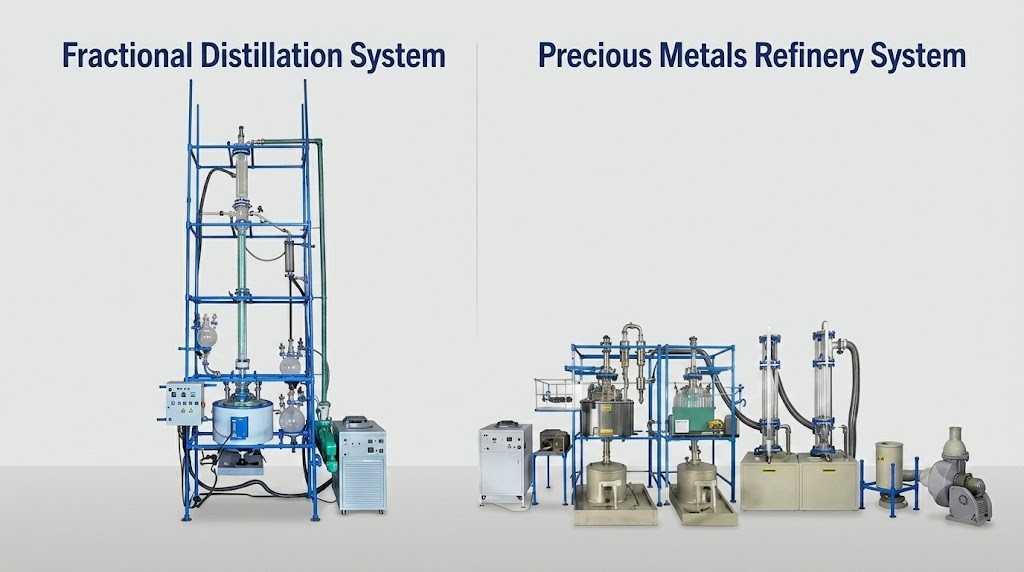
A dedicated fractional distillation system solves this problem by placing a fractionating column between the heated flask and the condenser. This column – packed with structured metal packing or fitted with bubble-cap, sieve, or valve trays – creates an extended zone of repeated vapour-liquid contact. Each contact stage moves the vapour composition progressively closer to that of the lower-boiling pure component. High-performance columns can separate components with boiling-point differences as small as 1–2°C, which makes them essential in pharmaceutical intermediate isolation, specialty chemical production, and petrochemical fractionation.
The reflux ratio is the other central variable in fractional distillation. Not all of the condensed vapour at the column top is withdrawn as product – a controlled portion is returned to the column to flow downward and contact rising vapour again. A higher reflux ratio increases purity but reduces throughput per hour. Determining the optimal ratio is a process design exercise, and maintaining it consistently during production is the job of the control system.
Pharmaceutical Manufacturing: Isolation of active pharmaceutical ingredient intermediates frequently involves mixtures with closely aligned boiling points. Regulatory requirements in pharmaceutical environments add a layer of complexity – the system must support GMP compliance, full batch record traceability, and in some cases IQ/OQ/PQ validation protocols.
Petrochemical Refining: Atmospheric and vacuum fractionation towers are the backbone of petroleum refining. Crude oil is resolved into naphtha, kerosene, gas oil, and heavier residues through the same vapour-liquid equilibrium principles that operate at laboratory scale, applied in columns that can stand tens of metres tall.
Solvent Recovery: Manufacturing operations in coatings, adhesives, and printing generate large volumes of spent mixed solvents. Recovering and re-purifying these solvents reduces raw material costs and satisfies environmental compliance requirements simultaneously. The economics strengthen quickly as daily solvent consumption rises above a few hundred litres.
Specialty Chemical and Fine Chemical Production: Flavours, fragrances, and high-value fine chemicals are sold against tight purity certificates. Pilot-to-small-industrial scale fractional distillation gives producers the equilibrium stage count needed to meet those specifications batch after batch.
Every complete unit integrates the same core elements, regardless of scale or application. The reboiler at the base provides continuous heat input and sets the maximum vapour load. The fractionating column provides the surface area and contact time for separation. The condenser at the top returns vapour to liquid, part of which flows back as reflux and part of which is collected as product. A reflux divider controls the split in real time.
Temperature profiling along the column height and, where relevant, vacuum operation for heat-sensitive compounds round out the control requirements. Material selection – borosilicate glass for laboratory and pilot scale, glass-lined steel or high-grade alloys for industrial applications – must be driven by the corrosivity and temperature profile of the specific feed, not by availability or cost alone.
Automation is available across manual, semi-automatic PLC-controlled, and fully automatic SCADA-integrated configurations, with the appropriate tier determined by the required throughput, batch consistency standards, and regulatory environment of the application.
Where fractional distillation separates components by physical boiling-point differences, a precious metal refinery system recovers gold, silver, and platinum-group metals through controlled chemical dissolution and selective precipitation. The chemistry exploits the same property that makes these metals valuable – their resistance to attack by most reagents – by using the specific acid combinations capable of dissolving them.
Gold and platinum-group metals are dissolved using aqua regia, a mixture of concentrated hydrochloric and nitric acids. Gold enters solution as chloroauric acid and is recovered by adding a reducing agent – typically sodium metabisulfite or ferrous sulfate – which precipitates solid gold sponge from solution. After filtering, washing, drying, and melting, the recovered gold reaches purities of 99.95% or above in well-engineered systems.
Silver is processed using nitric acid, which dissolves it selectively. Subsequent addition of hydrochloric acid precipitates silver chloride, which is then reduced and cast into refined silver. For platinum-group metals, the separation sequence is more complex – several metals dissolve simultaneously and staged selective precipitation or solvent extraction is required to isolate each element.
The chemistry and configuration of a refinery system must match the specific feed. The most common feed types include:
Jewellery Scrap and Manufacturing Waste: Polishing dust, sprue, and rejected fabrication pieces represent high-grade, relatively predictable feeds. Simple aqua regia dissolution followed by selective gold precipitation delivers clean results.
Electronic Waste: Printed circuit boards, connector pins, and IC chips contain gold, silver, palladium, and platinum at profitable concentrations. E-waste is compositionally complex – aluminium, copper, tin, and lead must be managed before precious metal isolation – and systems for this feed type incorporate pre-treatment stages accordingly.
Spent Industrial Catalysts: Petroleum refining and chemical manufacturing consume platinum and palladium catalysts in large volumes. Spent catalyst recovery is one of the highest-value segments in the PGM market.
Dore Bars: An unrefined gold-silver alloy produced at the mining stage, processed in large quantities at commercial refineries.
Regardless of feed type, all refinery systems follow the same core sequence. Feed is weighed, sampled for assay, and prepared – shredded or granulated where necessary to improve acid access. It is then charged into an acid-resistant reaction vessel and dissolved under controlled temperature.
Fume management at the dissolution stage is critical. HCl and NOx vapours generated during aqua regia dissolution must be captured by integrated scrubbers before they reach the working environment. After dissolution, insoluble materials are removed by filtration. The clarified liquor proceeds to selective precipitation, where reducing agents isolate the target metal as a solid. The precipitate is washed, dried, assayed, and smelted to final product.
As with fractional distillation equipment, refinery systems are offered across manual, semi-automatic, and fully automatic tiers. Manual systems handle 1–5 kg per batch and suit small workshops and assay offices. Semi-automatic PLC-controlled units cover the 5–20 kg range and improve batch-to-batch consistency substantially. Fully automatic systems with SCADA integration handle 20 kg and above per batch, support continuous e-waste processing lines, and provide the complete batch records and remote monitoring that certified commercial refineries require.
Safety infrastructure is not optional in strong-acid processing. Every system should incorporate corrosion-resistant materials throughout, integrated acid fume scrubbers sized to peak dissolution load, secondary containment on all acid vessels, automated temperature interlocks, and ventilation interlocks that prevent operation without active scrubbing in place.
Whether procuring a fractional distillation column or a precious metal refinery unit, the same principle applies: the system must be designed around the specific process, not selected from a standard catalogue and adapted post-purchase.
Suppliers with genuine process engineering capability will begin with the separation or recovery specification and derive system dimensions, material selection, and automation configuration from it. Pilot-scale testing before full-scale commitment is a standard expectation from reputable manufacturers. Turnkey project delivery – process design, fabrication, installation, commissioning, and operator training – substantially reduces integration risk for buyers without in-house chemical engineering resource.
After-sales process support during the first operational period is equally important. Both distillation and refinery operations have a commissioning phase where reagent dosing, reflux ratios, or temperature profiles need fine-tuning to reach target purity. Access to the manufacturer’s process engineers during this period shortens the time to stable, spec-compliant production.
Fractional distillation and precious metal recovery represent two of the most technically demanding and commercially significant separation processes in industrial chemistry. Both require purpose-designed equipment, chemistry-matched materials, and the right level of automation for the production environment. Organisations investing in either technology benefit from working with manufacturers who bring process engineering depth alongside fabrication capability – the combination that determines whether a system delivers its specification reliably over years of operation, not just on commissioning day.

© 2025 Crivva - Hosted by Airy Hosting Managed Website Hosting.