

There are many more precise mechanical and dimensional standards required in the industrial engineering industry compared to ten years back. The torque that automotive transmissions must withstand is now much greater, the cyclic load on the rail assemblies must be endured continuously, and industrial equipment operates for prolonged periods with little room for vibration or inconsistency in structure. Under such circumstances, forged parts must keep their dimensions accurate, resistant to fatigue, and structurally sound during the entire lifetime of exposure.
For this reason, it is vital for every leading forging parts manufacturer to emphasize process stability, grain refinement, thermal consistency, machining precision, and inspection accountability over mere production capacity. The forging process has become an engineered environment where any minor deviations in billet temperature, die alignment, cooling properties, or machining accuracy could affect future mechanical characteristics.
It is the ability to provide consistent structural integrity and dimensional accuracy on massive scale that distinguishes the best forging producers.
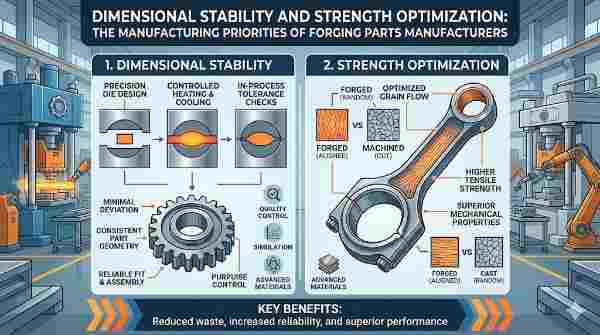
Dimensional stability is no longer treated as a final-stage inspection parameter alone. It has become a complete manufacturing objective that begins from billet preparation itself and continues through forging, heat treatment, machining, and inspection.
Modern industrial assemblies function under extremely tight geometric tolerances. A small variation in concentricity, parallel alignment, or surface geometry may gradually create vibration imbalance, uneven load distribution, lubrication instability, or accelerated wear during operation.
Because of this, every advanced forging parts manufacturer now places strong emphasis on repeatable dimensional control throughout the entire production cycle.
Rotating forged systems such as crankshafts, rotor assemblies, industrial shafts, and transmission components commonly require tolerance ranges between ±0.005 mm and ±0.05 mm depending on the application. Maintaining this level of consistency across high-volume production schedules requires controlled deformation behavior, stable thermal processing, and highly accurate machining capability.
Manufacturers supplying automotive and industrial sectors increasingly use coordinate measuring systems, digital process monitoring, and CNC-controlled machining operations to maintain dimensional repeatability throughout production.
This shift reflects a larger industrial reality. Buyers no longer accept forged components that merely meet dimensional targets during inspection. They expect manufacturing systems capable of maintaining stable geometry consistently across every production batch.
One of the primary engineering advantages of forging comes from grain-flow orientation developed during controlled compressive deformation.
When heated billets undergo forging compression, the internal grain structure elongates according to the geometry of the component itself. This directional grain continuity improves fatigue resistance, impact strength, crack-propagation resistance, and long-term structural reliability under cyclic loading conditions.
An advanced forging parts manufacturer carefully controls deformation ratios, die geometry, and material-flow behavior to optimize grain orientation according to expected operational stress paths.
This becomes especially important in forged systems used within:
A forged transmission shaft operating inside heavy industrial equipment may complete millions of stress cycles throughout its service life. Under such conditions, relatively small structural discontinuities may gradually develop into fatigue-sensitive regions capable of reducing operational durability.
Forging improves structural performance because the grain structure follows component geometry rather than remaining randomly distributed as commonly observed in cast systems.
This remains one of the strongest reasons forged systems continue dominating heavy-duty engineering applications.
Thermal consistency during billet reheating remains one of the most technically sensitive stages inside forging production.
If the billet temperature varies excessively before compression, material flow becomes unstable during deformation. Overheated regions may develop coarse grain growth while colder areas resist deformation and create localized stress concentration.
Modern forging parts manufacturer operations therefore rely heavily on digitally monitored reheating systems capable of maintaining stable thermal distribution throughout the billet section.
Depending on alloy composition and component geometry, billets commonly operate within a forging temperature range of approximately 1,050°C to 1,250°C before entering forging presses.
Large cross-sectional billets require carefully controlled soaking durations to ensure internal temperature stabilization before deformation begins.
The relationship between thermal stability and mechanical performance is significant because temperature variation directly influences:
| Manufacturing Variable | Effect On Final Component |
| Uniform billet heating | Stable material flow |
| Controlled soaking | Reduced residual stress |
| Balanced cooling | Better dimensional stability |
| Consistent forging temperature | Improved grain refinement |
| Thermal repeatability | Uniform hardness distribution |
Modern furnace systems increasingly integrate infrared monitoring, programmable heating cycles, and automated process recording to improve thermal repeatability across large production schedules.
The objective is not merely heating steel for shaping operations. The larger objective is maintaining predictable metallurgical behavior throughout the forging cycle itself.
Forging dies directly influence material-flow behavior, flash formation, cavity filling, and final geometric consistency.
Even relatively small die misalignment or cavity wear may gradually affect dimensional repeatability during production.
Because of this, advanced forging parts manufacturer facilities invest heavily in precision die engineering and maintenance systems.
Modern die-development processes increasingly use simulation software capable of predicting:
This allows manufacturers to optimize die geometry before full-scale production begins.
Large forging operations commonly use hardened die steels capable of handling repeated thermal and mechanical loading under pressures exceeding several thousand tons.
Maintaining die precision becomes especially important in automotive forging applications where dimensional consistency directly affects assembly compatibility and operational balance.
Manufacturers capable of controlling die wear and deformation stability across long production schedules generally achieve stronger dimensional repeatability throughout forging operations.
Traditional forging operations depended heavily on operator coordination between reheating, billet handling, deformation timing, trimming, cooling, and inspection stages.
Modern industrial requirements demand much tighter process consistency.
As a result, advanced forging parts manufacturer facilities increasingly integrate automation directly into production workflows through robotic manipulators, automated billet-transfer systems, programmable press controls, and digital production monitoring.
Automation improves manufacturing stability by reducing variation in:
Even relatively small delays between billet reheating and forging compression may reduce surface temperature significantly, particularly in medium and large forged sections.
Automation therefore contributes directly to metallurgical consistency and dimensional repeatability.
This becomes increasingly important in export-oriented industrial programs where buyers expect stable quality across large production schedules.
Forged systems retain residual stress after deformation and cooling. Without controlled thermal stabilization, these stresses may later influence hardness distribution, dimensional stability, and fatigue resistance during operational exposure.
Because of this, advanced forging parts manufacturer operations increasingly rely on programmable heat-treatment systems capable of maintaining repeatable thermal-processing conditions.
Processes commonly used include normalizing, quenching, tempering, and induction hardening depending on material grade and application requirements.
Hardness inconsistency may gradually influence load distribution and wear progression during operation, particularly in components functioning under cyclic stress conditions.
Modern heat-treatment systems therefore play a direct role in long-term mechanical reliability.
This becomes especially important in industrial gear systems, heavy vehicle components, railway assemblies, and transmission systems where forged components remain under severe operational loading for extended service durations.
Forging creates structural strength, but machining creates final operational precision.
Modern industrial assemblies require highly accurate dimensional compatibility because even small machining inconsistency may gradually affect vibration behavior, rotational stability, and assembly alignment.
Because of this, advanced forging parts manufacturer operations increasingly integrate CNC machining directly into forging production workflows.
Critical machining parameters commonly include concentricity, geometric symmetry, positional accuracy, dynamic balance stability, and surface-finish control.
Modern CNC systems commonly maintain micron-level tolerance capability depending on component geometry and application requirements.
Rotating forged systems require especially precise machining because imbalance may gradually increase bearing stress and fatigue loading during operation.
The integration of forging and precision machining therefore plays a major role in overall structural performance.
One example of companies operating within this increasingly precision-focused manufacturing environment is Unique Forge PVT. LTD., where forging operations align closely with metallurgical discipline, dimensional consistency, and industrial reliability expectations.
Industrial buyers increasingly prioritize manufacturing accountability alongside component strength.
Because of this, modern forging parts manufacturer facilities integrate inspection systems directly into production operations rather than depending only on final visual examination.
Inspection technologies commonly include ultrasonic testing, magnetic particle inspection, coordinate dimensional verification, hardness mapping, spectrochemical analysis, and microstructure evaluation.
Ultrasonic inspection remains especially important for large forged systems because internal discontinuities may remain invisible externally while still affecting fatigue resistance during operational exposure.
Many manufacturers now use inspection data to improve process optimization itself by identifying variation in thermal processing, forging pressure, machining behavior, or heat-treatment consistency.
This data-oriented approach is gradually improving production repeatability across large industrial manufacturing schedules.
The increasing industrial significance of each and every advanced forging parts manufacturer is an indicator of the larger change occurring in the manufacturing industry at large.
Today’s industrial system works within the parameters of higher tolerance, stress, cycle life, and fatigue levels when compared to previous generations of machinery. In this regard, the forging process depends on manufacturing skills rather than simply manufacturing capacity.
Today’s modern forging system relies on thermal control, grain flow control, die accuracy, CNC integration, automation, inspection responsibility, and metallurgy during each step of the process.
Manufacturers who are able to improve the industrial reliability of their system are those working behind-the-scenes to increase dimensional control, structural density, fatigue resistance, and process consistency while manufacturing forged parts that are able to last for years of tough industrial exposure without mechanical issues.

© 2025 Crivva - Hosted by Airy Hosting Managed Website Hosting.