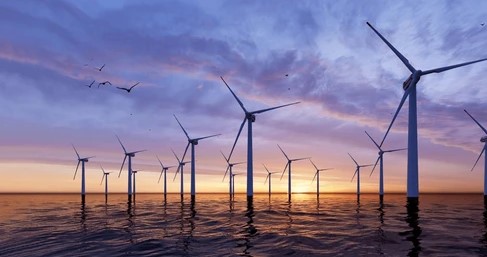
For decades, offshore wind energy was limited to shallow waters close to the shore. Engineers could only install turbines where the seabed was shallow enough to anchor a fixed foundation. That left the vast, windier stretches of the deep ocean completely out of reach. Floating turbines changed that. These structures sit on buoyant platforms tethered to the ocean floor, making it possible to harness wind energy in waters that were once off-limits. The result is a genuine shift in how the world thinks about renewable energy at scale.
Traditional offshore wind turbines require a solid foundation drilled into the seabed. This approach works well in waters up to roughly 50 to 60 meters deep. Beyond that depth, the cost of building fixed foundations rises sharply, and construction becomes technically difficult.
The problem is that the best wind resources are often found far from shore, in deeper water. Countries like Japan, Norway, South Korea, and much of the United States West Coast have very little shallow continental shelf. For these nations, fixed-bottom turbines were never a realistic option. Floating platforms opened the door to energy independence that geography had previously blocked.
The concept behind floating wind is straightforward. A turbine is mounted on a floating structure, which can take several forms: a semi-submersible platform, a spar buoy, or a tension-leg platform. Each design keeps the turbine stable in rough seas while allowing it to stay upright and operational.
The platform is anchored to the seabed using mooring lines, not rigid foundations. Power is then transferred to shore through underwater cables. Because the structure floats, it can be assembled in port and towed to its location, which also reduces the specialized construction vessels needed on-site.
Wind speeds tend to be stronger and more consistent farther offshore. This means floating wind farms can generate electricity more reliably than many nearshore options. The technology also avoids some of the visual and noise concerns that communities sometimes raise about wind farms built close to coastlines.
Following the 2011 nuclear disaster, Japan committed to exploring offshore renewables for its energy future. The Fukushima Floating Offshore Wind Farm Demonstration Project, known as Fukushima FORWARD, deployed a 2-megawatt semi-submersible turbine alongside a substation and a second turbine unit off the Fukushima coast between 2013 and 2020. What made the project stand out was its ambition to test an entirely Japanese-engineered platform design in some of the Pacific’s most technically demanding conditions, including typhoon exposure and significant wave heights. Although the project was eventually decommissioned after the research phase concluded, the engineering data it generated became the foundation for Japan’s current national floating wind strategy, directly influencing how the country now designs its commercial-scale projects.
Operated by EDF Renewables and its partners, this pilot project off the coast of Port-Saint-Louis-du-Rhone placed three floating turbines in the Mediterranean. What makes it notable is the environment: the Mediterranean has limited tidal range but strong mistral winds, and the project was specifically designed to test performance under those regional conditions. The lessons from this site are directly informing France’s broader offshore wind pipeline, particularly as the country pushes to reduce nuclear dependence while keeping emissions low.
Floating wind does more than add turbines to the ocean. It fundamentally changes the geography of energy planning. Nations that previously had no viable offshore wind resource now have a credible path to clean electricity generation.
It also changes the economic conversation. As more projects are built, supply chains develop, manufacturing scales up, and costs fall. The floating wind sector has followed a similar cost trajectory to that of fixed-bottom offshore wind in its early years, and industry projections suggest continued cost reductions as the market matures.
Ports and coastal economies benefit too. Floating platforms can be built and serviced in existing harbor infrastructure, creating local jobs in regions that might not otherwise benefit from offshore energy development.
It would be misleading to suggest floating wind is without obstacles. Installation and mooring in deep water still presents engineering challenges. The dynamic cables connecting floating turbines to the seabed and to the grid must handle constant movement without degrading. Grid interconnection in remote areas also adds cost.
Supply chain bottlenecks are real. The specialized components needed for floating platforms are not yet produced at the volumes required for rapid scaling. Permitting and regulatory frameworks in many countries are still catching up with the technology.
These are solvable problems, but they require coordinated investment across industry, government, and research institutions.
The story of offshore wind energy is being rewritten by innovations that most people have not yet heard of. As the industry continues to grow, events like the annual floating wind conference bring together engineers, policymakers, and investors to share findings, coordinate standards, and accelerate deployment. These gatherings matter because the challenges ahead are too large and too interconnected for any single company or country to address alone. What is clear is that floating turbines represent one of the most significant breakthroughs in renewable energy in the past decade, offering a realistic path to clean power for nations and regions that geography once left behind.
Q1. What is the main difference between floating and fixed-bottom offshore wind turbines?
Fixed-bottom turbines are anchored directly into the seabed and can only operate in relatively shallow water, typically up to 60 meters. Floating turbines sit on buoyant platforms held in place by mooring lines, allowing them to operate in water depths of 100 meters or more.
Q2. Are floating wind turbines reliable in storms and rough seas?
Yes. The platforms are engineered to handle significant wave heights and storm-force winds. Projects like Hywind Tampen in Norway operate in the North Sea, which is known for harsh weather, and have maintained strong availability rates during adverse conditions.
Q3. Which countries are leading in floating offshore wind development?
Norway, the United Kingdom, France, Japan, South Korea, and the United States are among the most active. Norway and the UK have the most operational capacity today, while Japan and South Korea are investing heavily due to their deep coastal waters.
Q4. How does floating wind energy connect to the onshore power grid?
Power generated by floating turbines travels through dynamic subsea cables to the seabed, then along static cables to shore, where it connects to the existing electricity grid. The dynamic cables are specially designed to flex with the movement of the floating platform.
Q5. When will floating wind become cost-competitive with other forms of energy?
Cost projections vary, but most industry analysts expect floating wind to reach cost parity with fixed-bottom offshore wind by the early 2030s as manufacturing scales up, more projects are built, and installation methods become more efficient. Several governments are already supporting this timeline through contract guarantees and port infrastructure investment.

© 2025 Crivva - Hosted by Airy Hosting Managed Website Hosting.