

The financial services industry is rapidly embracing digital transformation, and loan management software has become a critical technology investment for banks, NBFCs, fintech companies, microfinance institutions, and digital lenders. Traditional lending methods that rely on spreadsheets, paperwork, and manual tracking can no longer keep pace with the growing demand for faster approvals, better compliance, and seamless borrower experiences.
Modern loan management software provides a centralized platform that automates the complete loan lifecycle—from borrower onboarding and loan origination to disbursement, repayment tracking, collections, and reporting. Businesses using intelligent lending platforms can reduce operational costs, improve portfolio performance, minimize human errors, and scale efficiently.
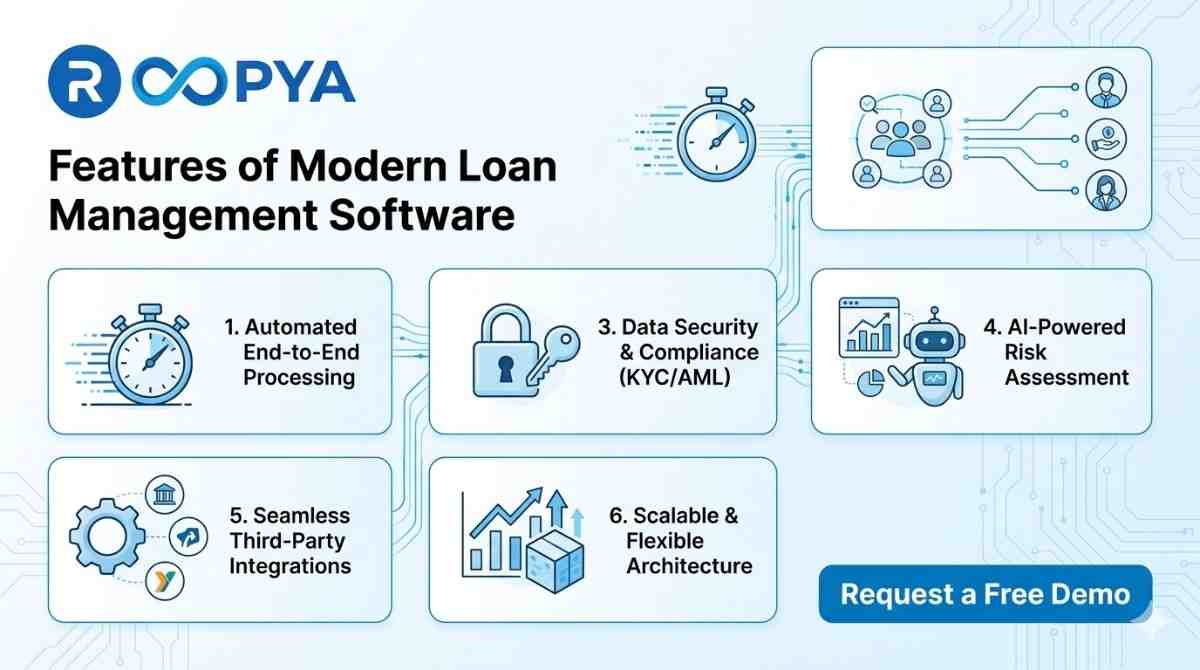
Solutions like Roopya’s AI-powered lending platform demonstrate how cloud-native, API-driven, and automation-focused systems can help lenders simplify complex workflows while maintaining compliance and improving customer satisfaction.
In this comprehensive guide, we will explore the essential features of modern loan management software and explain why they are vital for lenders operating in today’s competitive environment.
Loan management software is an integrated digital solution that helps lenders manage every stage of the lending process after or alongside loan origination. It enables financial institutions to automate loan servicing, EMI calculations, borrower management, collections, reporting, compliance, and analytics from a unified dashboard.
Unlike legacy systems that require significant manual intervention, modern platforms leverage cloud computing, artificial intelligence, APIs, and workflow automation to increase efficiency and reduce processing times.
Digital lending has transformed borrower expectations. Customers now expect:
Without a modern platform, lenders often struggle with:
A modern loan management solution addresses these challenges through automation and centralized operations.
One of the most valuable features is complete lifecycle management.
The platform should manage:
Having all operations within a single system eliminates duplication and improves efficiency.
Artificial Intelligence is revolutionizing lending.
Modern software should provide:
AI enables lenders to make faster and more accurate decisions while reducing operational costs.
Cloud technology provides flexibility and scalability.
Benefits include:
Cloud-native platforms are especially beneficial for rapidly growing NBFCs and fintech companies.
Customer onboarding should be completely digital.
Features include:
Digital onboarding significantly reduces processing time.
Managing repayments manually increases the risk of errors.
Modern software automates:
Automation ensures accuracy while improving borrower convenience.
Loan servicing extends beyond disbursement.
A robust servicing module includes:
This allows customer support teams to respond quickly.
Collections determine portfolio health.
Advanced systems include:
These features improve collection efficiency while reducing manual intervention.
Executives require instant visibility into loan performance.
Key dashboards include:
Real-time monitoring supports better business decisions.
Modern lenders often offer multiple products.
Software should support:
A configurable architecture eliminates the need for separate systems.
Workflow engines automate repetitive tasks.
Examples include:
Automation minimizes delays and improves productivity.
Integration with credit bureaus helps evaluate borrower risk.
Capabilities include:
These integrations accelerate underwriting.
Modern platforms should integrate seamlessly with third-party services.
Common integrations include:
API-driven ecosystems improve operational flexibility.
Digital lending increases fraud risks.
AI-based fraud prevention includes:
These safeguards protect lenders and borrowers.
Compliance is essential for financial institutions.
Modern loan management software should support:
This simplifies internal audits and regulatory reviews.
Analytics help lenders optimize performance.
Reports should include:
Business intelligence supports data-driven strategies.
Borrowers increasingly expect self-service capabilities.
The portal should allow users to:
Self-service reduces support workload and enhances customer satisfaction.
Field teams require mobile access.
Mobile capabilities include:
Mobile-first systems improve operational efficiency.
Growing institutions require centralized operations.
Key features include:
This enables scalable expansion.
Every lender follows unique policies.
Modern systems allow configuration of:
No-code configuration reduces dependency on developers.
Financial data security is non-negotiable.
Security features include:
These measures strengthen customer trust.
Predictive analytics identifies future risks.
Capabilities include:
This helps lenders take proactive action.
Communication automation improves borrower engagement.
Notifications include:
Timely communication reduces missed payments.
Different borrowers require different repayment models.
The software should support:
Flexibility broadens lending opportunities.
The platform should scale with business expansion.
Scalable systems support:
Future-ready architecture protects long-term investment.
AI can recommend optimal collection strategies.
Examples include:
This increases recovery rates.
India’s lending ecosystem is becoming increasingly digital. Institutions require software that supports:
Modern platforms deliver measurable improvements across all these areas.
Roopya provides an AI-powered, cloud-native loan management solution designed for NBFCs, fintech companies, and digital lenders. Its platform combines loan servicing, automation, analytics, collections, borrower management, and API integrations into a unified ecosystem to simplify lending operations and improve scalability.
Modern loan management software is no longer just an operational tool—it is a strategic asset for financial institutions. From AI-powered underwriting and automated EMI management to cloud infrastructure, analytics, compliance, and smart collections, the right platform enables lenders to reduce costs, improve customer experiences, and scale confidently.
For organizations aiming to stay competitive in India’s fast-evolving lending landscape, investing in a feature-rich, future-ready loan management system can significantly improve efficiency and long-term growth.
Loan management software is a digital platform that automates loan servicing, repayment tracking, collections, reporting, borrower management, and compliance.
Banks, NBFCs, fintech companies, MFIs, cooperative lenders, housing finance companies, and digital lending businesses.
Key features include AI automation, cloud deployment, EMI management, collections, analytics, compliance, API integrations, borrower portals, and workflow automation.
AI enhances credit assessment, predicts defaults, automates collections, detects fraud, and improves decision-making.
Cloud solutions reduce infrastructure costs, provide remote access, improve scalability, and simplify maintenance.
Yes. Modern platforms support integration with payment gateways, banking APIs, CRMs, accounting software, and KYC providers.
Many enterprise-grade systems include audit trails, secure data handling, reporting, and compliance workflows to assist with regulatory requirements.
It reduces manual errors, improves repayment tracking, sends reminders automatically, and streamlines reconciliation.

© 2025 Crivva - Hosted by Airy Hosting Managed Website Hosting.