

In the world of modern manufacturing and heavy industry, lifting and transporting large metal components with precision and safety has become a central challenge. Traditional single-point hoisting systems often struggle with issues such as uneven load distribution, excessive stress on machinery and structures, and a greater risk of accidents or product damage. To mitigate these challenges, synchronous lifting technology using Electric Overhead Traveling (EOT) cranes has emerged as a transformative solution — enabling safe, efficient, and highly controlled lifting of heavy and often irregular metal loads.
This article explores EOT crane synchronous lifting technology in depth — covering its principles, components, benefits, applications, challenges, and future potential in heavy metal component handling. With over 950 words, we aim to provide a comprehensive understanding of what synchronous lifting entails and why it’s rapidly becoming standard practice in heavy industries.
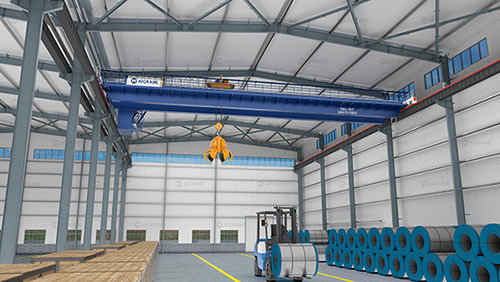
An Electric Overhead Traveling (EOT) crane — also referred to as a bridge crane — is a type of material handling equipment widely used in factories, warehouses, steel plants, and shipyards. An EOT crane typically consists of a bridge, trolley, and hoist. It runs on parallel runways attached to building support structures and can move horizontally across the length of a facility while the hoist moves along the bridge.
EOT cranes are known for their ability to transport heavy loads across large spans with high operational efficiency. However, when it comes to lifting particularly large or irregularly shaped metal components — such as turbine casings, industrial molds, or structural steel assemblies — traditional single-hoist systems may not suffice.
This is where synchronous lifting technology comes into play. By coordinating multiple hoists and cranes, it enables precise, balanced lifting of heavy, complex loads.
Synchronous lifting refers to the coordinated control of two or more hoists working together to lift a single load. Rather than operating independently and relying on the operator’s skill to balance the load, synchronous systems use sophisticated automation and real-time feedback to ensure all lifting points move together with precision.
A typical synchronous lifting setup for EOT cranes includes:
Multiple Hoists: These could be two hoists on a single bridge crane or hoists on separate cranes working in tandem.
Synchronization Controller: This is the central brain of the system, continuously monitoring and controlling the speed and position of each hoist.
Position Sensors: Sensors such as encoders or load cells feed real-time data into the controller.
Communication Network: Robust communication between all components is essential for real-time coordination.
Human–Machine Interface (HMI): Operators can monitor system status, lift parameters, and alarms through an easy-to-use interface.
The synchronization controller receives data from each hoist and adjusts their movements to maintain a consistent lift from all points. If one hoist begins to lag or move ahead, the controller compensates automatically so that the load remains level and stable.
To better understand how synchronous lifting operates, here’s a deeper look at its major elements:
Depending on the weight, size, and shape of the load, multiple hoists may be arranged in various configurations. These hoists can be:
Mounted on the same EOT crane bridge
Mounted on different cranes operating in tandem
Positioned at fixed lifting points in larger facilities
Greater numbers of hoists increase flexibility and lifting capacity.
This is the intelligent heart of the system. The controller continuously measures the relative positions, hoist speeds, and load distribution to make real-time adjustments. Advanced controllers allow:
Teach-in modes for preload and initial setup
Preset lifting paths
Automatic correction for drift or uneven motions
Load distribution algorithms to prevent overloads
Controllers may also integrate safety logic to automatically stop lifting in case of faults or synchronization loss.
Accurate sensing is crucial for synchronous lifting. Common devices include:
Encoders – measure the exact position of each hoist
Load cells – measure load weight distribution
Laser or ultrasonic sensors – detect deviations in lifting planes
Inertia sensors – detect load sway
These sensors feed data back to the controller at high frequency so that adjustments happen in milliseconds.
While much of the work is automated, operators still monitor and command the system through the HMI. This interface displays:
Lift height
Load distribution
Hoist positions
Alarms or warnings
Preset lifting sequences
A user-friendly HMI simplifies complex lifts and reduces operator workload.
The benefits of synchronous lifting technology are significant — touching on safety, efficiency, cost-effectiveness, and quality control.
Traditional multi-hoist lifts often rely on operator skill to balance loads. With synchronous control, the system ensures that all hoists move together and maintain a level lifting plane. This minimizes:
Load swing
Uneven stress on the load
Potential damage to sensitive components
Balanced lifting is especially crucial when handling asymmetrical or irregular metal parts.
Heavy metal components can be dangerous if lifted improperly. Synchronous lifting reduces risks by:
Preventing overload on individual hoists
Detecting and correcting drift or misalignment
Automatically stopping the lift if faults occur
Maintaining stable center-of-gravity control
This level of automation drastically reduces operator risk and minimizes workplace accidents.
Many industrial applications demand precision — for example:
Positioning heavy castings for machining
Aligning powertrain components
Assembling large structural steel pieces
Synchronous lifting systems provide repeatable, precise control that manual or non-coordinated lifts cannot achieve.
Automation reduces the time and manpower required for heavy lifts. Because the system handles synchronization, operators can focus on critical tasks such as positioning the load after lifting rather than constantly adjusting hoist speeds.
By keeping hoists synchronized, the system prevents excessive strain on any single hoist or crane. This leads to:
Longer service life for machinery
Fewer mechanical breakdowns
Lower maintenance costs
Balanced lifting spreads loads evenly — protecting both the equipment and the infrastructure (runways, bridges, and supporting structures).
Synchronous lifting technology with EOT cranes is widely used in industries that handle large metal components:
Heavy steel plates, beams, and frames require balanced lifting to avoid deformation or tipping. Synchronous systems ensure precise handling from storage to workstations.
Turbine casings, generators, and other power plant equipment are heavy and often need precise alignment during installation. Synchronous lifting enables safe and accurate placement.
Ship hull sections and large assemblies are lifted and aligned using synchronized cranes — especially in pre-fabrication bays.
Large structural parts such as fuselage sections or missile assemblies require strict load control — something synchronous lifting delivers.
Press frames, punch machines, and industrial molds often weigh tens of tons. Synchronous lifting technology enables safe and efficient movement during production and assembly.
While the benefits are clear, adopting synchronous lifting systems also comes with technical and financial considerations:
The control systems, sensors, and software add cost compared to traditional hoisting setups. However, these costs are often offset by savings in maintenance, reduced downtime, and improved throughput.
Retrofitting older crane systems may require updates to mechanical hardware and control networks.
Operators and maintenance personnel need training to understand system logic, troubleshoot issues, and make the best use of automated features.
Sensors must be durable and reliable in industrial environments. Poor sensor performance — due to contamination, vibration, or damage — can affect synchronization accuracy.
Technological advances are pushing synchronous lifting systems to new heights. Trends include:
AI-enhanced control algorithms that predict and correct for disturbances
Wireless sensor networks that minimize installation complexity
Digital twin integration for simulation and predictive maintenance
Augmented reality (AR) support for operators
IoT connectivity to log performance and analyze lifting data
The combination of automation, smart controls, and connected systems promises safer, more efficient heavy lifting operations across all industries that handle large metal components.
EOT crane synchronous lifting technology represents a major leap forward for industries that demand safe, reliable, and precise handling of heavy metal components. By coordinating multiple hoists through intelligent control systems, factories can achieve better balance, higher efficiency, and superior safety — even with the most complex loads.
As industries continue to evolve, the importance of advanced material handling technology will only grow. Synchronous lifting with EOT cranes stands at the forefront of this evolution — turning what once were risky and labor-intensive lifts into automated, precise, and dependable operations.
Whether you operate in steel fabrication, power generation, shipbuilding, or heavy machinery manufacturing, embracing synchronous lifting technology can lead to safer workplaces, streamlined processes, and significant competitive advantages.
If you’d like help choosing the right EOT crane system with synchronous lifting capability, or you want to explore tailored solutions for your facility, let me know — I can walk you through options and best practices.

© 2025 Crivva - Hosted by Airy Hosting Managed Website Hosting.