

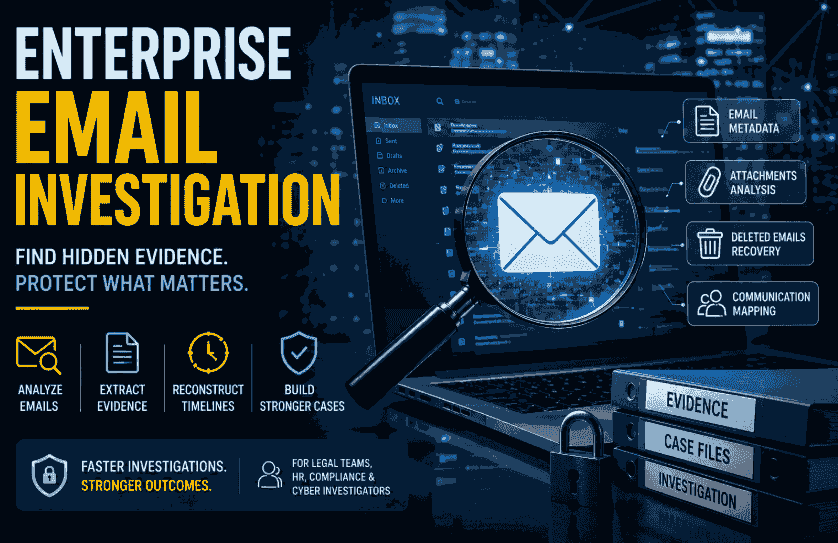
Blog Overview – An enterprise investigation rarely begins with obvious evidence. It usually starts with confusion. A suspicious attachment, a missing conversation, or an employee action that does not match the timeline. Then suddenly, legal teams, HR departments, and cyber investigators are searching through thousands of emails trying to find one critical clue before risk turns into damage. This blog explains enterprise email investigation in the simplest way possible and shows how modern organizations uncover hidden evidence faster without drowning in manual review.
Enterprise email systems store years of conversations, attachments, approvals, contracts, and internal discussions. During an investigation, this data becomes both valuable and overwhelming at the same time.
Imagine a military analyst standing inside a control room filled with radar signals. Every signal matters, but only one may reveal the real threat. Enterprise investigators face a similar challenge when reviewing massive mailboxes across multiple employees and departments.
This complexity grows during:
Manual review slows everything down. Teams often open emails one by one, search random keywords, and depend on screenshots that fail to show the complete communication trail.
Manual email investigations may look manageable in small cases. Enterprise environments are different.
One employee mailbox may contain:
Missing even one attachment or timestamp can affect legal decisions, compliance reporting, or internal disciplinary action.
This is why enterprise email investigation requires structured evidence analysis instead of scattered inbox review.
Enterprise email investigation is the process of examining organizational email data to identify evidence related to cyber incidents, employee misconduct, legal disputes, or security threats.
Investigators analyze:
Think of it like rebuilding a shredded business document. One small piece may not explain much. But once investigators connect conversations, timestamps, and attachments together, the entire picture becomes clear.
Most users only see the message written inside an email. Investigators focus on the hidden details behind it.
Email metadata works like a shipping label attached to a package. Even if someone changes the content inside, the label still shows where the package traveled, who handled it, and when it moved.
Metadata may reveal:
This makes metadata analysis one of the most important parts of enterprise email investigation.
Modern enterprises no longer rely entirely on manual inbox review. Investigation teams now use centralized forensic workflows to reduce blind spots and organize evidence more efficiently.
| Manual Review | Structured Investigation Workflow |
| Slow evidence review | Faster communication tracing |
| High investigator fatigue | Organized case analysis |
| Missed metadata | Better evidence visibility |
| Scattered screenshots | Centralized investigation process |
For example, an HR department investigating confidential file sharing may need to identify:
Reviewing this manually across multiple mailboxes becomes extremely difficult under legal deadlines.
This is where specialized investigation platforms become valuable.
Email Analysis Tools helps enterprises, investigators, and legal teams analyze email evidence from multiple sources in a centralized environment. Investigation teams can review communication trails, attachments, and mailbox activity in a more organized and investigation-focused workflow.
Enterprise investigations often depend on one overlooked detail.
A legal team may review thousands of employee emails during a compliance investigation. Most conversations appear harmless until investigators discover one forwarded attachment connected to unauthorized data sharing.
The challenge is not simply accessing emails. The real challenge is identifying critical evidence before legal, financial, or reputational damage grows larger.
Organizations should focus on investigation clarity instead of overly technical complexity.
An effective enterprise email investigation process should help teams:
The biggest problem in modern investigations is not lack of data. It is too much unorganized information.
Most enterprises already possess the evidence they need. The real challenge is finding the right communication quickly before time pressure and human error create larger operational risks.
Enterprise email investigations have become a critical part of cybersecurity, HR response, compliance management, and legal discovery. However, modern investigations require more than manual inbox searching and scattered screenshots.
Organizations need structured investigation workflows that simplify evidence discovery, reduce blind spots, and help teams analyze communication trails with clarity and speed.
As enterprise data continues growing, efficient email investigation is no longer just an IT task. It has become an operational necessity for protecting organizations, accelerating investigations, and supporting better decision-making under pressure.
Enterprise email investigation is the process of analyzing organizational emails to identify evidence related to digital incidents, insider threats, employee misconduct, legal disputes, or compliance violations. Investigators examine communication patterns, attachments, metadata, timestamps, and deleted emails to reconstruct the complete sequence of events.
Emails often contain critical business communication, approvals, file transfers, and conversation history. During legal or cybersecurity investigations, email evidence helps teams understand who communicated, when actions occurred, and whether sensitive information was shared improperly.
Yes. Deleted emails may still leave traces behind through mailbox records, archives, metadata, and communication references. Modern forensic investigation methods help investigators recover or analyze deleted communication patterns that may be important to a case.
Large organizations manage massive volumes of email data across multiple mailboxes and departments. Manual review becomes slow, stressful, and prone to human error. Investigators may miss important attachments, hidden metadata, or suspicious communication threads while reviewing emails individually.
Modern organizations use centralized email investigation solutions to organize communication trails, analyze attachments, review mailbox activity, and simplify evidence collection. Structured investigation workflows help legal teams, enterprises, and cyber investigators reduce blind spots and manage investigations more efficiently.
Organizations should prioritize solutions that simplify evidence review, support large mailbox analysis, improve communication tracking, organize investigation timelines, and reduce manual effort during complex investigations.

© 2025 Crivva - Hosted by Airy Hosting Managed Website Hosting.