


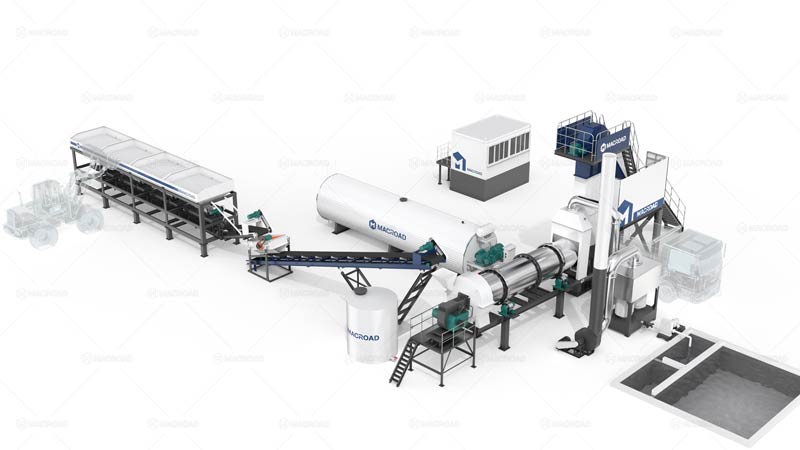
The road construction sector in Latin America is under increasing pressure to deliver cost-effective, high-quality infrastructure while minimizing environmental impact. Mobile asphalt plants have emerged as a versatile solution for contractors needing flexibility without compromising production efficiency. From the initial capital investment to operational expenses and life cycle costs, understanding the full economic impact of mobile asphalt plants is crucial for project planning, resource allocation, and long-term profitability.
As infrastructure projects become larger and more dispersed across Latin America, the ability to relocate production quickly and efficiently becomes a significant advantage. Mobile asphalt plants provide this flexibility, making them increasingly popular for regional roadworks, urban resurfacing, and short-term government projects. Even mini mobile units are now widely used for smaller urban or rural applications, providing affordable, high-quality drum mix asphalt production at sites with limited space.
Latin American road projects often face geographically dispersed sites, challenging terrain, and tight timelines. Unlike traditional stationary drum mix asphalt plants, mobile units can be transported to different locations quickly, reducing the need to haul hot mix asphalt over long distances. This capability helps contractors reduce logistical costs while maintaining high-quality output.
Mobile asphalt plants(Planta asfáltica móvil) are also adaptable to different project scales. For example, a large highway expansion may require a high-capacity mobile plant, while urban streets or secondary roads may be efficiently served by a mini mobile asphalt plant. This versatility allows contractors to tailor production to specific project requirements, maximizing both cost efficiency and operational performance.
These factors make mobile asphalt plants a cost-effective option for many Latin American contractors, especially in regions with dispersed job sites or varying project demands.
The initial investment for a mobile asphalt plant is generally lower than a traditional stationary drum mix asphalt plant(planta de asfalto continua). Cost considerations include plant capacity (usually measured in tons per hour), type of mixing system (counterflow, parallel flow, or double-drum), and the level of automation in control systems.
For contractors in Latin America, these initial savings are crucial. A mobile asphalt plant allows smaller companies to compete in larger projects without committing to a large, stationary facility. Even mini mobile asphalt plants, though limited in capacity, provide high-quality drum mix asphalt production while keeping initial capital expenditure manageable.
Mobile asphalt plants are designed for relocation, but transportation still adds to the initial cost. Factors affecting these expenses include:
Despite these costs, mobile asphalt plants remain more economical than stationary drum mix asphalt plants when considering long-term flexibility and the ability to serve multiple job sites with a single unit.
Fuel represents a major portion of operational expenses for any asphalt plant. Mobile asphalt plants are engineered with energy-efficient burners and indirect heating systems, optimizing fuel consumption even when producing high volumes of drum mix asphalt. Efficient heating not only reduces operational costs but also minimizes environmental impact—a growing concern in Latin American infrastructure projects.
Energy efficiency becomes even more critical when incorporating recycled asphalt pavement (RAP) into the mix. Mobile asphalt plants can preheat aggregates and partially warm RAP to maintain uniform mix quality while conserving fuel, thereby lowering life cycle costs.
Mobile asphalt plants generally require fewer operators than stationary drum mix asphalt plants, thanks to automation and compact design. Features such as programmable batching, automated feed control, and remote monitoring reduce labor intensity. However, routine maintenance is essential to sustain efficiency and extend service life. Regular inspection of burners, conveyors, and mixing drums ensures consistent production quality and prevents costly downtime.
A well-maintained mobile asphalt plant can operate efficiently for more than 10–15 years, comparable to stationary drum mix asphalt plants. Depreciation, replacement parts, and maintenance scheduling are key factors in life cycle cost analysis. By optimizing preventive maintenance, contractors can reduce total cost of ownership while ensuring consistent asphalt quality throughout the plant’s operational life.
Latin American contractors often source aggregates locally, which can vary significantly in size, moisture, and quality. Mobile asphalt plants are designed to handle this variability, producing consistent drum mix asphalt across different project sites. Advanced pre-heating systems, moisture control, and uniform mixing techniques ensure stable output even with fluctuating raw materials.
Recycled asphalt pavement (RAP) is increasingly used to reduce costs and environmental impact. Mobile asphalt plants can incorporate high RAP ratios without compromising drum mix asphalt quality. Benefits include reduced expenditure on virgin aggregates and binder, lower emissions, and compliance with sustainability standards. Careful material handling and precise dosing are essential to ensure RAP is uniformly blended, highlighting the importance of operator skill and plant configuration.
A mid-sized Brazilian contractor deployed a mobile asphalt plant for a regional highway expansion. Key outcomes included:
This project demonstrated how mobile asphalt plants can optimize operational efficiency and life cycle costs simultaneously.
In Mexico, a mini mobile asphalt plant was used for urban street resurfacing. The plant allowed contractors to produce high-quality drum mix asphalt in tight urban environments, achieving:
These examples illustrate the economic benefits of mobile asphalt plants across diverse Latin American project scenarios.
To maximize life cycle efficiency, contractors should consider:
Efficient operation requires disciplined procedures, including:
When combined with high-quality equipment, these practices enhance the economic efficiency of mobile asphalt plants across their lifespan.
Incorporating recycled materials, reducing energy consumption, and minimizing waste all contribute to both financial and environmental efficiency. Mobile asphalt plants facilitate these strategies, making them a sustainable solution for Latin American road construction.
Mobile asphalt plants are redefining the economics of road construction in Latin America. By lowering initial investment, minimizing operational costs, and offering flexibility across multiple sites, they provide a compelling alternative to traditional stationary drum mix asphalt plants. As technology advances and sustainability requirements increase, the adoption of mobile and mini asphalt plants will likely continue to grow, offering contractors both economic and operational advantages while supporting the development of robust infrastructure throughout the region.

© 2025 Crivva - Hosted by Airy Hosting Managed Website Hosting.