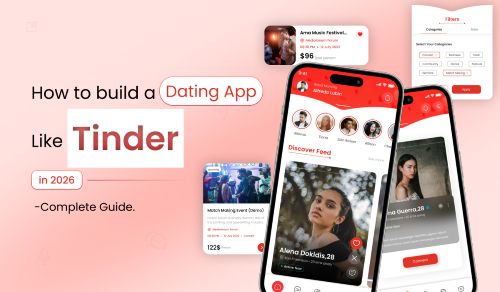
A dating app like Tinder — but one Tinder can’t build — is the real opportunity in 2026. It’s about serving a specific niche, integrating AI matching from day one, building safety into the architecture, and monetizing through subscriptions before it ever shows an ad. This guide walks through every step — from market positioning and core features to tech stack, cost, and go-to-market strategy.
The global online dating market hit $9.8 billion in 2026 and is forecast to reach $15 billion by 2035. Southeast Asia alone — Indonesia, Malaysia, Vietnam, Philippines — is growing at 11% CAGR, driven by a young, smartphone-first population increasingly comfortable with digital matchmaking. Tinder has 75 million registered users. Bumble IPO’d at a $13 billion valuation. Hinge grew revenue 200% in a single year.
$9.8B
Global dating app market value in 2026
11%
SEA dating market annual growth rate (CAGR)
360M
Global dating app users in 2024, growing year-on-year
This guide covers everything you need to build a competitive dating app in 2026 — not a Tinder clone, but a product with a specific purpose, a real audience, and the technical foundation to keep users coming back.
The strategic niche decision that determines everything
All 10 core features with engineering depth
Full tech stack recommendation for 2026
Monetisation tiers and revenue model
Southeast Asia market specifics
Step-by-step build process (6 phases)
How the AI matching algorithm actually works
Realistic cost breakdown by build approach
Go-to-market strategy for early user growth
5 critical mistakes to avoid
Planning to add dating features into a messaging platform? See our WhatsApp clone app development contact page → for the real-time chat and WebRTC calling infrastructure that underpins both products. Ready to start building? Explore our dating app development services → for a detailed overview of what we build at Primocys.
The single most important question in dating app development is not “what features should we build?” It is: are you building for everyone, or for someone specific?

The chicken-and-egg network effect problem is magnified in dating apps. An app needs critical mass in a specific geography and a specific demographic before matches feel meaningful. A general-purpose app must solve this everywhere simultaneously. A niche app needs to solve it for one audience in one city — a far more tractable problem.
Building a dating app is a six-phase process. Each phase builds on the last. Skipping phases — particularly the research and design phases — is the most reliable way to waste development budget and launch a product no one uses.
Document your target persona (age range, geography, relationship goal, what they hate about existing apps). Write a one-sentence unique value proposition: “The only dating app for [X] in [Y] that does [Z] differently.” Map your competitive landscape. Validate with 20–30 user interviews before any design work begins.
Draw a clear line between what ships in the MVP and what waits for Phase 2. The MVP rule: users must be able to create a profile, browse, match, and message. Nothing more. Every additional feature in the MVP is a risk to launch timeline and budget.
Dating app UX lives and dies on two flows: onboarding (signup to first swipe in under 90 seconds) and Match → Message (zero friction). Prototype in Figma and test with 10 real target users before development begins. Key principles: large fast-loading photos, single-thumb usability, and gamified micro-interactions that drive return visits.
The critical decision: Flutter (cross-platform, recommended for SEA and most markets) vs. native Swift + Kotlin (maximum performance for premium Western markets). See the full tech stack breakdown below. Decide before development starts — migration is expensive.
Sprint structure: 2-week sprints, backend first (auth, profile, matching engine) then frontend. Start with rule-based matching — do not build ML until you have 10,000+ active users for training data. Conduct a closed beta with 50–200 users in your target city before App Store submission.
If you want to build a dating app like Tinder that can actually compete in 2026, you cannot ignore AI. Artificial intelligence is no longer an advanced feature reserved for Phase 3 — it is the core competitive differentiator separating apps that users love from apps they delete after a week. Every serious dating app development project today is, fundamentally, an AI dating app project.
Here is a comprehensive breakdown of how AI is being used across the six most impactful areas of modern dating apps — and what you need to build from day one.
Start with rule-based filtering on Day 1 and log all behavioural signals from launch. When you reach 10,000 active users, your ML model has months of rich training data already waiting — dramatically improving cold-start accuracy.
Fake profiles and catfishing are the #1 trust destroyer in dating apps. In 2026, with AI-generated faces and deepfake photos now trivially easy to produce, photo verification is a non-negotiable MVP requirement — not a Phase 2 nice-to-have.
The most common reason a match goes nowhere: neither user knows what to say first. AI icebreakers solve the blank-message problem by generating personalised conversation starters based on both users’ profiles, interests, and past successful conversation patterns within the app.
Manual moderation does not scale. At 50,000 users, your team cannot read every chat or review every photo upload. AI moderation handles the volume, flags borderline cases for human review, and enforces safety standards 24/7 without a growing headcount.
Want to explore our full dating app development services including AI-powered matching and profile optimization? Our team at Primocys has delivered production-grade AI dating apps for clients across South Asia, Southeast Asia, and international markets.
The frontier of AI dating apps in 2026 is moving beyond matchmaking into relationship coaching. AI can detect when a conversation has stalled, suggest re-engagement prompts, identify matches who have gone quiet, and surface “second chance” profiles of users who liked the current user but were never seen. Some platforms are integrating lightweight conversational AI coaches that help users reflect on past matches, improve their communication style, and set healthier dating intentions.
Want to explore our full dating app development services including AI-powered matching and profile optimisation? Our team at Primocys has delivered production-grade AI dating apps for clients across South Asia, Southeast Asia, and international markets.
If you’ve read this far, you understand that the question is never “should I build a dating app?” — the market at $9.8 billion in 2026 answers that. The real questions are: who are you building for, what problem are you solving better than the incumbents, and how do you execute with a technical foundation that can actually scale?
Let’s recap the critical decisions that separate successful dating apps from the 95% that fail:

The dating app market is not winner-take-all at the niche level. Grindr didn’t lose to Tinder. Hinge didn’t lose to Bumble. Each found its audience and served it deeply. Your opportunity is the same: pick your community, earn their trust, and build the app that Tinder — a general-purpose platform optimised for mass appeal — simply cannot build for them.
Primocys has built production-grade dating apps for clients across South Asia, Southeast Asia, and international markets — from MVPs to full AI-powered platforms. If you’re serious about how to create a dating app that actually ships and scales, we’d love to talk.
The next big dating app won’t look like Tinder. It’ll look like yours. Let’s build it — get in touch today.

© 2025 Crivva - Hosted by Airy Hosting Managed Website Hosting.