

Managing contact data in Excel is common across businesses, marketers, sales teams, and IT professionals. Excel makes it easy to organize names, phone numbers, email addresses, and company details in one place. The challenge begins when these contacts need to be used on mobile devices, email platforms, or cloud-based contact services.
This is where excel to vCard converter software becomes essential.
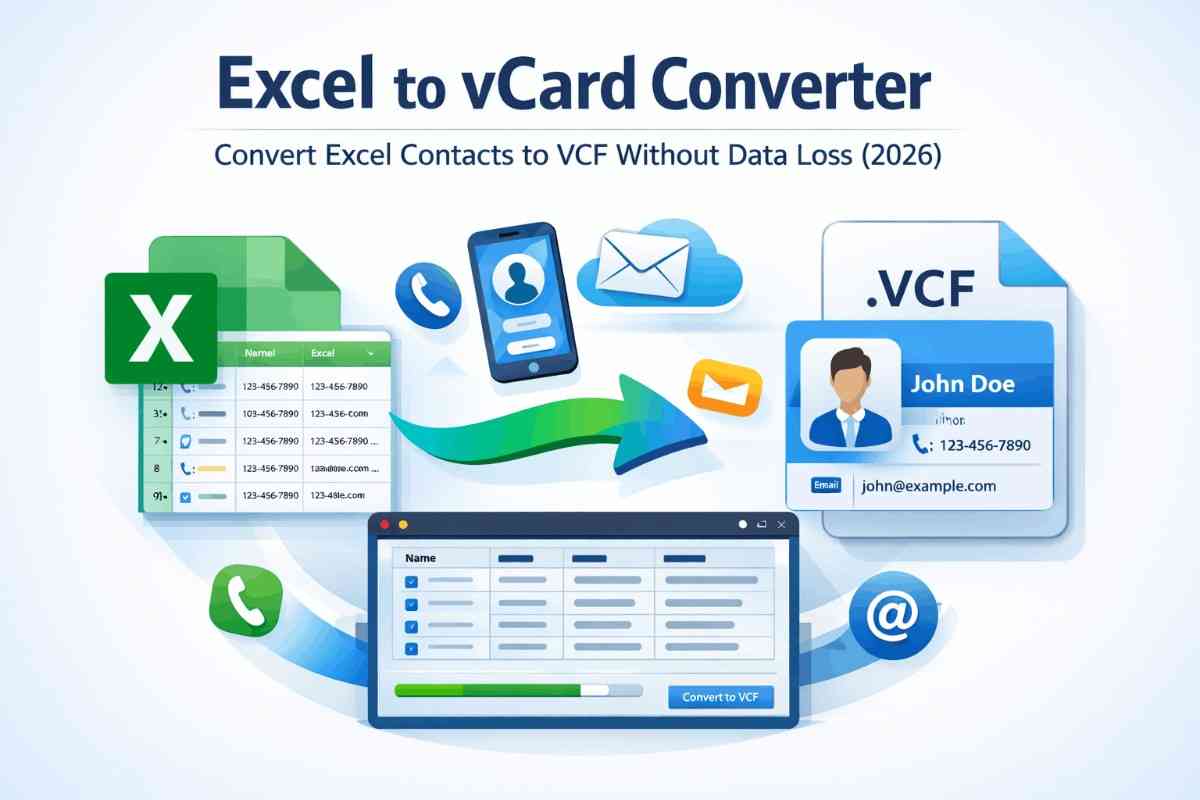
An Excel to vCard Converter helps transform Excel-based contact lists into the VCF format, which is universally supported by smartphones and email clients. Whether the requirement is a simple excel to vcf converter for a small list or bulk excel to vcard conversion for thousands of contacts, accuracy and data preservation are critical. This guide explains how Excel to vCard conversion works, why manual methods often fail, and how contacts can be converted without losing important data fields such as phone numbers, email addresses, and addresses.
An Excel to vCard Converter is a specialized tool designed to convert contact information stored in Excel files into vCard (VCF) format.
Excel files store data in rows and columns. Each row typically represents a contact, while each column represents a specific attribute such as name, phone number, or email address. This structure works well inside spreadsheets but is not compatible with contact platforms.
vCard files follow a standardized structure created specifically for contact exchange. An Excel to vCard Converter bridges this gap by correctly interpreting Excel data and converting it into a format that mobile devices, email clients, and cloud services can understand.
Excel was designed as a spreadsheet application, not a contact exchange format. Because of this, Excel files cannot be imported directly into most contact platforms.
Key limitations include:
Mobile operating systems do not support Excel files for contact import
Email clients require structured contact formats
Excel does not enforce standardized contact field definitions
Multiple phone numbers and email addresses are often misinterpreted
Due to these limitations, Excel contacts must be converted into a compatible format before they can be used reliably.
vCard, also known as VCF, is a globally accepted standard for storing and sharing contact information.
A vCard file can store:
Full name and display name
Multiple phone numbers
Multiple email addresses
Physical addresses
Company name and job title
Website URLs and notes
The biggest advantage of the vCard format is its universal compatibility. Almost all modern devices and applications support VCF files, making it the preferred format for contact sharing.
Users often face issues during Excel to vCard conversion when the process is not handled correctly.
Common problems include:
Phone numbers appearing in incorrect fields
Email addresses missing after import
Contact names split or merged incorrectly
Address details lost or misaligned
Duplicate contacts created
Large Excel files failing during conversion
These issues usually result from improper conversion methods or lack of field mapping control.
Before using an Excel to vCard Converter, many users attempt manual methods.
A typical manual process involves:
Saving the Excel file as CSV
Importing the CSV file into Google Contacts or Outlook
Exporting contacts as a VCF file
While this approach may work for a very small number of contacts, it has serious limitations.
No control over field mapping
High risk of data loss
Poor handling of multiple phone numbers and emails
No duplicate contact management
Time-consuming and error-prone
Manual methods are not suitable for professional or bulk contact conversion.
A dedicated Excel to vCard Converter is built specifically to handle contact data accurately.
Such tools provide:
Precise field mapping between Excel columns and vCard fields
Support for large Excel files
Bulk conversion without data corruption
Multiple vCard version support
Preview of contacts before export
Using Excel to vCard Converter software ensures greater accuracy and control compared to manual workflows.
Understanding the conversion workflow helps users avoid errors and evaluate tools properly.
The Excel file containing contacts is selected. Most converters support both XLS and XLSX formats.
The software scans the Excel file and displays contacts in a structured preview. This allows users to verify data before conversion.
Each Excel column is mapped to a corresponding vCard field, ensuring accurate placement of phone numbers, emails, and addresses.
Users can choose vCard 2.1, 3.0, or 4.0 depending on device compatibility.
Contacts are exported as a single VCF file or multiple individual VCF files.
| Factor | Manual Method | Excel to vCard Converter |
|---|---|---|
| Bulk Support | Limited | Full |
| Field Mapping | Automatic | User-controlled |
| Data Accuracy | Low | High |
| Time Required | High | Low |
| Professional Use | Not Recommended | Recommended |
This comparison highlights why businesses and professionals rely on Excel to vCard Converter software rather than manual workflows. When accuracy, bulk handling, and data consistency are required, automated conversion tools provide a controlled and reliable approach that manual methods cannot match.
In real-world scenarios, Excel to vCard conversion is often required during business contact migration. Companies moving sales, customer, or partner data from Excel spreadsheets to mobile devices or email platforms frequently deal with large files containing hundreds or thousands of contacts. These files often include multiple phone numbers, multiple email addresses, job titles, and department information.
Manual conversion methods struggle with this complexity and often result in missing or misaligned fields. Using a structured Excel to vCard Converter allows businesses to preserve all contact attributes while handling bulk data efficiently.
Once contacts are converted into VCF format, they can be used across devices and applications.
VCF files can be imported through the Contacts app using the “Import from storage” option.
VCF files can be uploaded to iCloud Contacts and synced across Apple devices.
Email clients such as Outlook and Thunderbird support direct VCF import.
Proper preparation improves conversion results.
Best practices include:
Using clear column headers such as First Name, Last Name, Email, Phone
Avoiding merged cells
Keeping consistent data formatting
Removing empty rows and obvious duplicates
In professional environments, users rely on dedicated Excel to vCard Converter tools rather than manual workflows. Tools such as Softaken Excel to vCard Converter are used in scenarios where structured field mapping, bulk contact handling, and preview-based verification are required. These tools provide controlled conversion without altering the original Excel file, helping users maintain data accuracy.
What is an Excel to vCard Converter?
An Excel to vCard Converter is a tool that converts Excel contact files into VCF format for use on mobile devices and email platforms.
Can Excel contacts be converted to vCard in bulk?
Yes, Excel to vCard Converter software supports bulk conversion of large Excel files.
Does Excel to vCard conversion support XLS and XLSX files?
Yes, most modern converters support both XLS and XLSX formats.
Is there a risk of data loss during conversion?
Data loss usually occurs with manual methods. Software-based conversion significantly reduces this risk.
Which vCard version should I choose?
vCard 3.0 or 4.0 is recommended for modern devices and platforms.
Excel to vCard conversion is more than a file format change. It directly affects how contact data is preserved, accessed, and shared across platforms. By understanding the limitations of Excel, the benefits of vCard format, and the role of an Excel to vCard Converter, users can avoid common mistakes and ensure reliable results.
This guide is designed to serve as a long-term, high-quality reference for converting Excel contacts into VCF format safely and professionally.

© 2025 Crivva - Hosted by Airy Hosting Managed Website Hosting.