


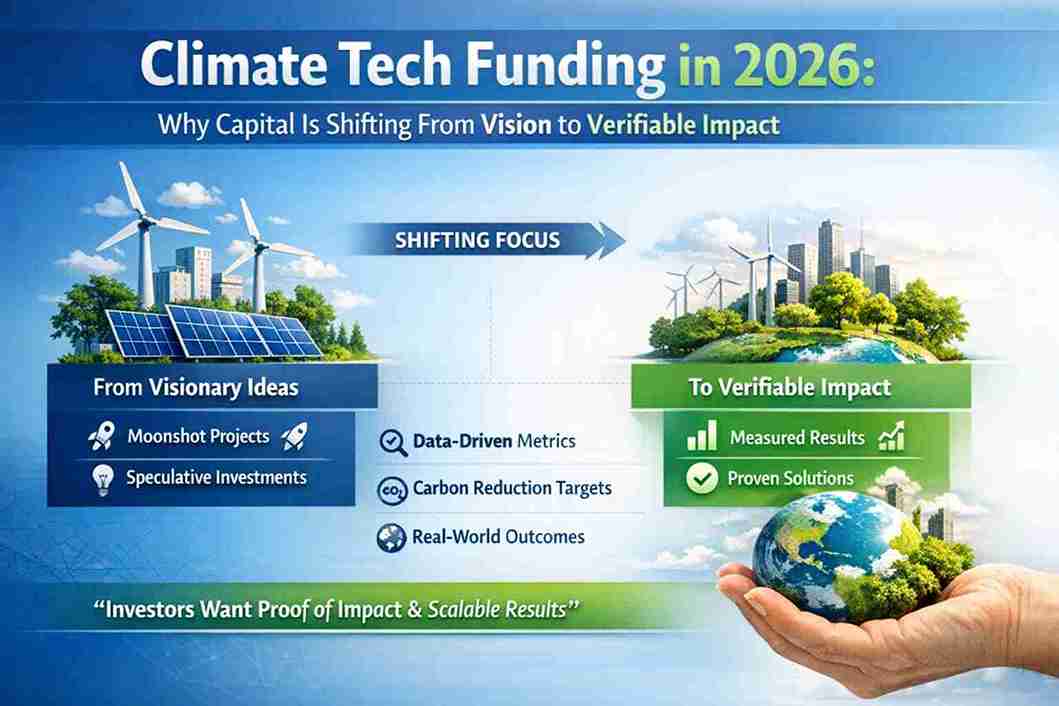
Climate tech funding entered a more disciplined phase in early 2026. Investors are still deploying capital, but the criteria have changed materially. The market has moved away from speculative climate narratives toward solutions that demonstrate measurable emissions reduction, cost efficiency, and commercial adoption.
This shift reflects broader changes across global venture capital. Capital is no longer chasing ambition alone. It is underwriting execution, resilience, and near-term value creation. Climate innovation is now evaluated with the same rigor as enterprise software or infrastructure technology.
For any venture capital firm, this transition represents a clear maturation of the climate tech ecosystem. From the perspective of Evolve Venture Capital, climate innovation is no longer viewed as a moral or values-driven allocation alone. It is increasingly treated as a performance-driven asset class where returns are tied directly to adoption, scalability, and operational durability.
Despite global macro uncertainty, climate-related startups continue to attract consistent capital inflows. Governments, enterprises, utilities, and infrastructure operators face mounting pressure to meet sustainability and emissions targets. This pressure is no longer theoretical. It is embedded in regulation, procurement decisions, and enterprise risk frameworks.
As a result, climate tech demand in 2026 is structural, not cyclical. Capital is flowing toward startups addressing:
These are not long-horizon science experiments. They are operational technologies with near-term revenue potential and defined customer demand.
For investors focused on venture capital investing in early stage startups, this creates a clearer filter. Climate solutions must integrate into existing workflows, infrastructure, and procurement processes to scale. Products that require full system replacement or depend on unproven behavior change face longer adoption cycles and higher risk.
A defining characteristic of climate tech funding in 2026 is accountability. Investors now expect startups to quantify impact with the same discipline applied to revenue and margins.
Startups raising capital are increasingly required to demonstrate:
This evolution benefits founders who prioritize execution over storytelling. Climate narratives without data are no longer fundable.
For those looking to Raise Capital for Startups, climate impact must be supported by operational metrics, third-party validation where possible, and real-world deployments. Aspirational targets are insufficient without measurable progress.
At Evolve Venture Capital, climate startups are evaluated through a dual lens: environmental impact and economic durability. Impact without economics is fragile. Economics without impact lacks long-term relevance.
In 2026, climate capital is concentrating in areas where regulation, economics, and enterprise demand align.
Key funding concentrations include:
These sectors benefit from regulatory tailwinds, rising energy costs, and mandatory reporting standards. Adoption is often driven by necessity rather than optional sustainability initiatives.
For a venture capital firm, alignment between policy and profitability reduces downside risk. When regulation accelerates demand rather than distorts it, startups can scale faster and more predictably.
Early-stage climate investing remains more capital intensive than traditional software. Hardware, infrastructure integration, and pilot deployments require longer timelines and higher upfront costs.
In response, investors are structuring rounds more carefully. Tranche-based funding, milestone-linked releases, and strategic partnerships are increasingly common. These structures align capital deployment with execution progress.
For venture capital investing in early stage startups, the objective is to reduce capital waste while preserving innovation velocity. Investors are no longer funding multi-year R&D cycles without commercial checkpoints.
Founders must demonstrate learning efficiency, not just technical ambition. Rapid iteration, customer feedback, and pilot results carry more weight than theoretical performance claims.
At Evolve Venture Capital, we emphasize pilot deployments, customer validation, and operational readiness before aggressive scaling. This approach reduces execution risk while maintaining upside exposure.
Climate challenges differ significantly by geography, and so do viable solutions.
For a venture capital firm with global reach, understanding regional dynamics is critical. A climate solution that works in one regulatory or economic environment may require meaningful adaptation elsewhere.
Scalability is no longer assumed. It must be demonstrated across jurisdictions, pricing environments, and infrastructure maturity levels.
Evolve Venture Capital evaluates geographic adaptability as part of our climate investment thesis. Solutions that can adjust to different regulatory regimes and cost sensitivities carry stronger long-term potential.
Climate tech is not immune to risk. Policy uncertainty, subsidy changes, permitting delays, and infrastructure dependencies can materially affect outcomes.
Overreliance on government incentives introduces fragility. When subsidies shift or political priorities change, startups without standalone economics struggle to survive.
For founders seeking to Raise Capital for Startups, addressing these risks transparently is critical. Investors value realism over optimism. Risk acknowledgment signals maturity, not weakness.
A disciplined venture capital firm prioritizes resilience. Startups must demonstrate the ability to compete on cost, performance, and reliability, even as policy environments evolve.
Another notable change in 2026 is deeper alignment between founders and investors around expectations. Growth timelines are more realistic. Capital plans are more conservative. Expansion is phased rather than rushed.
This alignment reduces friction post-investment and improves long-term outcomes. Climate startups are increasingly built with durability in mind, not just funding optics.
For venture capital investing in early stage startups, this shift improves portfolio construction. Fewer failures driven by premature scaling. More companies are reaching sustainable operating models.
Climate innovation is now a permanent pillar of global venture portfolios. It intersects with energy, infrastructure, enterprise software, industrial technology, and data analytics.
For a venture capital firm planning over a ten-year horizon, climate exposure is not optional. However, exposure must be selective. Capital concentration without execution discipline leads to underperformance.
Evolve Venture Capital approaches climate tech with long-term conviction and near-term rigor. We invest where impact, adoption, and economics reinforce each other.
Climate tech funding in 2026 reflects a broader shift toward accountability and execution across venture capital. Capital is flowing to startups that combine measurable impact with commercial viability.
Founders and investors who adapt to this standard will define the next phase of climate innovation.
“Impact without economics is unsustainable. Founders should prioritize deployable solutions with clear ROI. Investors should back climate startups that can survive policy cycles and compete on cost. Long-term impact comes from scalable execution.”
Contact Information:

© 2025 Crivva - Hosted by Airy Hosting Managed Website Hosting.








