Every growing business eventually encounters the same quiet obstacle—data scattered across the web, waiting to be collected but not easily accessible. At that moment, a familiar question appears: should we rely on ready-made scraping tools or invest in custom-built solutions? Both promise efficiency and both deliver, in their own ways, yet the differences are often hidden beneath marketing claims and technical jargon. This guide unpacks those differences with clarity and a touch of wit—because choosing the right path today often determines how smoothly operations scale tomorrow.
Understanding Data Scraping Tools
Data scraping tools are essentially pre-built platforms designed to extract information from websites with minimal effort. They typically offer user-friendly interfaces, allowing businesses to gather data without writing complex code. From browser extensions to cloud-based services, these tools aim to simplify the extraction process. However, while they advertise simplicity, real-world usage can sometimes feel like assembling flat-pack furniture—straightforward at first glance, but occasionally puzzling when things do not quite fit as expected.
Advantages of Using Data Scraping Tools
One of the biggest advantages of scraping tools lies in their accessibility. Quick setup, minimal technical expertise, and relatively low cost make them appealing for startups and small teams. Many tools come with built-in automation, scheduling, and dashboards, allowing users to see results almost instantly. There is also a certain satisfaction in launching a scraping task and watching data flow in before the first cup of coffee is finished. For short-term projects or lightweight data needs, these tools often deliver impressive efficiency.
Limitations of Data Scraping Tools
Despite their convenience, scraping tools are not without limitations. As data requirements grow, these tools often struggle with complex websites, dynamic content, or anti-bot protections. Flexibility becomes a concern, and customization options may feel restrictive. Data accuracy can also fluctuate, particularly when website structures change unexpectedly. A common observation emerges—everything works perfectly until it suddenly does not. At that point, troubleshooting can become time-consuming, and the initial simplicity begins to feel less like an advantage.
What Are Custom Data Scraping Solutions?
Custom data scraping solutions are tailored systems built specifically to meet unique business requirements. Instead of relying on generic functionality, these solutions are engineered from the ground up to handle specific data sources, formats, and workflows. Developers design them with scalability and adaptability in mind, ensuring they align closely with organizational goals. Unlike off-the-shelf tools, custom solutions do not attempt to fit every scenario—they focus on solving one problem exceptionally well, often delivering results that generic tools cannot match.
Benefits of Custom Data Scraping Solutions
Custom solutions offer unmatched flexibility and control. They can handle complex data structures, navigate dynamic websites, and adapt quickly to changes. Scalability is another major advantage—systems can grow alongside business needs without requiring constant reconfiguration. Data quality also improves, as extraction logic is fine-tuned for accuracy and consistency. There is a certain satisfaction in watching a custom system perform exactly as intended (almost like it finally understands the assignment), delivering reliable insights without the compromises often seen in generic tools.
Challenges of Custom Solutions
Of course, building a custom solution comes with its own set of challenges. Development requires time, technical expertise, and a higher initial investment. Implementation timelines can stretch longer than expected, especially when dealing with complex requirements. Ongoing maintenance is another consideration, as websites evolve and systems need updates. The classic dilemma emerges—build or buy? While custom solutions offer long-term advantages, they demand patience and resources upfront, which can be a hurdle for businesses seeking immediate results.
Key Factors to Consider Before Choosing
Choosing between tools and custom solutions depends on several critical factors. Project complexity, data volume, and required accuracy all play a role. Budget constraints and expected return on investment must also be evaluated carefully. Time sensitivity can influence decisions, particularly when quick deployment is necessary. Technical expertise within the organization is another key consideration. Finally, long-term scalability and compliance requirements should not be overlooked. Each factor contributes to a clearer picture—because the right choice is rarely about convenience alone.
Tools vs Custom Solutions: A Comparative Overview
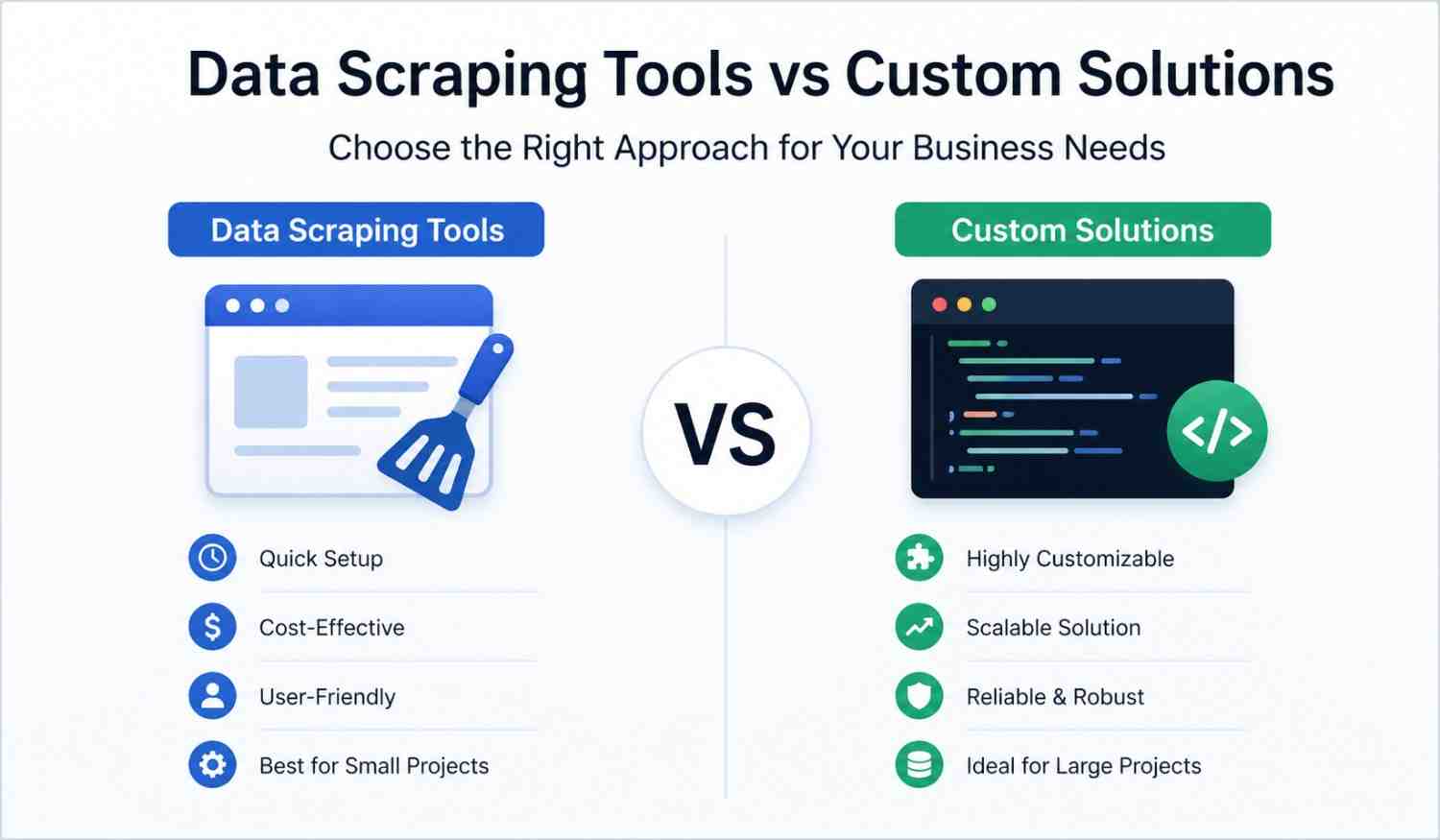
When comparing tools and custom solutions, the differences become more apparent. Tools offer lower upfront costs and faster setup, but limited flexibility. Custom solutions, on the other hand, provide scalability and precision at a higher initial investment. Ease of use favors tools, while long-term performance often favors custom builds. Maintenance also varies—tools rely on external updates, whereas custom systems require internal oversight. In short, one prioritizes speed, the other prioritizes control. The decision ultimately depends on which trade-offs align with business goals.
Hybrid Approach: The Best of Both Worlds
A hybrid approach combines the strengths of both tools and custom solutions. Businesses often begin with tools to validate ideas and gather initial data, then transition to custom systems as needs become more complex. This strategy balances speed with scalability, allowing organizations to adapt without overcommitting resources early on. It is a practical middle ground—leveraging convenience where possible while building tailored capabilities where necessary. Many successful companies follow this path, quietly evolving their data strategies as their operations grow.
When Should You Choose Data Scraping Tools?
Data scraping tools are ideal for smaller projects or short-term needs. They work well when budgets are limited and technical expertise is minimal. Quick deployment is another advantage, making them suitable for experimentation or proof-of-concept initiatives. When data requirements are relatively simple and do not demand high customization, tools can deliver efficient results. They serve as a strong starting point, especially for businesses exploring data-driven strategies without committing to large-scale development efforts.
When Should You Choose Custom Solutions?
Custom solutions become essential when data needs are complex, large-scale, or mission-critical. They are particularly valuable for handling dynamic websites, real-time data extraction, or integration with internal systems. Businesses with long-term data strategies benefit significantly from custom builds, as these solutions can evolve alongside organizational growth. When reliability, scalability, and precision are priorities, investing in a tailored system often proves worthwhile. In such cases, flexibility is not just a feature—it becomes a necessity.
Real-World Observation (Anecdote Section)
A familiar pattern often emerges in data projects. A business starts with a scraping tool, enjoying quick wins and early success. Over time, requirements expand, and limitations begin to surface—data gaps, performance issues, or unexpected failures. Eventually, the shift to a custom solution becomes inevitable. This progression is not unusual; it is almost predictable. Growth tends to outpace generic capabilities, and what once felt sufficient gradually becomes restrictive. Observing this cycle reinforces one simple truth—data strategies must evolve alongside business ambitions.
How Kanhasoft Approaches Data Scraping
At Kanhasoft, the focus remains on aligning solutions with business objectives rather than forcing a one-size-fits-all approach. Each project begins with understanding specific data challenges and long-term goals. Whether leveraging tools, building custom systems, or combining both, the strategy is always tailored for efficiency and scalability. Expertise in web data scraping services ensures reliable and compliant data extraction. The emphasis stays on delivering meaningful insights—not just collecting data, but transforming it into actionable value.
Best Practices for Making the Right Choice
Making the right choice requires a balance between immediate needs and future growth. Starting small can be effective, but planning for scalability is essential. Evaluating long-term return on investment often provides better clarity than focusing solely on initial costs. Data quality should always take priority over quantity, as inaccurate data can lead to flawed decisions. Compliance with legal standards is equally important. Collaborating with experienced professionals can also simplify the decision-making process, ensuring that strategies are both practical and sustainable.
Conclusion
Selecting between data scraping tools and custom solutions is rarely a straightforward decision. Each option brings its own strengths and trade-offs, and the best choice depends on specific business needs. Tools offer speed and simplicity, while custom solutions provide control and scalability. The key lies in understanding current requirements while anticipating future growth. Thoughtful planning today can prevent costly adjustments later. In the end, success in data scraping is not just about choosing a method—it is about building a strategy that evolves with the business.
FAQs
1. What is the difference between data scraping tools and custom solutions?
Data scraping tools are pre-built platforms designed for quick and easy data extraction, while custom solutions are tailored systems built to meet specific business requirements with greater flexibility and scalability.
2. Are data scraping tools suitable for large-scale projects?
They can handle small to medium tasks effectively, but often struggle with large-scale or complex data requirements due to limited customization and scalability.
3. Why are custom scraping solutions more expensive?
Custom solutions require development time, technical expertise, and ongoing maintenance, which increases the initial investment compared to ready-made tools.
4. Can businesses switch from tools to custom solutions later?
Yes, many organizations begin with tools and transition to custom systems as their data needs grow and become more complex.
5. How can compliance be ensured in data scraping?
Compliance involves following legal regulations, respecting website policies, and implementing ethical data collection practices.
6. Which option is faster to implement?
Data scraping tools are faster to deploy, while custom solutions take more time but offer greater long-term benefits.