

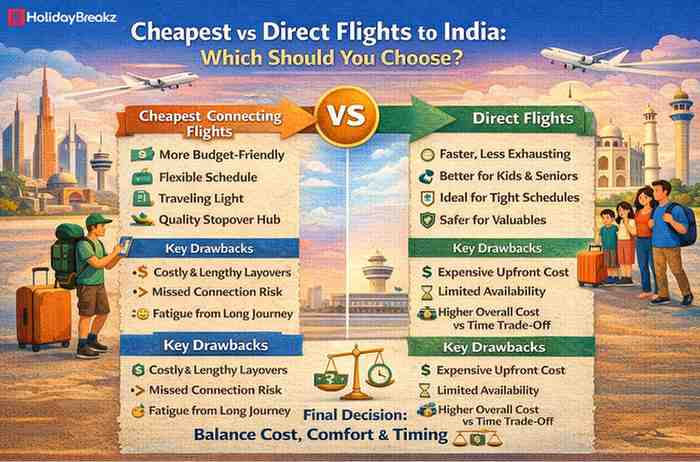
When you start searching for flights to India, you will quickly notice that you are not comparing apples to apples. On one side, there are the cheap fares — connecting flights with one or two stopovers that stretch a 9-hour journey into a 20-hour ordeal but cost significantly less. On the other side, there are direct flights — faster, more comfortable, and considerably more expensive.
The question is: which option actually makes more sense for you?
The honest answer is that it depends entirely on your situation. A backpacker travelling solo with flexible dates and no pressing schedule will make a very different choice from a family of four flying with young children for a wedding. A business traveller with a client meeting the morning after landing will weigh things differently from someone heading home for a month-long holiday.
Before going further, it helps to get the terminology straight, because these terms are often used loosely and inconsistently.
A direct flight is a flight that travels from your departure airport to your destination without requiring you to change aircraft. It may make a technical stop — to refuel or pick up passengers — but you stay on the same plane. True non-stop flights have no stops at all between origin and destination.
A connecting flight requires you to disembark at an intermediate airport, wait, and board a second (or third) aircraft to complete your journey. The stopover might be as short as 90 minutes or as long as 12 hours, depending on the routing.
When people refer to “direct flights to India,” they usually mean non-stop or minimal-stop flights that get you to your Indian destination as quickly as possible. When they refer to “cheap flights to India,” they are generally looking at connecting itineraries routed through hub airports in the Middle East, Southeast Asia, or Central Asia.
Here is where many travellers get caught out. The advertised fare for a connecting flight looks attractive, but the complete picture often includes costs that are not immediately visible.
Extra time equals extra spending. A layover of several hours at an airport is rarely free. You might spend money on food, drinks, airport lounges, or simply impulse purchases during a long wait. If your stopover is overnight or extends into a full day, you may need to book an airport hotel. In some cases, this alone can wipe out a significant portion of the fare saving.
Checked baggage handling. On connecting flights operated by different carriers — or even the same carrier across multiple legs — baggage can get misrouted, delayed, or lost at the point of transfer. If your bags do not arrive when you do, you may face immediate expenses buying essential items at your destination.
Transit visa requirements. Depending on your nationality and your stopover airport, you may need a transit visa. This is especially relevant for travellers stopping in the United Kingdom, the United States, or certain other countries even if they do not intend to leave the airport. Research transit visa requirements before booking any itinerary with a stopover in an unfamiliar country.
The missed connection risk. If your inbound flight to the hub is delayed and you miss your connecting flight, the cost — in time, stress, and potentially money — can be substantial. While airlines are generally obligated to rebook you on the next available flight when the delay is their fault, this does not account for the disruption to your plans on arrival.
Physical and mental fatigue. On long-haul routes to India, connecting flights can push total journey time to 20, 25, or even 30 hours. Arriving exhausted matters — especially if you have immediate commitments at your destination, are travelling with young children, or have health considerations.
With all of the above said, there are situations where taking the cheaper connecting flight is a straightforward, sensible decision.
You have flexible timing. If your schedule allows you to arrive a day early or leave a day later without consequence, a longer itinerary is far less disruptive. Solo travellers and those on leisure trips often fall into this category.
You are travelling light. If you are carrying only cabin baggage, the risks associated with checked baggage on connecting flights largely disappear. Short trips, business travel with minimal luggage, and experienced travellers who pack efficiently are well-placed to take advantage of cheaper connecting fares.
The layover is at a quality hub. Some stopover airports are genuinely pleasant experiences. Changi Airport in Singapore, Hamad International in Doha, and Dubai International are regularly ranked among the world’s best airports. A well-timed layover of four to six hours at one of these hubs — with access to good food, comfortable lounges, and interesting facilities — is a very different proposition from a poorly organised stopover at a smaller, less well-equipped airport.
On the other side of the equation, there are circumstances where the extra cost of a direct flight is clearly justified and often the smarter financial decision overall.
Travelling with young children. A 10-hour non-stop flight with a toddler is challenging. A 22-hour journey involving two aircraft changes, a crowded transfer terminal, and disrupted nap schedules is a genuine ordeal — for the child and for the parents. The value of a direct flight in this situation goes well beyond comfort: it can genuinely determine how the first few days of your trip unfold.
Medical conditions or mobility needs. Long connecting journeys with tight transfer windows are physically demanding. Passengers with mobility limitations, chronic health conditions, or who are travelling post-surgery should give serious weight to the reduced physical stress of a direct flight.
Time-sensitive arrival. If you have a wedding, a business meeting, an exam, a medical appointment, or any other commitment that requires you to be at your destination at a specific time in a functioning state, a direct flight significantly reduces the risk of disruption.
The most effective approach is to search with full transparency — seeing both direct and connecting options side by side, with clear information about what is included in each fare.
When comparing flight options to India, look beyond the headline price and consider the total cost of the journey. Factor in baggage fees, the cost of meals or accommodation during long layovers, transit visa requirements, and the value of your own time.
Here are the key steps to finding the right flight rather than just the cheapest one:
Set your actual priorities first. Before you open a search engine, be honest with yourself about what matters most on this specific trip. Speed? Cost? Baggage allowance? Arrival time? A clear priority list makes the choice much easier.
Use flexible date searching. Shifting your departure by even one or two days can sometimes reveal significantly lower fares on direct flights, narrowing the gap between direct and connecting options.
Check total journey time, not just flight time. A flight listed as “1 stop, 16 hours” sounds manageable until you realise the layover is at 3am for 6 hours in an airport with limited facilities. Always check the actual layover timing, not just the total duration.
Read the fare rules. Cheap connecting fares sometimes come with non-refundable and non-changeable conditions that add significant risk to the booking. A slightly more expensive direct fare with flexible terms can be the more sensible investment.
Book connecting flights on a single ticket where possible. When your outbound and return legs are booked as one itinerary on a single ticket (rather than two separate bookings), the airline bears responsibility for rebooking you if a connection is missed. Split ticketing reduces that protection significantly.
Look at layover airports, not just airlines. The quality of your stopover experience depends heavily on the airport. Research basic amenities, lounge access options, transit hotel availability, and transfer processes before committing to a connecting itinerary.
The cheapest flight to India and the best flight to India are not always the same thing — but they are also not always different. The right choice depends on a combination of your travel profile, your priorities, the specific route, and the time of year.
For budget-conscious travellers with flexibility and light luggage, a well-chosen connecting itinerary through a quality hub can deliver real value without significantly diminishing the travel experience. For families, time-pressed professionals, and anyone for whom disruption would have real consequences, the reliability and simplicity of a direct flight often justifies the higher fare.
What matters most is making the comparison with full information rather than being drawn in by a headline price that looks lower than it really is once all the true costs are counted.
Take the time to compare both options carefully before you commit. The right flight is the one that gets you to India the way you need to arrive — on time, within your budget, and ready to enjoy the journey ahead.

© 2025 Crivva - Hosted by Airy Hosting Managed Website Hosting.