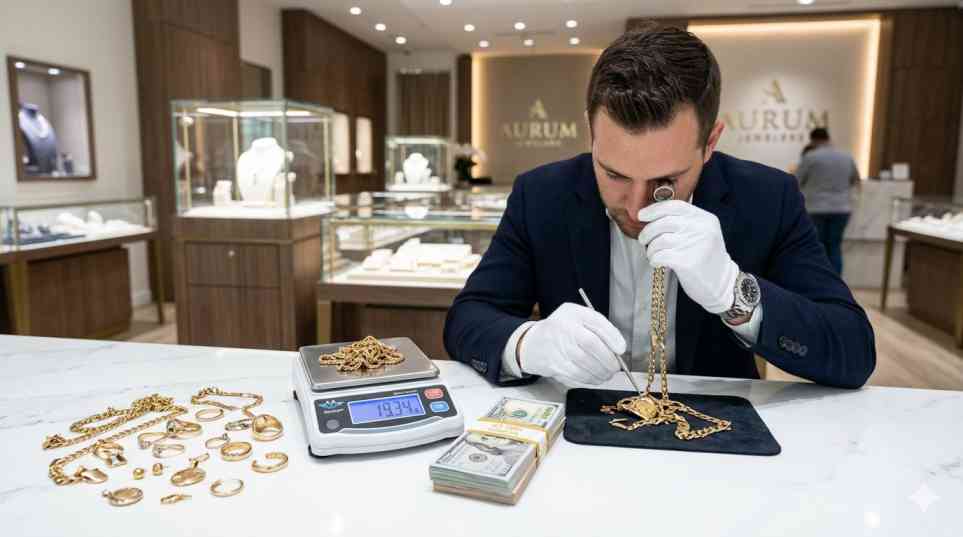
Your broken gold chain is not rubbish. It is valuable. Many people keep snapped necklaces, bent rings, and single earrings in a drawer because they think damaged jewellery has no value. The truth is that buyers offering cash for gold care about the gold content, not how the item looks.
Even if your jewellery is scratched, dented, or missing stones, it can still be turned into instant cash. In 2026, strong gold prices make this a great time to sell unwanted pieces. This guide explains how broken jewellery is valued and how to get the best possible payout.
When you buy jewellery from a store, you pay for:
When you sell broken jewellery, buyers focus on the gold content only. This is called the melt value.
Melt value is the value of the pure gold that can be recovered when the item is melted down and refined.
A broken bracelet may look unattractive, but if it contains several grams of solid gold, it still has real worth.
Retail value is what you paid when the jewellery was new.
Scrap value is based on:
This is why a damaged ring can still bring a good payout.
Gold prices remain strong in May 2026 due to ongoing global inflation, economic uncertainty, and steady investor demand for precious metals.
When inflation rises, many people buy gold as a safe asset. This increases demand and supports higher prices.
As a result, now is an excellent time to sell broken jewellery and receive competitive cash offers.
Most buyers accept many kinds of damaged gold items, including:
If it is solid gold, condition usually does not matter.
Gold purity is measured in karats.
| Karat | Gold Purity |
|---|---|
| 10K | 41.7% |
| 14K | 58.5% |
| 18K | 75.0% |
| 22K | 91.6% |
| 24K | 99.9% |
Higher purity means more gold and a higher payout.
A broken 10K ring weighing 10 grams contains less pure gold than an 18K ring of the same weight.
That means the 18K ring will usually receive a much higher offer.
Professional buyers use precise tools to determine value.
Digital scales measure the exact weight of your gold down to fractions of a gram.
Acid testing confirms whether the item matches its karat stamp.
Advanced buyers use X-ray fluorescence (XRF) machines. These provide highly accurate purity readings without damaging the jewellery.
If a buyer gives only an estimated weight without showing you the scale, this is a warning sign.
Buyers do not pay 100% of melt value because they must cover refining costs and earn a profit.
This difference is called the spread.
Many reputable buyers pay between 70% and 95% of the gold’s melt value, depending on:
Always ask:
Pawn shops offer quick and convenient payments.
Some sellers report receiving only around 60% of actual melt value.
Gold refiners process metal directly and often pay more.
Refiners cut out middlemen, which often leads to better offers.
Online services let you request quotes from home.
If mailing jewellery, use:
A little preparation can improve your selling experience.
Group 10K, 14K, and 18K items separately.
Use a soft cloth to remove visible dust and dirt. Avoid heavy polishing.
Receipts, certificates, and original packaging can be useful, especially if gemstones are included.
Ask these questions before selling:
A trustworthy buyer will answer clearly and openly.
Be cautious if a buyer:
Transparent buyers are usually the safest choice.
The first offer is not always the best.
Getting quotes from several buyers helps you compare rates and avoid low offers.
A 10% difference can be significant.
For example, if your gold is worth $2,000, one buyer may offer $1,600 while another offers $1,800.
That is a $200 difference for the same jewellery.
Not all gold-coloured jewellery contains solid gold.
A thin gold coating over another metal.
Contains more gold than plated items but less than solid gold.
Contains gold throughout the entire piece.
Look for marks such as:
If the surface is worn and a different metal appears underneath, the item may be plated.
Tiny scraps can add up.
Do not throw away:
Collecting all pieces can increase your final payout.
To get the highest return:
These simple steps can help you secure a much better offer.
Sometimes repair costs are higher than the jewellery’s sentimental or practical value.
Selling may be the smarter option if:
Turning unused pieces into cash can be a practical financial decision.
Broken gold jewellery is far from worthless. It is a hidden savings account sitting in your jewellery box.
Whether you have snapped chains, dented rings, single earrings, or old dental gold, professional buyers can evaluate the gold content and provide competitive cash for gold offers.
Before selling, remember this checklist:
Now is an excellent time to turn damaged jewellery into money. Clean out your drawers, gather your broken pieces, and get a quote today.
© 2025 Crivva - Hosted by Airy Hosting Managed Website Hosting.