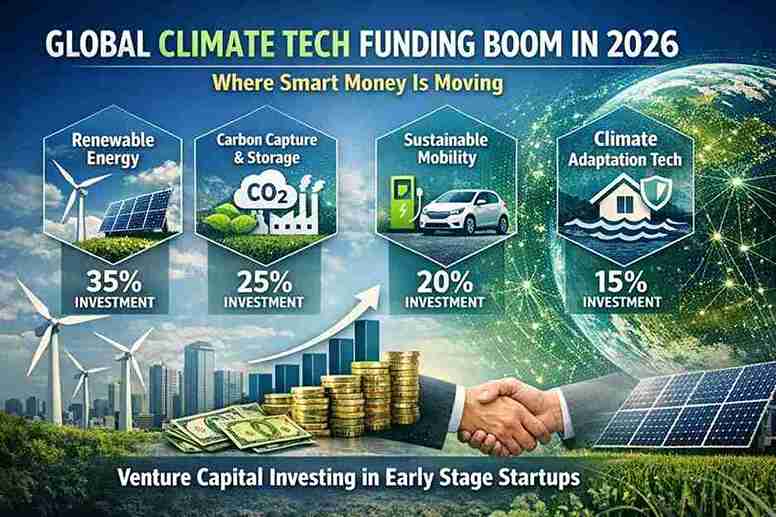
However, climate technology is no longer an emerging field to be viewed under investment surveillance. By 2026, climate technology has turned out to be one of the most active spaces when it comes to competition. The government has tightened its sustainability standards, big businesses have geared up their net-zero initiatives, and end consumers want to invest in cleaner infrastructure. Hence, climate tech has shifted from being a long-term investment option to making it a priority space.
For investors, the most significant change is that climate tech is now viewed as an infrastructure investment rather than just an innovation investment. In other words, this means more demand predictability, larger deal sizes, and high growth potential. From the point of view of venture capital investing in early-stage startups, climate tech is now viewed as a top opportunity for building a global and scalable business.
This traction is not limited to the U.S. and Europeans. Funding in climate tech in 2026 is going to be speeding up across Asia, the Middle East, and the emerging world too. The market is now global, and so is the capital.
In addition, there are many major forces driving this boom. One of the driving forces behind this boom is government policies. In most countries, regulations regarding sustainability have become mandatory instead of optional. New markets for carbon reporting, clean energy, and incentives for green manufacturing are coming up. Corporate needs are another driver behind this boom. Large corporations have become investors in climate technologies due to the need to meet regulations and maintain their brand image.
The third is energy economics. Clean energy is no longer just good for the planet; in many parts of the world, it is now cheaper than traditional energy systems. That completely changes the calculus. Climate tech is no longer just “good for the planet.” It is rapidly becoming “good business.”
A situation of this kind is one which a venture capital firm would hope for, especially since it brings together issues of urgency, policies, and strong commercial need. That is why climate tech is one of the most discussed financing topics for 2026.
Among the most trending and viral terms or phrases in the circles of investors today is carbon removal startups. It is one of the biggest attention-grabbing terms because it represents the next generation of climate tech innovation. Renewable energy, like electric vehicle infrastructure, was the first revolution. The next one is carbon removal, which is considered a trillion-dollar market.
Carbon removal startups focus on the capture of carbon dioxide from the atmosphere and reducing emissions from industries by using modern chemistry. Investors focus more on companies dealing in carbon capture as governments and companies are ready to make payments to remove carbon dioxide, not just reduce it.
The reason that the keyword is going viral is that the idea of carbon removal is no longer theoretical; instead, it is being integrated into various policy frameworks, corporate ESG practices, and climate finance pledges on a global scale. For founders in need of capital, carbon removal is likely one of the swiftest tickets to attracting investors in 2026.
“The climate tech landscape is vast, yet investment is far from evenly distributed. Investors in 2026 are pouring money mainly into a number of thriving ‘sub-‘ sectors. First is energy storage, including next generation battery technology, grid-level energy storage, and alternative battery chemistry solutions. Second is hydrogen technology specifically focused on the distribution and usage of green hydrogen for industries where electrification is impossible.”
While electric mobility continues to draw investments, the trend appears to be changing from electric vehicle brands to electric vehicle infrastructure. Charging projects, battery recyclers, and electric vehicle fleet platforms appear to gain more investment interest than electric vehicle brands.
Another good investment opportunities segment is climate-based AI and predictive system development. Startups with AI system development for overall energy optimization, smart grid analysis, and climate risk prediction tend to be gaining traction as these solutions can scale fast with technology-like margins.
From the perspective of venture capital investing in early-stage startups, these two segments are desirable because of the apparent synergy of demand and defensibility. Not only are investors backing innovation; they are backing market share.
Many founders still assume that fundraising in climate tech is slow due to heavy regulation and complex technology. That was true in earlier cycles, but in 2026, investors are moving faster because climate tech is now tied to national priorities. Governments want energy independence. Corporations want carbon compliance. Consumers want cleaner systems. This creates a rare scenario where market demand is accelerating from multiple directions.
In the process, investors have come to realize that climate tech can spit out enormous winners, much like fintech and SaaS did in previous decades. The difference being that when you’re dealing with climate tech winners, they often turn into infrastructure giants, which means their long-term valuation upside potential is just huge.
In other words, for a venture capital firm, this is the kind of environment in which early-stage bets can pay off with exponential returns. This is why climate tech has moved to the center of global investor strategy.
The boom is not limited to any particular geography. The United States remains at the forefront of funding, but Europe is gaining traction with its push on green manufacturing and policy. Similarly, while China has stalled on some parts of the EV and battery technologies, the Indian market is gaining traction because of the energy needs, population growth, and infrastructure development. The Middle East is now entering the climate tech space with aggressive investments going into clean energy and hydrogen.
The current international competition will significantly influence the future of start-up financing. The competition is producing opportunities for investment between countries. In 2026, climate start-ups get investments from international investors, form partnerships with global industrial players, and enter multiple markets at an early stage.
For the founders, it is essential as this field is becoming a global market quicker than almost any other. This ensures strong scaling opportunities.
Climate tech fundraising is not the same as SaaS fundraising. Investors want technical credibility, strong execution capability, and a clear plan for scaling infrastructure. Startups will have to be able to prove that they can handle real-world deployment challenges, complexities in their supply chains, and all the ways regulations make life different.
The best founders understand one thing, though: climate tech investors really care about commercial adoption. Sure, it can be a very innovative product, but unless it has realistic market entry and customer willingness to pay, it just won’t cut it. In other words, the fastest-growing climate startups are ones that marry deep technology with strong distribution strategies.
According to him, for founders looking to Raise Capital for Startups, climate tech requires a far stronger pitch structure. Investors want to be shown proof that the business can scale efficiently, secure partnerships, and survive longer development cycles. If the founders are able to show this, the funding market in 2026 is highly favorable.
We at Evolve Venture Capital believe that climate technology presents one of the most significant strategic investment opportunities of this decade because, on one hand, such an investment presents high economic potential; on the other hand, responding to climate change through innovation is no longer optional for governments or businesses. It’s a requirement. The market opportunity, therefore, is structural rather than cyclical.
We at The Climate Cyber believe that the top climate tech startups of 2026 will be those with infrastructure platforms, not single-product companies. Those with technology, supply chain partnerships, deployment networks, and impact reporting will be at the center of investors’ radar screens. Climate tech success will not be measured by companies alone; it will be measured by companies that become long-term global infrastructure leaders.
This is the same reason why venture capital investing in early-stage startups in the climate tech sector has the potential to be an effective trend. The type of companies that we are building today will shape the world’s energy, mobility, and sustainability ecosystems over the next 20 years.
The single biggest mistake climate tech founders make is assuming that investors will fund them purely because the mission is important. Investors care about impact, but they invest in execution. A climate tech pitch really needs to prove that the startup has a clear product-market fit strategy, realistic scaling economics, and a path toward revenue expansion.
Founders who are only focused on vision and don’t care about unit economics can easily struggle. The startups winning funding in 2026 will be those that demonstrate a strong operational plan, strong partnerships, and measurable adoption milestones. Investors want climate innovation, but they want it packaged as a real business-not as a research project.
Climate tech provides a huge opportunity for founders looking to raise capital for startups, but it demands discipline and market readiness.
Contact Information:

© 2025 Crivva - Hosted by Airy Hosting Managed Website Hosting.