


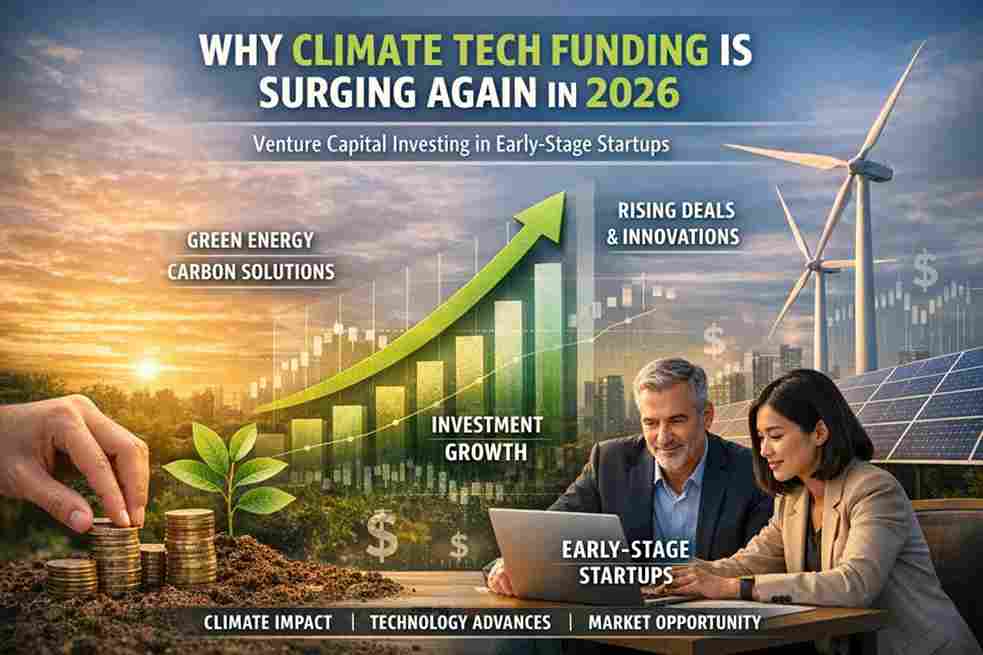
Climate tech is no longer a “future trend.” In 2026, it has become one of the most serious global investment priorities driven by regulation, industrial transformation, and rising climate-related economic risk. After a short period of slower deal activity in earlier years, funding in climate tech is accelerating once again, particularly across Europe, North America, India, and the Middle East.
What’s different this time is the investor mindset. Climate tech is no longer funded mainly because it sounds ethical or sustainable. It is funded because it is becoming unavoidable infrastructure. The governments are tightening carbon rules, industries face supply chain disruption, and energy costs remain volatile. In this environment, companies that reduce emissions or improve energy efficiency are not optional; they are competitive necessities.
For investors concerned with venture capital investing in early stage startups, in 2026 climate tech presents a rare combination of long-term relevance and massive addressable markets. The difference, however, is that unlike consumer tech, climate tech needs a smarter capital strategy due to the more difficult complexities of product timelines, regulation, and deployment cycles.
Why Climate Tech Is Back at the Top of Global Funding
Climate technology received a tremendous boost in 2026 for three areas: energy security, industrial modernization, and carbon compliance. Many governments now understand that climate policy is neither simply environmental in nature nor just about saving the planet. It is also about economics and geopolitics.
Europe is persisting with aggressive decarbonization strategies, and industries have been asked to adapt as per these strategies at a faster rate than anticipated. The US is witnessing great investments from corporations in clean energy, grids, and manufacturing efficiency. India is moving aggressively in technologies such as renewables, EVs, and energy storage. The Gulf economies have also started investing in clean hydrogen and industrial transition strategies.
These changes have made climate tech startups far more investable. In short, investors no longer see climate tech startups as “experimental innovation,” but rather “the next industrial growth cycle.”
This is important for a venture capital firm, especially as the climate tech space is one of the rare areas in which public policies and capital trends are moving favorably. In that sense, the area has much less long-term uncertainty than other startup spaces.
One of the most talked-about trends in changing funding interests in the climate sector is Carbon Credits, due to which global organizations have to now justify emission reduction rather than simply producing sustainability reports. Amidst all these strategies in corporate compliance, the importance of carbon credits was realized, and they have become one of the most important tools for startups.
This has led to a strong wave of investments in carbon measurement platforms, carbon accounting automation, and verification technologies. Investors have been observing other startups that offer transparency within the voluntary carbon market. As is evident, credibility is a key issue within this market.
The market for carbon credits is expanding at a fast rate since enterprises demand a level of traceability. They want assurance that these credits are real, measurable, and sustainable. New companies that can offer traceable measurement and audit systems are key value infrastructure providers.
For founders, the opportunity is HUGE. But for investors, the segment is quite strict. For investors, associations with climate credibility are also key. When your startup is unable to signal the impact with good validation mechanisms, raising funds becomes hard.
In 2026, the most significant funding is being pumped into climate tech that addresses industrial-sized challenges. Among the biggest winners in climate tech is energy storage. The emergence and development of renewable energy sources have been hindered by energy storage capabilities, and new battery technologies and hybrid energy startups have shown significant demand for investments.
Another key segment is grid modernization. There are many countries with grid infrastructure that are outdated and not suitable for handling renewables. Startups offering smart grid technology, predictive energy distribution capability, and load balancing expertise are gaining huge traction.
Another prime area for investment that has drawn significant interest among investors is industrial decarbonization. Industries like cement, steel, and chemicals are major emission sources for the planet, and investors are interested in startups that can help bring these emissions down.
Climate mobility is another space with high activity. EVs are gaining traction in terms of adoption, but charging infrastructure and battery chain innovation face significant challenges. Startups in fleet electrification, charging station optimization, and battery recycling are emerging as attractive investment options.
From the Evolve Venture Capital standpoint, the most fundable climate change tech startups are the ones with demonstrated unit economics and scalability plans, not just the environment-centric rhetoric.
Climate technology doesn’t function like SaaS; there is hardware roll-out, regulatory approval, and long development cycles for the final product. Hence, one cannot use similar parameters by which investor interest and evaluation happen for consumer technology or software companies, while investing in climate technology startups.
As far as venture capital is concerned, early-stage investing in startups, climate tech success is greatly dependent on execution capabilities. There is assessment and analysis of the industrial experience, partnership, and execution complexity of the founding team.
Another factor is the efficiency of capital employed. One of the main reasons why climate tech startups have been and will be closing is that they ran out of money before scaling up. Today, investors prefer businesses that can pilot and test first before scaling up their production.
This is why, as we go into 2026, climate tech funds are not solely about innovation; it is about industrialization. The startups that are securing the largest funds are those that are able to demonstrate commercial traction and expansion strategies.
One key factor that has accelerated climate funds is geopolitics. Governments are interested in having energy independence. They are interested in having stable energy supply chains domestically. They are interested in cutting down on imported resources. Climate tech is now being factored into national security.
This is further spurring more public-private initiatives. Governments are offering various types of subsidies, policy initiatives, as well as large infrastructure budgets, that facilitate startups indirectly. Purchasers are more inclined to sign long-term deals as they are aware that climate compliance rules will only become more stringent.
This trend has created a global market that allows climate tech startups to scale like never before, especially those that have created sustainable solutions that can be applied globally.
This is certainly a big plus for investors. Climate tech is no longer a niche industry. It’s a global transformation of infrastructure.
So, for the founders, it also means that fundraising involves global positioning. If you are thinking about Raise Capital for Startups, then it is very important to present that your product has scalability beyond a specific nation and can thrive despite different regulatory standards.
For instance, at Evolve Venture Capital, we regard climate technology as a highly significant investment theme because it overlaps with energy, infrastructure, and industrialization. In 2026, the most promising climate tech startups in terms of funding prospects are the ones that lower costs and emissions.
From an investor point of view, climate tech is becoming less about a bet and more about an actual movement. Startups that can provide efficiencies for those things like energy use, logistics, industrial output, and manufacturing processes will continue to receive money.
Climate tech startups need to get beyond mission storytelling. While investors care about sustainability, they care about scalable economics, too. Your pitch has got to prove it saves money, makes more, or breaks regulations.
Another important factor is the deployment strategy. Startups focused on the climate must assure investors how they plan to scale beyond a pilot.
Thirdly, credibility: claims around climate change need to be measurable and auditable. If your startup hasn’t got proof of what you can measure, you may face difficulty raising funds in 2026.
“If you’re launching a climate tech business, prioritize commercial traction first and storytelling second. The sooner you can prove viability, paying customers, and scalability without excessive capital, the better. Climate tech is one of the greatest business opportunities this decade, but investors only fund companies that balance innovation and execution.”
Contact Information:

© 2025 Crivva - Hosted by Airy Hosting Managed Website Hosting.