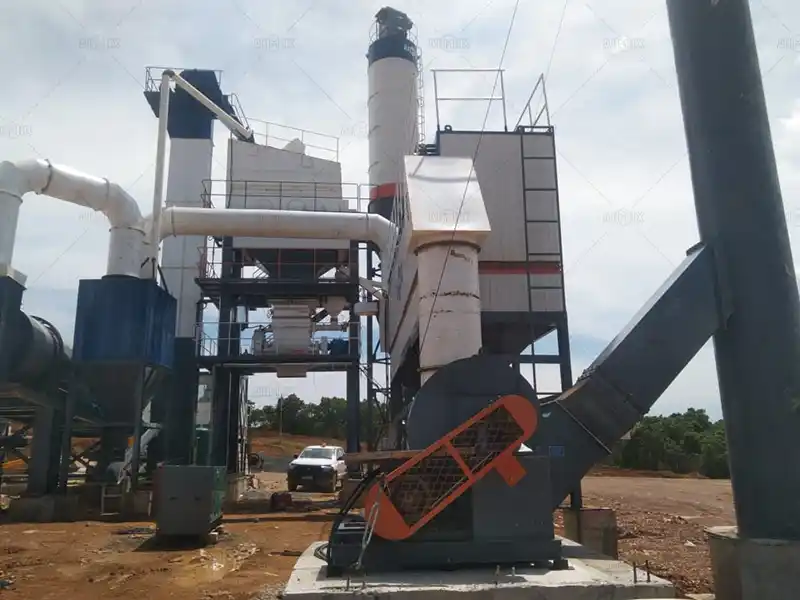
Road maintenance in Ghana is growing fast as cities expand and rural connectivity improves. Contractors now face tighter deadlines, higher traffic pressure, and stronger expectations from government and private developers. In this context, equipment selection becomes a key factor for project success. One common question from contractors is whether a 60 TPH asphalt plant can support a continuous 10 km road repair project in Ghana. The answer depends on production planning, logistics coordination, and site conditions. This article breaks down the real performance of a 60 TPH asphalt mixer plant and explains how it fits into medium-scale road maintenance projects.
We will look at production capacity, real project conditions in Ghana, operational strategy, and practical decision-making. This will help contractors understand not only the machine itself, but also how it behaves in real construction environments.
A 60 TPH asphalt plant produces around 60 tons of asphalt mix per hour under ideal working conditions. This number is important, but it does not tell the full story. Real output depends on material quality, weather conditions, fuel supply, operator skill, and maintenance planning. In Ghana, where road construction often faces heat, dust, and logistics delays, actual output usually ranges between 45 to 60 tons per hour.
To understand its real value, we must connect production speed with project demand. A 10 km road repair project usually needs consistent daily supply rather than extreme peak output. This is where a 60 TPH plant becomes relevant for many contractors.
Now let’s move from theoretical capacity to real construction requirements in Ghana.
A 10 km road repair project is not a small task. It often includes milling, base repair, asphalt overlay, and compaction. In Ghana, such projects are often located between urban expansion zones and rural highways. Traffic control and limited working hours also affect construction speed.
Typically, a 10 km maintenance project requires between 3,000 to 8,000 tons of asphalt mix, depending on road width and thickness. For example, a 7-meter-wide road with a 5 cm overlay requires significantly more material than a narrow rural road.
Therefore, contractors must ensure steady production instead of irregular batch supply. This requirement directly connects to plant capacity and logistics efficiency. Now let’s see how a 60 TPH plant fits into this scenario.
A 60 TPH asphalt plant can support a 10 km road repair project in Ghana, but success depends on how you organize production and delivery. The plant itself has enough output capacity for medium-scale continuous operations. However, it requires proper coordination with trucks, storage silos, and paving teams.
Let’s break it down with a simple production scenario. If the plant runs for 8 hours per day, it can produce around 480 tons of asphalt daily. In 10 working days, the total output reaches approximately 4,800 tons. This is enough for many 10 km repair projects in Ghana.
However, if the project demands higher thickness or wider lanes, contractors may need to extend working hours or improve logistics speed. This is why operational planning matters as much as machine capacity.
Next, we will explore how production efficiency affects real construction progress.
Even though a 60 TPH plant has stable rated capacity, real-world output changes based on several factors. Contractors in Ghana often face unique field conditions that influence productivity.
Asphalt production depends heavily on aggregate and bitumen supply. If trucks arrive late or materials are inconsistent, the plant stops frequently. This reduces total output and affects paving continuity.
Ghana has a tropical climate with high humidity and rainfall in certain seasons. Rain can delay paving operations and reduce effective working hours. Heat can also affect bitumen performance if not controlled properly.
A 60 TPH plant requires at least 6–10 dump trucks depending on distance to the paving site. If truck turnover is slow, asphalt cooling becomes a problem. This directly reduces road quality and increases waste.
Regular maintenance ensures stable output. Dust filters, burners, and mixing systems must stay clean and calibrated. Poor maintenance quickly reduces production efficiency.
These factors show that success is not only about plant capacity. It is also about system coordination. Now let’s compare this plant with project needs more directly.
In most Ghana road repair cases, a 60 TPH asphalt plant is well-suited for medium-scale projects. It balances cost, mobility, and production output. Contractors who work on government contracts or regional road upgrades often find this capacity range practical.
If the project is continuous and well-organized, the plant can easily support 10 km maintenance without major delays. However, if the project has tight deadlines or heavy traffic constraints, contractors may need to increase working shifts or add a second plant.
In short, the 60 TPH plant is not oversized or undersized. It sits in the optimal range for controlled and steady road repair work in Ghana.
Next, we will look at how contractors can improve efficiency when using this capacity level.
To fully use a 60 TPH asphalt plant in Ghana, contractors must focus on system optimization instead of only production speed. Small improvements in coordination can significantly increase project success.
Keep trucks in a continuous cycle. Avoid waiting time at both plant and site. This ensures stable paving temperature and reduces material waste.
Instead of running the plant randomly, set daily production goals based on paving progress. This improves control and reduces unnecessary fuel consumption.
Use insulated storage silos when possible. This helps maintain asphalt quality during transport delays or unexpected pauses.
Experienced operators can reduce fuel waste and improve output stability. Proper training often increases real production by 10–15%.
When these strategies are applied correctly, a 60 TPH plant can perform close to its maximum efficiency in real Ghana road projects.
Contractors in Ghana often choose 60 TPH asphalt plants because they offer a balance between investment cost and operational flexibility. Larger plants require higher fuel consumption and more complex logistics. Smaller plants may fail to meet continuous paving demand.
Therefore, 60 TPH becomes a strategic middle point. It supports government contracts, rural road upgrades, and urban maintenance projects without excessive operational pressure.
It also allows contractors to scale gradually. Once project demand increases, they can upgrade to higher capacity plants or add modular units.
A 60 TPH asphalt plant can absolutely support a 10 km continuous road repair project in Ghana when used with proper planning and coordination. Its success does not depend only on output capacity, but also on logistics, workforce organization, and site management. For most medium-scale contractors, this capacity offers a strong balance between performance and cost control.
If you are planning a road maintenance project in Ghana and want stable production with controlled investment, a 60 TPH asphalt plant is a practical solution. With the right configuration and support, it can deliver consistent results and help you complete projects on time.
If you want to evaluate your project requirements or get a customized asphalt plant solution for Ghana road conditions, contact an asphalt plant supplier today. Our engineering team can help you match capacity, budget, and project timeline to ensure maximum efficiency from day one.

© 2025 Crivva - Hosted by Airy Hosting Managed Website Hosting.