


The financial services industry is undergoing one of the biggest technological transformations in history. Traditional banking systems that relied on paper documentation, manual approvals, on-premise software, and disconnected workflows are rapidly being replaced by modern cloud-based platforms.
Software as a Service (SaaS) has emerged as one of the most powerful innovations driving this digital revolution. Instead of investing millions in servers, infrastructure, and maintenance, financial institutions can now access enterprise-grade applications through the cloud with minimal setup costs and maximum flexibility.
For banks, NBFCs, fintech companies, microfinance institutions, cooperative lenders, and digital lending startups, SaaS solutions provide an opportunity to automate operations, improve compliance, reduce costs, and deliver superior customer experiences.
As competition increases and customer expectations continue to evolve, adopting SaaS is no longer optional—it has become a strategic necessity.
This article explores the major benefits of SaaS in financial services and explains why cloud-based lending software is shaping the future of digital finance.
Software as a Service (SaaS) is a cloud computing model where software applications are hosted by a provider and delivered over the internet through a subscription-based model.
Instead of installing software on local servers, financial institutions simply log in through a secure browser or mobile application.
Examples include:
The SaaS provider manages:
allowing lenders to focus entirely on business growth.
Digital lending has become increasingly competitive.
Customers expect:
Legacy software struggles to meet these expectations.
Cloud-native SaaS platforms solve these problems by offering:
One of the biggest advantages of SaaS is eliminating expensive IT infrastructure.
Traditional systems require:
SaaS removes these expenses entirely.
Organizations pay only for the services they use.
This significantly reduces:
making technology affordable for startups and growing NBFCs.
Traditional financial software implementations often take months.
Cloud SaaS platforms can be deployed within days.
This enables lenders to:
Rapid deployment provides a major competitive advantage.
As lending businesses grow, application volumes increase.
SaaS platforms scale automatically without purchasing additional hardware.
Organizations can easily support:
without downtime.
Cloud software enables employees to work securely from any location.
Loan officers can:
using laptops, tablets, or smartphones.
This improves operational flexibility and productivity.
Modern borrowers expect digital-first experiences.
SaaS lending platforms enable:
reducing friction throughout the customer journey.
Traditional software requires manual upgrades.
SaaS providers continuously release:
without disrupting operations.
Financial institutions always run the latest version.
Leading SaaS providers invest heavily in cybersecurity.
Common protections include:
These measures often exceed what smaller organizations can implement independently.
Financial institutions operate under strict regulatory frameworks.
SaaS platforms simplify compliance through:
making regulatory reporting easier.
Modern SaaS platforms increasingly integrate Artificial Intelligence.
AI helps automate:
resulting in faster and more accurate decisions.
Financial ecosystems rely on multiple services.
Cloud platforms integrate with:
through secure APIs.
Automation replaces repetitive tasks like:
allowing staff to focus on higher-value activities.
Real-time dashboards provide visibility into:
This enables smarter decision-making.
Cloud providers maintain redundant infrastructure across multiple environments.
Even during outages, data remains protected through automated backups and disaster recovery planning.
Financial institutions can launch:
without rebuilding software infrastructure.
Multiple departments can work simultaneously.
Teams including:
access the same centralized data.
NBFCs benefit significantly from SaaS by reducing operational costs while expanding lending capacity.
Cloud platforms support:
without expensive IT investments.
Fintech startups need speed and flexibility.
Cloud-based SaaS allows them to:
while focusing on innovation.
Banks use SaaS to modernize legacy infrastructure.
Benefits include:
MFIs can digitize field operations through:
improving efficiency across rural lending operations.
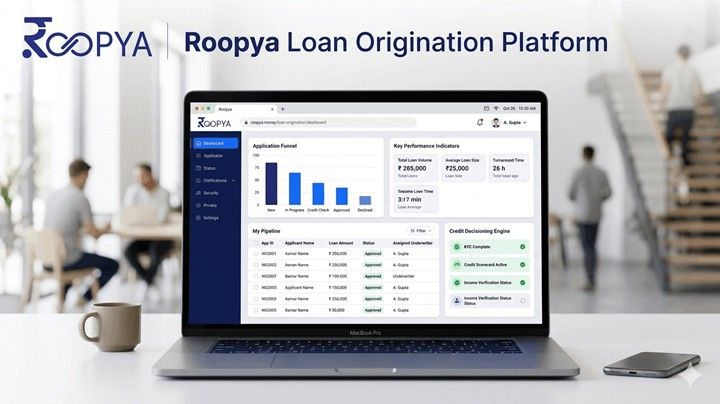
Roopya provides a cloud-based lending platform that supports the complete loan lifecycle—from borrower onboarding and underwriting to loan management and analytics—with AI-driven automation and configurable workflows for Indian lenders.
Key capabilities include:
The next generation of SaaS platforms will increasingly leverage:
Organizations that adopt cloud-first lending technologies early will be better positioned to compete in an increasingly digital financial ecosystem.
Software as a Service is redefining financial services by making enterprise-grade technology more accessible, scalable, and cost-effective. Whether the goal is to reduce operational expenses, improve borrower experiences, automate underwriting, or accelerate product launches, SaaS offers a practical foundation for modern lending.
For NBFCs, fintech companies, banks, and microfinance institutions, cloud-based platforms can help streamline the entire lending lifecycle while supporting long-term growth and innovation.
SaaS in financial services refers to cloud-hosted software delivered over the internet to help institutions manage lending, compliance, customer onboarding, payments, and other operations without maintaining on-premise infrastructure.
It reduces infrastructure costs, automates workflows, improves scalability, and enables faster deployment of lending products.
Yes. Reputable SaaS providers implement encryption, role-based access controls, audit logs, backups, and continuous monitoring to protect sensitive financial data.
Yes. Most modern SaaS lending platforms support API integrations with credit bureaus, payment providers, KYC systems, and banking services.
It automates borrower onboarding, document collection, underwriting, approvals, disbursement workflows, and reporting, reducing manual effort and turnaround time.
Absolutely. Subscription-based pricing and rapid deployment make SaaS especially attractive for startups seeking to scale quickly.
Banks, NBFCs, fintech firms, microfinance institutions, housing finance companies, cooperative lenders, and digital lending platforms all use SaaS-based lending solutions.
Traditional software is typically installed and maintained on local infrastructure, whereas SaaS applications are hosted in the cloud, updated automatically, and accessed through the internet.

© 2025 Crivva - Hosted by Airy Hosting Managed Website Hosting.