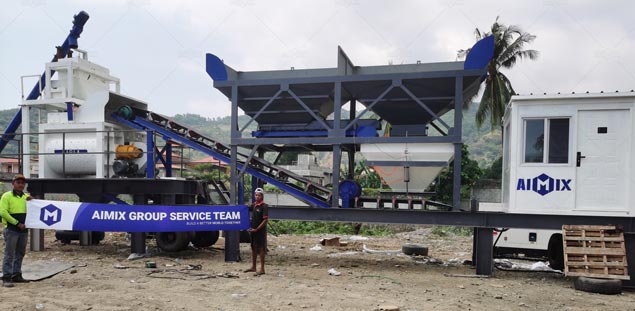
For contractors and entrepreneurs across Latin America, investing in a concrete batching plant represents a significant but potentially lucrative capital decision. The central, pressing question is not just about the initial concrete plant price, but about the timeline to profitability: “How long will it take to recoup my investment?” Understanding the typical payback period is crucial for securing financing, planning business growth, and managing cash flow. This period is not a fixed number; it varies dramatically based on plant capacity, market demand, operational efficiency, and strategic positioning. A contractor evaluating a concrete plant in Peru on the coast will have a different financial model than one supplying a mining project in the highlands. This article breaks down the key variables and presents realistic case studies to provide a clear framework for projecting your own return on investment.
The payback period is the time required for the net cash inflows from an investment to equal the initial capital outlay. For a batching plant, the calculation goes far beyond simply dividing the purchase price by an estimated monthly profit. It requires a holistic view of both costs and revenue streams, heavily influenced by the Latin American context.
Total Initial Investment: This is the starting point. As explored in previous analyses, the true cost is the “Total Installed Cost,” which includes:
The concrete plant price(planta de hormigón precio) (equipment FOB or CIF).
Import duties, taxes, and inland logistics.
Civil works, foundation, and utility connections.
Installation, commissioning, and training.
Initial working capital for materials and permits.
Operational Revenue Drivers: This is where market strategy comes into play.
Sales Price per Cubic Meter: Determined by local competition, project type (commercial, infrastructure, residential), and concrete specifications.
Utilization Rate: The percentage of plant capacity actually sold. A plant running at 50% capacity will have a much longer payback than one at 80%.
Effective Working Days: Accounting for weather, holidays, and maintenance downtime.
Operational Cost Drivers: These directly eat into gross margin.
Raw Material Costs: Volatile prices of cement, aggregates, and admixtures.
Labor and Energy Costs: Local wage rates and electricity/fuel prices.
Maintenance and Repair: A well-maintained plant costs more upfront but has lower long-term operating costs.
Logistics: Cost of mixer truck fleet operation or third-party haulage.
Let’s apply these variables to three hypothetical but realistic scenarios in the Latin American market.
This scenario involves a concrete plant in Peru(planta de concreto en Perú) operated by a local contractor to supply their own housing projects and small municipal contracts in a regional city.
Investment Profile: A simple, semi-automatic plant with a lower concrete plant price. Total installed cost: $180,000.
Operational Assumptions:
Average sales price: $85/m³.
Average production: 60 m³/day (40% utilization of 150 m³ daily capacity).
Operating 20 days/month.
Gross profit margin after material costs: $25/m³.
Monthly Financial Picture:
Revenue: 60 m³/day * 20 days * $85 = $102,000.
Gross Profit: 60 m³/day * 20 days * $25 = $30,000.
Fixed Costs (loan payment, labor, utilities, maintenance): $18,000.
Net Monthly Cash Flow: ~ $12,000.
Payback Calculation: $180,000 / $12,000 = 15 months.
Analysis: The payback is relatively quick due to lower capital outlay. Success hinges on securing a steady stream of small to medium projects to maintain the utilization rate. This model is common for entrepreneurs entering the market.
This represents an established company supplying ready-mix to multiple private and public works in a growing urban area, like a secondary city.
Investment Profile: A fully automatic plant with decent environmental controls. Total installed cost: $450,000.
Operational Assumptions:
Average sales price: $90/m³.
Average production: 300 m³/day (50% utilization of 600 m³ daily capacity).
Operating 22 days/month.
Gross profit margin: $28/m³.
Monthly Financial Picture:
Gross Profit: 300 m³/day * 22 days * $28 = $184,800.
Fixed Costs (larger team, higher utilities, loan payment): $120,000.
Net Monthly Cash Flow: ~ $64,800.
Payback Calculation: $450,000 / $64,800 = ~7 months.
Analysis: This scenario shows the power of scale. While the concrete plant price was 2.5 times higher, the net cash flow is over 5 times greater, leading to a much faster payback. It assumes the company has the commercial network and reputation to secure high-volume contracts consistently.
This model is for a contractor or joint venture directly supplying a mega-project, such as a highway, dam, or large-scale mining operation.
Investment Profile: A high-capacity, fully automated plant with extensive silos and backup systems. Total installed cost: $1.2 million.
Operational Assumptions:
Sales price is often contractually fixed (e.g., $95/m³).
Average production is very high but defined by the project pace: 1,200 m³/day (70% utilization).
Operating 25 days/month.
Gross margin may be tighter due to competitive bidding: $22/m³.
Monthly Financial Picture:
Gross Profit: 1,200 m³/day * 25 days * $22 = $660,000.
Fixed Costs (significant manpower, high energy use, major equipment financing): $500,000.
Net Monthly Cash Flow: ~ $160,000.
Payback Calculation: $1,200,000 / $160,000 = 7.5 months.
Analysis: Payback is similar to Case Study 2 but on a vastly larger financial scale. The risk is also concentrated; the plant’s viability is tied to a single project or client. Post-project, the owner must find a new mega-project or repurpose the plant, which can be a challenge.
Regardless of scale, proactive management can shorten the path to profitability.
The single most effective strategy is having a confirmed portfolio of work or a long-term supply contract in place before the plant is commissioned. This eliminates the ramp-up period and maximizes the utilization rate from day one.
Invest in training to reduce material waste and batching errors. Implement preventive maintenance to avoid costly unplanned downtime. Negotiate long-term supply agreements for cement and aggregates to control input costs.
While a longer loan term reduces monthly payments, it increases total interest and can psychologically extend the payback period. Aim for a balance that ensures healthy cash flow while minimizing long-term debt cost.
The typical payback period for a batching plant in Latin America can range from under 12 months for a well-utilized medium-capacity plant to 18-24 months for a smaller or under-utilized operation. The case studies demonstrate that capacity and utilization rate are more critical to fast payback than the absolute concrete plant price.
When evaluating a specific opportunity, such as a concrete plant in Peru, resist the temptation to minimize the initial concrete plant price at the expense of quality and reliability. A slightly higher investment in a robust, automated plant can lead to faster, more consistent production, directly improving your utilization and margin—and dramatically shortening your payback period. Ultimately, your payback calculation is your business plan in numbers. A realistic, conservative model that accounts for local costs, market rates, and operational challenges is your best tool for transforming a capital expenditure into a powerful, profitable engine for growth.

© 2025 Crivva - Hosted by Airy Hosting Managed Website Hosting.