

Ever stood in your living room, phone in hand, watching that little WiFi icon spin while your video call freezes mid-sentence? You’re not imagining it; your home network is probably struggling. With every smart bulb, streaming stick, gaming console, and laptop competing for the same signals, even a “fast” router can seem slow during busy times. When you start shopping for a new router and see WiFi 6 next to WiFi 6E, both claiming faster speeds and fewer dropouts, it’s natural to wonder if they are the same thing with a fancy label or if there’s a real difference that justifies spending more. Let’s break it down simply.
Wi-Fi 6, officially known as 802.11ax, is the standard that most new routers and devices have used since about 2019. It represents a significant improvement over Wi-Fi 5; it offers not just faster speeds but also a smarter way to manage traffic.
Here’s what makes it special:
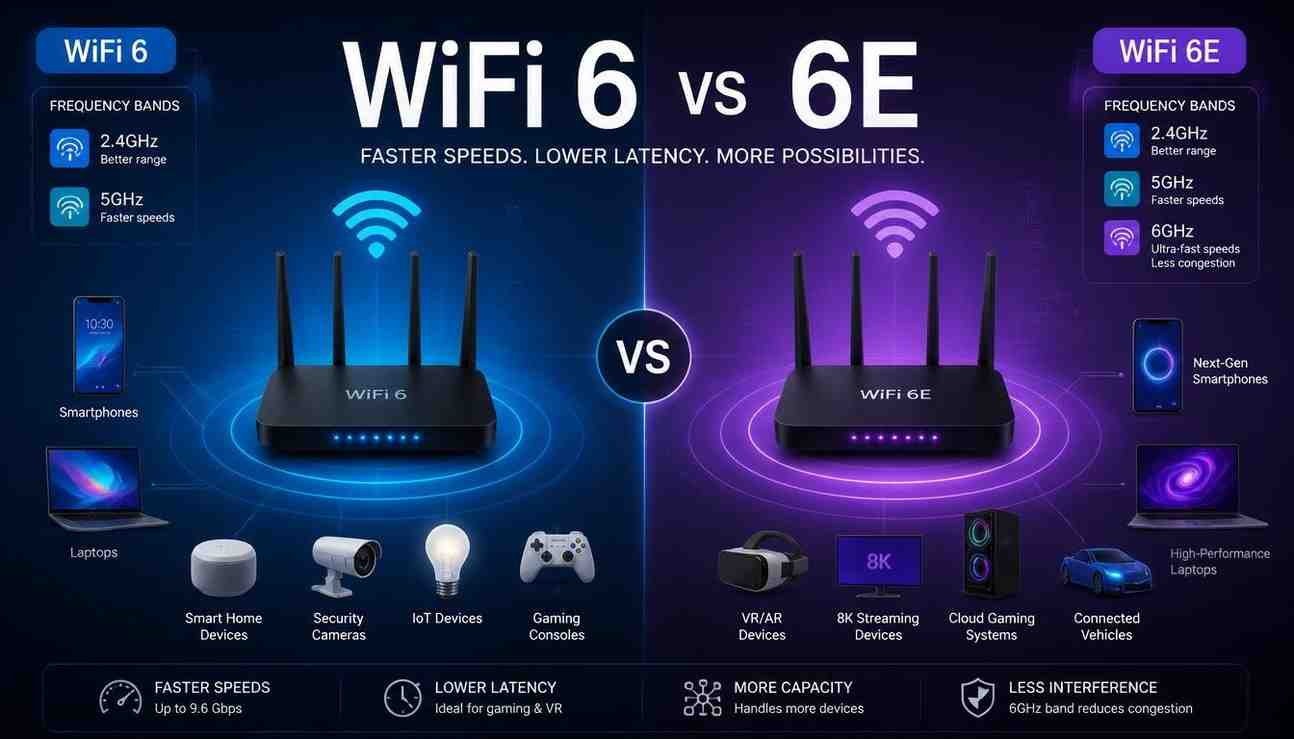
WiFi 6 works on the same two frequency bands we have used for years, 2.4 GHz and 5 GHz. However, it is much better at handling multiple devices at the same time. It uses a technology called OFDMA. This allows the router to talk to several devices at once instead of one at a time. If your home has fifteen connected gadgets, which most homes do now, this can make a significant difference.
It also introduced Target Wake Time, which helps battery-powered devices like smart locks and sensors sleep more efficiently. This significantly extends their battery life.
In short, WiFi 6 is faster, manages crowded networks better, and is more efficient than older standards. For most households, it is already a solid upgrade from WiFi 5.
Here’s where things get interesting. WiFi 6E isn’t a brand-new standard; it’s WiFi 6 with one major addition: access to the 6GHz frequency band.
Until WiFi 6E arrived, all WiFi devices were limited to just two bands, 2.4 GHz and 5 GHz. These bands have been getting more crowded for years. Imagine a highway that has carried the same amount of traffic since the 90s, except now everyone in your neighborhood has ten cars instead of two. WiFi 6E essentially opens up a new highway with much less traffic.
This 6GHz band offers:
The catch is that both your router and your device must support 6E to benefit from it. Older phones, laptops, and smart home devices cannot see or connect to the 6 GHz band; they will continue using 5 GHz as usual.
Let’s get practical here, because specs on a box don’t always translate to your actual day-to-day experience.
If you are using an older router (Wi-Fi 5 or earlier) and experiencing constant buffering, slow speeds during busy times, or devices that often lose connection, Wi-Fi 6 is a significant upgrade. It is affordable, well-supported, and will clearly boost performance for most homes, especially those with many connected devices.
This is a good choice for people on a budget, homes with both older and newer devices, and anyone who wants dependable everyday performance without spending too much.
WiFi 6E is worth considering if you meet a few conditions. First, you live in an area with heavy WiFi congestion, like apartments, condos, or densely populated neighborhoods. Second, you own newer devices that support 6E, so check your phone or laptop specs. Third, you engage in high-bandwidth activities, such as 4K streaming, competitive gaming, or transferring large files. Finally, you want to prepare your home network for the future as more devices adopt 6E.
If most of your devices are a few years old and do not support 6E, spending extra on a 6E router means you’re investing in future possibilities instead of immediate benefits. That is not necessarily bad if you plan to upgrade your phone or laptop soon, but you should be aware of what you are actually paying for.
Ask yourself two questions. First, do I own at least one device that supports Wi-Fi 6E? Second, is Wi-Fi congestion a real issue in my home, or is my current network fine except during busy times? If you answered no to both, Wi-Fi 6 will likely meet your needs and save you money.
If you answered yes to either question, Wi-Fi 6E could be worth the investment. This is especially true if you plan to keep your router for several years while your devices gradually upgrade to support it.
There’s no single “right” answer here. It really depends on your living situation, your devices, and how much you want to spend now compared to later. WiFi 6 is a great, budget-friendly upgrade that fixes most common connectivity issues. WiFi 6E is a better long-term choice if you’re facing serious interference or already have newer devices that can use that extra 6GHz space. In any case, getting rid of an old router is usually a good move for your internet experience. You’ll have fewer dropped calls, smoother streaming, and a network that can keep up with the number of devices we all use today.
Yes. A WiFi 6E router still supports the 2.4 GHz and 5 GHz bands, so older WiFi 6 and even WiFi 5 devices will connect normally. They just won’t be able to use the new 6 GHz band.
Yes, your device needs a Wi-Fi 6E-compatible chip to access the 6 GHz band. Many flagship phones and laptops released in the past couple of years include this feature, but plenty of devices still don’t.
No. These standards improve how your devices communicate with your router, but they can’t make your internet plan faster than what you’re paying your provider for. If your base internet speed is slow, a new router won’t change that.
It can be, especially if you’re surrounded by other WiFi networks causing interference. The 6 GHz band tends to be much less crowded, which can lead to a more stable connection even in a compact space.
WiFi 6 is widely supported and likely to stay relevant for several more years, similar to how WiFi 5 had a long run. It’s a safe, practical choice if you’re not ready to invest in 6E-specific hardware yet.

© 2025 Crivva - Hosted by Airy Hosting Managed Website Hosting.