


Your customers spend 92% of their mobile time inside apps — not on websites. If your business isn’t where they are, you’re invisible to them. Here’s what you’re missing, who benefits most, and exactly how to start.
Quick answer: If your customers interact with your business more than once a month, a mobile app will increase their retention by 25–40%, triple their engagement versus your website, and give you a direct communication channel no social platform or search engine can cut off. In 2026, a mobile app isn’t a luxury — it’s infrastructure. And with Indian development companies, it costs 60–70% less than most business owners think.
6.8B
smartphone users globally in 2026
92%
Apps dominate mobile screen time.
75%
of eCommerce sales via mobile in 2026
5h 16m
average daily phone time, US users
3×
More Engagement Than Websites
The implication for your business is direct: if you only have a website, you are competing for the 8% of mobile time that users spend in browsers. Your competitor with an app is competing for the other 92%. This is not a technology question — it is a market access question.
✅ India is the world’s #1 app download market: India leads global app downloads in 2026, ahead of the US and China. If your business operates in India, Southeast Asia, or the Middle East, your customers are more likely to engage with your brand through an app than through any other channel.
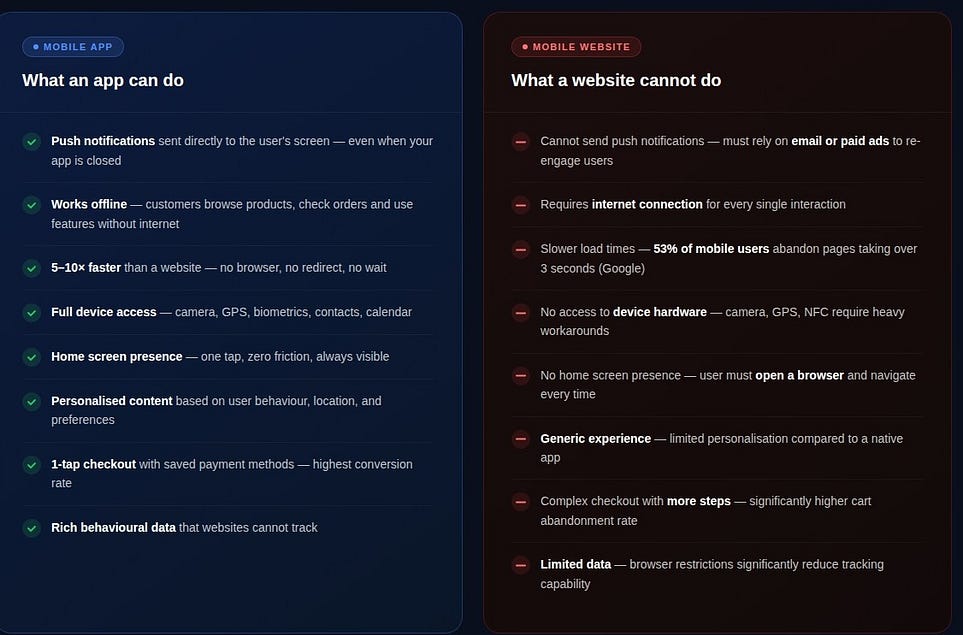
The verdict is not that websites are bad — every business needs one. The point is that a website and an app serve fundamentally different purposes. A website acquires customers. An app retains them.
Not every business needs an app on day one. Here are the five clearest signals that your business is ready — and waiting longer is costing you:
Repeat customers are the highest-value segment for an app. If your customers buy weekly, book monthly, or visit regularly — an app will materially increase the frequency and value of those interactions.
This is the strongest signal. If customers are booking through WhatsApp, you are using a personal messaging app as a business operating system. An app replaces this with a scalable, trackable, professional booking flow — and eliminates the manual workload of managing it.
If you are running Facebook or Google retargeting ads to customers who already know you, a mobile app eliminates most of that cost. Push notifications to your own app users cost nothing and convert far better.
If you can see that businesses in your category are launching apps or significantly improving their digital presence, the window for differentiation is closing. The second mover in any market still wins — but the gap is narrowing every month.
If a third-party platform changed its algorithm, raised its commission, or suspended your account tomorrow, what would happen to your revenue? An app removes this dependency. You own the relationship, the data, and the communication channel directly.
Online ordering, table booking, loyalty rewards, delivery tracking, push notification promotions. Reduces dependence on Swiggy/Zomato commissions.
→ 30–45% increase in repeat orders · Food app →
Product browsing, wish lists, personalised offers, 1-tap checkout, loyalty points, order tracking. App shoppers spend 40% more per visit.
→ 3× higher conversion vs mobile web · eCommerce app →
Class booking, workout tracking, trainer messaging, challenges, streaks, nutrition logging. Replaces WhatsApp scheduling chaos with a professional platform.
→ 38% increase in class attendance · Fitness app →
Appointment booking, telemedicine, prescription reminders, health record access, doctor-patient messaging. HIPAA-compliant design for sensitive data.
→ 60% reduction in missed appointments ·
Property listings with virtual tours, enquiry management, mortgage calculator, agent messaging, saved searches with push alerts for new listings.
→ 2× higher lead quality from app enquiries · Mobile app →
Online booking, stylist selection, service menus, loyalty stamps, before/after portfolio, re-booking reminders. Eliminates phone booking workload.
→ 45% of repeat bookings shift to app within 90 days ·
Service booking, technician tracking, quote requests, payment collection, rating system. Replaces manual dispatch with automated job management.
Click Here: On-demand app →
Video lessons, live classes, progress tracking, assignments, parent communication, certificate management. Growing market driven by mobile-first students.
→ 55% higher course completion vs web platform ·
The most common reason businesses delay getting an app is a misconception about cost. The reality in 2026 — with Indian development companies using Flutter’s cross-platform framework — is that a high-quality business app costs 60–70% less than most founders expect.
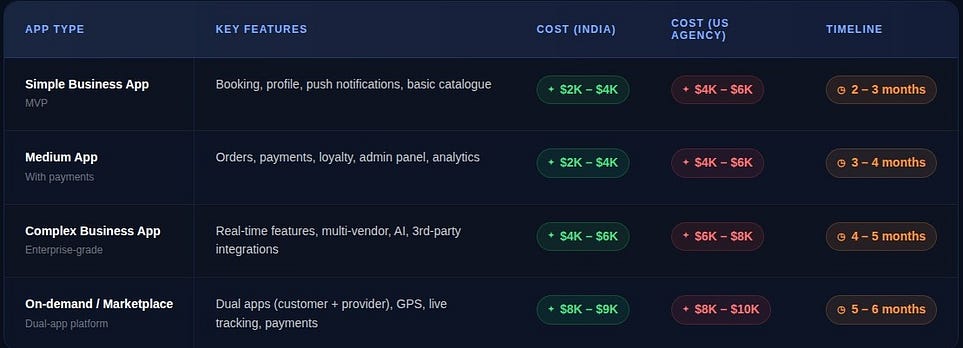
For a personalised estimate based on your specific app idea, use our free App Cost Calculator — 6 questions, 2 minutes, no email required to start.
This mobile app development guide for startups and growing businesses covers the exact process from concept to launch — so you know what to expect, what to budget, and what to demand from a development partner at every stage.
Most business owners who want an app don’t know what the first step is. Here is the exact process — starting today:
01. 2–3 Hours
Answer four questions: Who is your user? What is the one core problem your app solves? What are the 3–5 features you absolutely need for launch? What does success look like in 6 months? You do not need a technical background to answer these — you need business clarity.
02. 1–2 weeks
Share your brief with 2–3 agencies. Ask each one the 8 questions from our hiring guide. Compare not just price but process, portfolio, and post-launch support. The cheapest quote almost always costs the most in the long run.
03. 1–2 weeks · $500–$1,000
A serious development company will spend 1–2 weeks in Discovery: user persona mapping, competitor analysis, feature prioritisation, and a formal scope document. This is not overhead — it saves 25–35% of your total budget by catching scope issues before development begins.
04. 2–4 weeks · Part of development cost
Design decisions made here cost 10× less to change than development decisions. Review every screen, every user flow, and every interaction in the Figma prototype before a line of code is written. Ask yourself: “Can a new user complete the core task in under 30 seconds without reading any instructions?”
05. Ongoing during development
Insist on agile 2-week sprints with a working build at the end of each sprint. This is not optional — it is how you stay in control of the project, catch issues early, and ensure what is being built matches your expectations. Any agency that resists sprint demos should be treated with caution.
06. Ongoing after launch
Your first app version should be your MVP — the minimum feature set that delivers core value to users. Launch it, measure engagement data (daily active users, session length, retention rate), and plan your next feature set based on what users actually use. The best apps are built iteratively, not all at once.
Building an app? Get a free cost estimate — no commitment needed. Get Estimate.
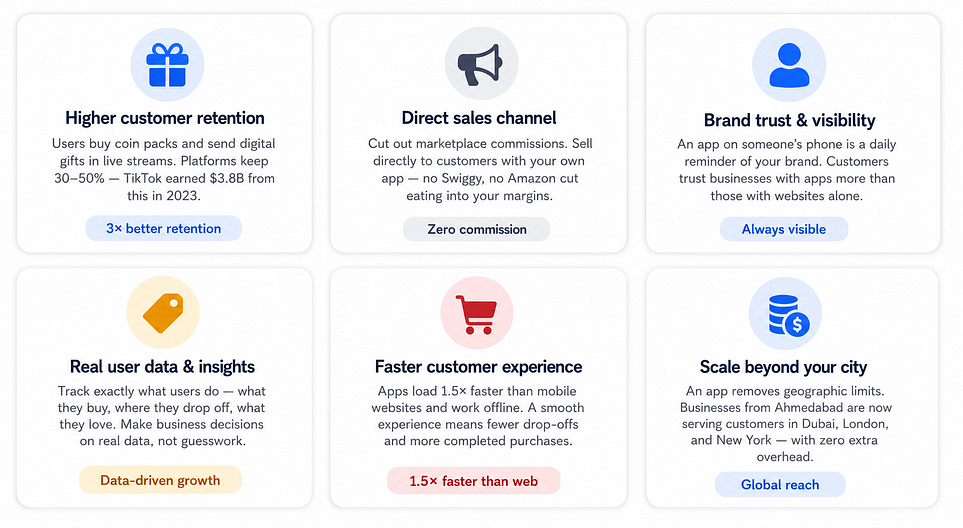
Customers spend 90% of their phone time inside apps — not browsers. Here’s what a well-built app actually does for your revenue, retention, and reach.
Get a free 30-min consultation — we’ll tell you honestly if it’s worth building.
Click Here: Book free call ↗
The evidence is clear. Businesses with mobile apps retain customers better, generate more revenue per user, own their communication channel, and build a platform that grows with technology. In 2026, 92% of mobile time is spent inside apps — not websites. The gap between having an app and not having one is not a technology gap; it is a market access gap.
This mobile app development guide for startups and small businesses has covered the full picture: why apps outperform mobile websites, the seven measurable benefits of a mobile app for business, which industries see the fastest ROI, what it costs, and how to build a mobile app for business from idea to launch in a structured, low-risk process.

© 2025 Crivva - Hosted by Airy Hosting Managed Website Hosting.








