


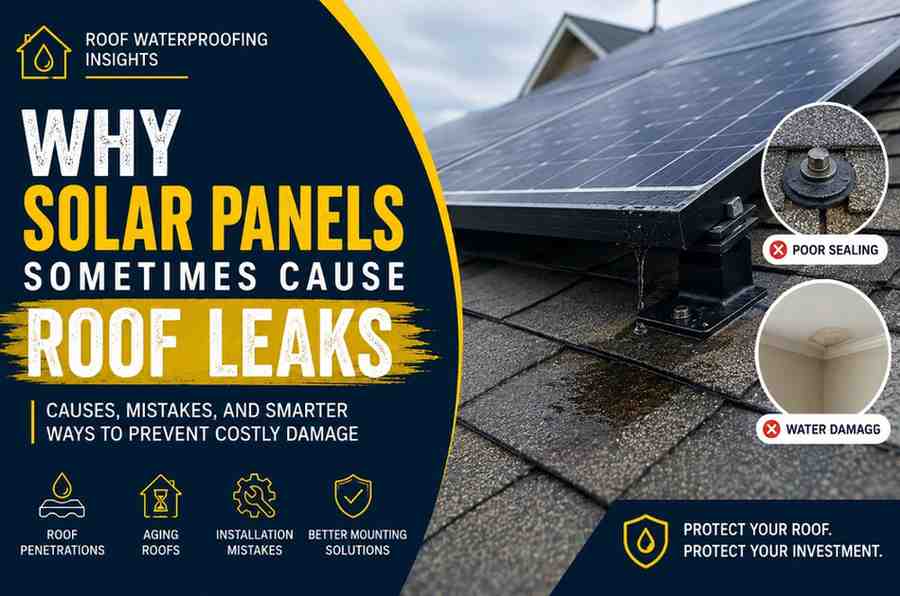
Most homeowners don’t expect a solar project to create roofing issues. The assumption is usually simple: once the panels are installed, the roof should continue working the same way it always has. But that’s not always what happens.
A few months after installation, some homeowners begin to notice ceiling stains, attic moisture, or damp insulation following heavy rain. In colder states, leaks sometimes appear after repeated freeze-thaw cycles in winter.
According to the National Renewable Energy Laboratory (NREL), proper roof attachment and waterproofing practices are essential for maintaining long-term roof integrity after solar installation. The challenge is that not every roof is carefully evaluated beforehand, and not every mounting system handles water exposure equally well over time.
In many cases, the solar panels themselves are not the actual cause of the leak. The problem usually starts underneath the array, around penetrations, flashing details, or roofing materials that were already beginning to fail before installation began. For homeowners and contractors alike, understanding those risks early can prevent expensive repairs later.
Every rooftop solar system requires attachment points. Those penetrations must withstand wind uplift, snow loads, temperature changes, and years of weather exposure.
When flashing and waterproofing are handled correctly, the roof typically performs normally for decades. But small installation mistakes can gradually create points of moisture entry.
Roofing contractors commonly find issues like:
What makes these problems difficult is that leaks often develop gradually. Water may move beneath shingles or underlayment long before interior damage becomes visible.
That’s especially common in regions dealing with:
Experienced contractors know that waterproofing details matter just as much as panel performance.
Not all solar mounting systems affect the roof the same way. Traditional railed systems often require additional hardware and more roof penetrations across the installation area. Over time, thermal expansion and contraction can place stress on flashing details if attachment spacing or waterproofing methods are inconsistent.
That’s one reason many roofing and solar contractors have started paying closer attention to lower-profile mounting systems that reduce unnecessary roof penetrations while improving long-term waterproofing reliability.
Modern approaches focused on waterproof solar mount design are becoming increasingly popular because they help minimize roof disruption compared to more hardware-heavy mounting methods. For contractors managing long-term roof performance, reducing unnecessary penetrations can help lower future leak risks while simplifying installation workflow.
This becomes even more important in regions of the United States that experience severe weather. Contractors in states like Colorado, Texas, Minnesota, Arizona, and Florida regularly deal with conditions that expose weak waterproofing details much faster than expected. That’s also why many installers have started evaluating railless and reduced-penetration mounting strategies for high-exposure environments.
This article explains why weather-resistant solar mounting systems often perform better in severe weather conditions:
Reducing unnecessary roof disturbance can help improve:
For roofing-focused contractors, fewer penetrations usually mean fewer long-term waterproofing concerns.
One of the most overlooked problems in residential solar happens before installation even begins.
Sometimes the roof itself is already near the end of its service life, even if it still looks acceptable from the ground. A roof may not show visible leaks yet, but aging shingles, weakened decking, trapped moisture, or years of weather exposure can already compromise long-term waterproofing performance.
An asphalt shingle roof with only a few years of remaining life may still technically support solar panels, but future maintenance becomes much more complicated once the system is installed. Reroofing later often requires panel removal, reinstallation labor, flashing replacement, and additional waterproofing work around existing penetrations.
That’s why experienced roofing and solar contractors usually inspect far more than just the roof surface itself.
They typically evaluate:
If those conditions are overlooked, future roof leaks are often blamed entirely on the solar installation, even when the roofing system was already vulnerable.
In many reroofing projects, contractors discover older water intrusion issues hidden beneath the underlayment long after the solar array was installed. That’s why long-term roof performance starts with understanding the roof’s actual condition before installing the first attachment point.
A roofing contractor in the Midwest recently inspected a home where leaks appeared less than a year after solar installation.
From the ground, everything looked normal. The panels were properly aligned, and the system appeared to be professionally installed. But after a winter freeze-thaw cycle, moisture stains began forming near the attic decking. The issue wasn’t the panels themselves.
Several attachment points had partially missed the structural framing, resulting in slight movement around the penetrations. Over time, the flashing integrity weakened enough for water intrusion to begin.
The repairs eventually involved:
Situations like this are becoming more common as residential solar installation schedules continue speeding up across the market.
That’s why many experienced contractors now prioritize mounting systems that simplify installation complexity while minimizing unnecessary roof disturbance from the beginning.
Solar panels don’t usually cause roof leaks on their own. Most leak problems come from poor installation practices, weak flashing details, excessive roof penetrations, or roofing materials that were already aging before solar was installed.
That’s why homeowners should pay attention not only to the panels, but also to how the mounting system interacts with the roof over the long term. A properly planned installation should protect waterproofing integrity, minimize unnecessary penetrations, and account for years of weather exposure.
For contractors and property owners, the better long-term decision is often the system that creates less roof disruption while supporting reliable performance over time. Lower-profile mounting approaches, including systems like RT-MINI II, are gaining attention for simplifying attachment layouts and reducing potential leak points across different roofing conditions.
In many cases, long-term waterproofing performance depends more on installation quality and mounting design than the solar panels themselves. A roof that stays dry years after installation is usually the clearest sign of a well-executed solar project.

© 2025 Crivva - Hosted by Airy Hosting Managed Website Hosting.