

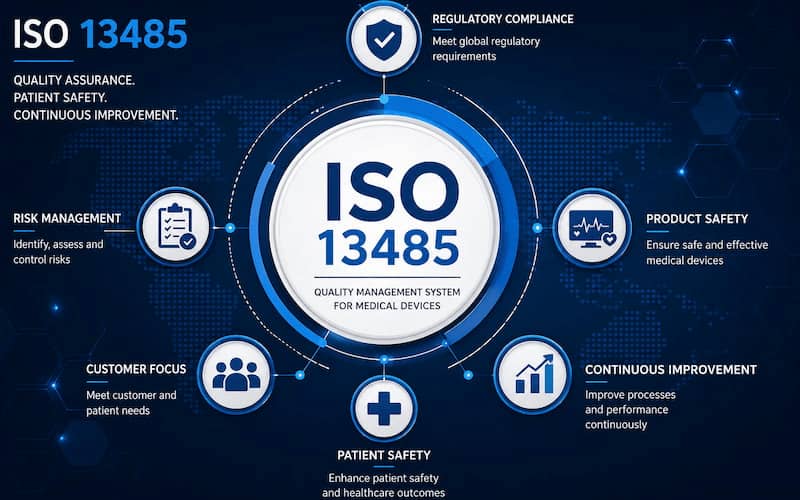
The medical device industry operates in one of the most highly regulated environments in the world. Patients, healthcare providers, and regulatory authorities expect products to meet strict standards for safety, quality, and performance. This is why medical device manufacturers need ISO 13485 to establish a robust quality management system that supports consistent product quality and regulatory compliance.
ISO 13485 certification is an internationally recognized standard specifically designed for organizations involved in the design, production, installation, servicing, and distribution of medical devices. It provides a structured framework for managing quality throughout the product lifecycle while helping businesses meet customer and regulatory requirements.
As competition increases and regulatory expectations become more demanding, adopting this standard has become a strategic decision for organizations seeking sustainable growth and market credibility.
ISO 13485 is a quality management system (QMS) standard developed specifically for the medical device sector. Unlike general quality management standards, it focuses on regulatory compliance, risk management, product traceability, and maintaining consistent quality throughout manufacturing processes.
The standard applies to various organizations within the healthcare supply chain, including:
Medical device manufacturers
Component suppliers
Distributors
Contract manufacturers
Sterilization service providers
Maintenance and servicing companies
By implementing the standard, organizations create documented processes that help ensure products consistently meet applicable safety and performance requirements.
Medical devices directly impact patient health and safety. Even minor manufacturing defects can result in serious consequences, including product recalls, regulatory penalties, reputational damage, and patient harm.
A structured quality management system helps organizations:
Maintain product consistency
Reduce manufacturing errors
Improve process control
Strengthen regulatory compliance
Enhance customer confidence
Support continuous improvement
Without a well-defined framework, businesses may struggle to manage risks effectively and maintain compliance with changing regulations.
One of the primary advantages of adopting the standard is the ability to maintain consistent product quality. Documented procedures and standardized processes help reduce variability in manufacturing operations.
Organizations can:
Monitor critical production activities
Establish quality checkpoints
Detect issues early
Implement corrective actions efficiently
This proactive approach helps prevent defects from reaching customers.
Regulatory requirements differ across countries and regions. Meeting these requirements can be challenging without a structured management system.
ISO 13485 aligns closely with many international regulatory frameworks and supports compliance efforts by providing:
Comprehensive documentation controls
Risk-based decision-making processes
Product traceability systems
Supplier management procedures
As a result, organizations are better prepared for regulatory inspections and audits.
Healthcare providers and purchasing organizations often prefer suppliers that demonstrate strong quality management practices.
Certification provides evidence that a company follows internationally recognized quality standards. This can strengthen business relationships and improve credibility in competitive markets.
Risk management is a critical component of medical device manufacturing.
The standard encourages organizations to identify, evaluate, and control risks throughout the product lifecycle. This includes:
Product design risks
Manufacturing risks
Supplier-related risks
Distribution and storage risks
Managing risks proactively reduces the likelihood of quality failures and regulatory issues.
Many organizations discover process inefficiencies during implementation.
Standardized procedures help:
Eliminate duplication of work
Improve communication
Reduce rework
Minimize waste
Increase productivity
Over time, these improvements can result in significant cost savings.
Regulators expect organizations to maintain accurate and controlled documentation.
The standard establishes requirements for:
Quality manuals
Procedures
Work instructions
Records
Change management documentation
Proper documentation ensures consistency and demonstrates compliance during audits.
Traceability is essential for medical devices, especially when investigating complaints or conducting recalls.
Organizations must establish systems that track:
Raw materials
Components
Production batches
Distribution records
This capability enables rapid identification and resolution of potential issues.
Continuous improvement is supported through corrective and preventive action processes.
When nonconformities occur, organizations must:
Investigate the root cause
Implement corrective measures
Verify effectiveness
Prevent recurrence
This systematic approach strengthens product quality and operational reliability.
The first step involves assessing current processes against standard requirements.
A gap analysis helps identify:
Existing strengths
Areas requiring improvement
Documentation gaps
Compliance risks
This assessment forms the foundation of the implementation plan.
Organizations then establish documented procedures covering key operational activities.
Common areas include:
Quality management
Purchasing controls
Production management
Risk management
Complaint handling
Internal audits
Clear documentation promotes consistency throughout the organization.
Successful implementation depends on employee understanding and participation.
Training programs should cover:
Quality objectives
Process requirements
Roles and responsibilities
Regulatory expectations
Well-trained employees contribute significantly to maintaining compliance.
Before certification, internal audits are conducted to evaluate system effectiveness.
These audits help identify:
Nonconformities
Process weaknesses
Improvement opportunities
Addressing findings before certification improves readiness.
An accredited certification body performs an independent assessment of the quality management system.
The audit typically includes:
Documentation review
Process evaluation
Employee interviews
Facility inspection
Organizations that successfully meet requirements receive certification.
Implementing a quality management system requires time, personnel, and financial investment.
Businesses should establish realistic timelines and allocate sufficient resources to support successful implementation.
Many organizations underestimate the amount of documentation required.
Creating, maintaining, and controlling documents can be challenging without a structured approach.
Resistance to change can slow implementation efforts.
>Management should communicate the benefits of the system clearly and encourage employee involvement throughout the process.
Selecting an experienced certification and consulting partner can significantly influence project success.
When evaluating providers, consider:
Look for organizations with proven experience in the medical device sector.
Industry-specific knowledge helps address unique regulatory and quality challenges.
Qualified auditors understand applicable regulations and can provide valuable insights during assessments.
Review customer testimonials, references, and industry recognition before making a decision.
Some providers offer additional services such as:
Gap assessments
Training programs
Implementation guidance
Internal audit support
These services can simplify the certification journey.
Certification is not simply about compliance. It also creates long-term business value.
Organizations often experience:
Improved market access
Stronger supplier relationships
Increased customer confidence
Enhanced operational performance
Better preparedness for regulatory changes
As healthcare markets continue to evolve, organizations with mature quality management systems are better positioned for growth and competitiveness.
In an industry where product quality and patient safety are paramount, medical device manufacturers need ISO 13485 to establish reliable processes, manage risks effectively, and meet regulatory expectations. ISO 13485 certification provides a globally recognized framework that strengthens quality management, improves operational efficiency, and enhances customer trust.
By implementing this standard, organizations can reduce compliance risks, improve product consistency, and create a solid foundation for sustainable business growth. For companies seeking to compete in domestic and international healthcare markets, certification is a strategic investment that delivers both regulatory and commercial benefits.

© 2025 Crivva - Hosted by Airy Hosting Managed Website Hosting.